
Discover why the future of generative AI depends on context, not prompting. Learn why context engineering is the real deal behind GenAI business value.
In recent years, the term prompt engineering has become synonymous with making the most of generative artificial intelligence. However, real-world experience in corporate projects shows that true success lies not only in crafting better prompts, but in something much deeper: the data context and knowledge base provided to the model.
Although generative AI systems are becoming increasingly proficient at understanding natural language, their ability to deliver useful, reliable, and business-aligned responses still depends on the quality, structure, and governance of the data they receive.
A model without a well-designed data context — organized information, efficient integration processes, and clear governance policies — will never be able to generate accurate, auditable, or strategic outputs, no matter how sophisticated the prompt.
The era of “learning how to ask AI” is coming to an end. From now on, the true differentiator will be who can build the most powerful and intelligent context, embracing a new discipline that is redefining business AI: context engineering.
In this article, we explore why — and how — pioneering companies are already leveraging context engineering to transform their results with generative AI.
By 2025, most generative AI models —such as Microsoft Copilot, ChatGPT, Gemini, Grok, and Anthropic’s Claude 4— will understand natural language flawlessly. In this new landscape, access to AI is becoming increasingly democratized, especially since the launch of OpenAI’s Prompt Packs.
In short, the art of formulating prompts is losing prominence, while the real — and still largely untapped; differentiator is context engineering: the ability to prepare, structure, and govern the data context that fuels AI systems so they can respond with precision, relevance, and traceability.
The Limitations of Prompt Engineering
Prompt engineering is useful for defining instructions that guide the behavior of a language model, but it does not solve the main challenge companies face when adopting artificial intelligence: ensuring the quality, structure, and governance of their data context.
Experience consistently shows that no matter how sophisticated a prompt may be, a model without a robust, reliable, and well-structured data context cannot generate truly accurate, relevant, or business-valuable answers.
While prompt engineering made sense as an initial phase in the adoption of generative AI, its limitations become evident in more complex, enterprise-level AI projects:
- A good prompt cannot fix a bad context. If the AI accesses incomplete, disorganized, or outdated data, it will fail — even with a flawless prompt. The quality and structure of the information form the real foundation of any reliable generative model.
- Natural language no longer needs tricks. Language models are continuously improving their comprehension capabilities and require fewer linguistic “tricks” to interpret instructions. The focus must now shift from how we ask to what data context the model receives to respond effectively.
- Enterprises need auditability and compliance. Defining prompts alone is not enough to ensure transparency or traceability. Without a governed and auditable data context aligned with corporate compliance policies, generative AI can expose organizations to legal, ethical, and strategic risks.
5 Common Mistakes When Context Is Ignored in Generative AI
- “More data is better": Without proper curation, normalization, and quality control, increasing data volume only adds noise and bias, making it harder for AI systems to generate useful, consistent, and reliable responses. In context engineering, quality always outweighs quantity — a well-defined data context is far more valuable than massive but disorganized datasets.
- Relying on the model’s “magic memory": It’s essential to define what information the model should remember, for how long, and under which governance policies. Without explicit control, AI memory can become opaque, inconsistent, and unreliable — especially in enterprise environments where traceability, data governance, and security are critical pillars of a trustworthy data context.
- Assuming integration is automatic: Enterprise systems are inherently heterogeneous and require ETL, normalization, and data modeling processes to provide a consistent, high-quality context for the model. Context engineering involves orchestrating these processes to ensure that data integration delivers information that is accurate, structured, and aligned with business goals.
- Accepting answers without traceability: In a corporate setting, no critical decision should rely on outputs that lack transparency. Understanding which data source supports an AI-generated result and how the model reached that conclusion — is essential for auditable and explainable AI. A strong data context provides the traceability that prompt engineering alone cannot guarantee.
- Delegating everything to IT: Context is a strategic asset, not merely a technical one. While IT teams enable the infrastructure and tools, the definition, governance, and alignment of data with business strategy must be led by management and domain experts. Effective context engineering requires close collaboration between business and technology, ensuring that the data context truly reflects organizational priorities.
These issues make it clear that a good prompt cannot compensate for a bad context.
Is Your Data Ready for AI?
At Bismart, we specialize in assessing and optimizing the data context of enterprise systems to unlock the real potential of artificial intelligence, delivering tangible results without false promises.
Request a free analysis of your data context and discover whether your organization is truly ready for AI.
What is Context Engineering in AI?
Context engineering is the discipline dedicated to preparing, structuring, and governing the context that an artificial intelligence system requires to generate accurate, relevant, and trustworthy responses.
It encompasses a wide range of tasks: designing the information architecture, creating and maintaining data integration frameworks (ETL/ELT), ensuring data quality and curation, and establishing governance and security models that guarantee traceability, compliance, and accountability across all AI processes.
The rise of context engineering over prompt engineering has a simple explanation: while language models are becoming increasingly capable of understanding complex instructions without the need for linguistic tricks, artificial intelligence is still only as good as the data context it receives.
In other words, prompt engineering focuses on how we ask, while context engineering defines what the model has to work with. Together, they form the foundation for the next generation of enterprise AI systems: intelligent, auditable, and truly aligned with business goals.
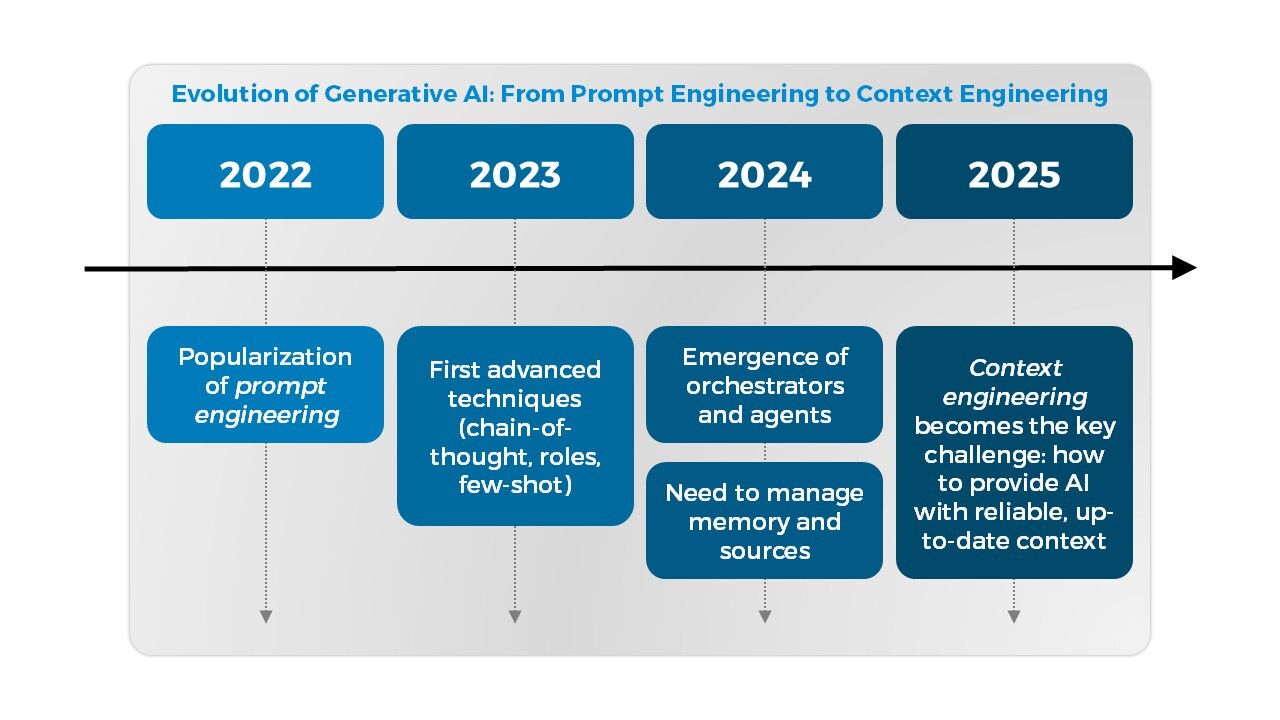
The Evolution from Prompt Engineering to Context Engineering
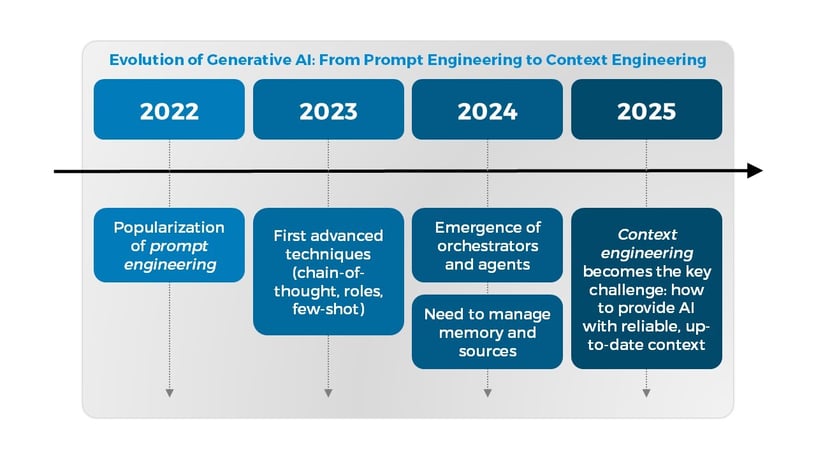
For this reason, leading organizations in genAI adoption are already prioritizing strategic projects focused on building a strong and reliable data context through initiatives such as:
- Developing well-structured data warehouses and data lakes
- Implementing data integration and orchestration processes (ETL/ELT)
- Investing in information curation and data cataloging
- Establishing data governance and quality control frameworks
- Deploying advanced contextual retrieval techniques such as RAG (Retrieval-Augmented Generation) and vector databases
Ultimately, prompt engineering will become a standard professional skill — a necessary but not differentiating capability. In contrast, context engineering will remain the true driver of business value, enabling organizations to achieve reliable, explainable, and high-impact outcomes with generative AI.
Prompt Engineering vs Context Engineering: Key Differences
As we’ve already seen, prompt engineering and context engineering are not the same, nor do they deliver value in the same way.
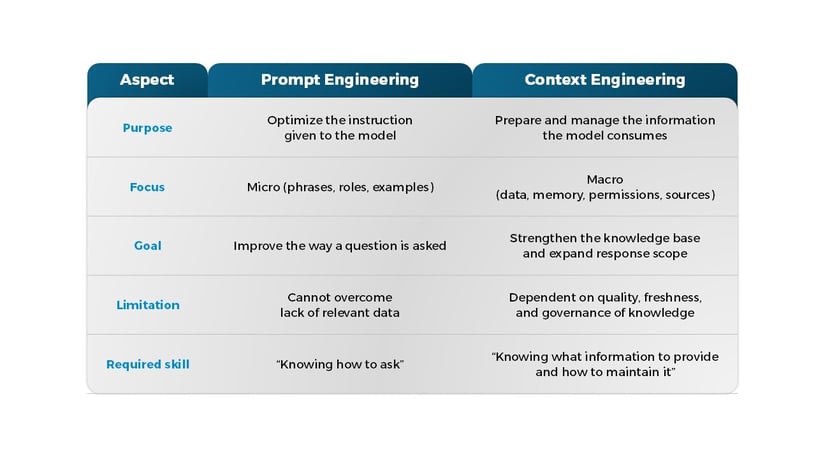
While prompt engineering focuses on optimizing how we ask the model for something — the art of crafting the perfect instruction, context engineering takes it one step further. It manages the information, data, and environment that enable the model’s response to be useful, accurate, and consistent with enterprise knowledge.
In essence, prompt engineering shapes the question, whereas context engineering builds the foundation that determines the quality of the answer.
The table below summarizes the main differences between prompt engineering and context engineering, highlighting their purpose, approach, limitations, and core competencies.
How to Prepare Your Data for Artificial Intelligence?
The quality of any artificial intelligence model’s results depends directly on the quality, relevance, and timeliness of the data that feeds it. Before training or deploying AI solutions, it is crucial to ensure that your data context is properly prepared, structured, and governed.
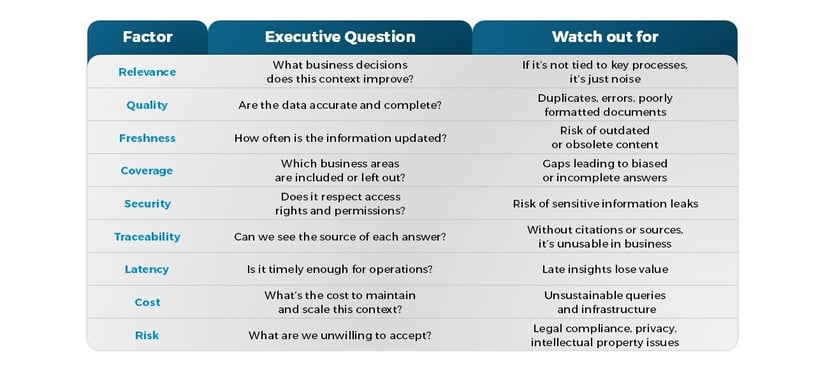
This context engineering framework will help you evaluate the maturity of your data before starting an AI project. It includes the key questions every executive should ask, from traceability and security to cost efficiency and sustainability, as well as the critical checkpoints needed to prevent errors, biases, or data leaks.
The table below summarizes the essential factors for preparing data for AI, enabling you to transform data into knowledge, and knowledge into smarter, more reliable business decisions.
1. Prioritize Quality Over Volume
Having more data doesn’t necessarily guarantee better results. What truly matters is relevance. Eliminate duplicates, unify terminology, and apply consistent labeling so that the information is clear, coherent, and usable within your data context. Quality, not quantity, is the foundation of reliable artificial intelligence outcomes.
2. Build a Solid Data Architecture
Establishing data warehouses, ETL processes, system integrations, and automated pipelines enables AI models to access a unified, consistent, and trustworthy information base. A robust data architecture is the backbone of effective context engineering.
3. Ensure Effective Curation and Governance
Define who owns each dataset, how it is updated, and under which retention, security, and governance policies it operates. This is especially crucial when AI interacts with sensitive or regulated data, where traceability and compliance are mandatory. Strong governance ensures that your data context remains reliable and auditable.
4. Control Memory and Persistence
Decide what the model should remember, for how long, and how that memory should be cleared or refreshed. Poorly managed model memory can compromise both confidentiality and response accuracy. In context engineering, controlled persistence is key to maintaining trustworthy and compliant AI behavior.
5. Enable Dynamic Contextual Integration
Leverage tools such as RAG (Retrieval-Augmented Generation) and vector databases to let the model retrieve relevant information in real time. This approach prevents overloading the system with unnecessary data while preserving agility, precision, and contextual awareness, all essential qualities for generative AI in business environments.
Key Questions Every Steering Committee Should Ask Before Investing in AI
- How reliable and governed is the data context we are providing to AI?
- Do we have a data architecture capable of scaling the use of generative models?
- Can we audit and explain the origin of the answers generated by the model?
- Who is leading the context strategy — business or IT?
- Are we measuring the real return on investment in AI beyond pilots and experiments?
Real Cases of Context Engineering and Its Impact on Companies
1. European Bank: 60% Reduction in Data Latency and Improved Compliance

A major European financial institution redesigned its data pipelines to better feed its genAI models. The initiative was based on a context engineering approach that included a governed data architecture, real-time data integration, and strict data quality controls.
As a result, the bank achieved a 60% reduction in data latency, 40% lower infrastructure costs, and a more secure, auditable environment, ensuring full compliance with financial regulations and strengthening trust in AI-driven decision-making.
2. Financial Services Firm: Data Governance for Agility and Confidence

A global financial services company strengthened its data governance strategy to support AI and advanced analytics initiatives.
Through context engineering, the firm consolidated data licenses, established standardized quality metrics, and unified visibility across all information assets.
The result was greater reporting agility, improved control over data providers, and an enhanced ability to adapt to regulatory changes with confidence and transparency.
3. Global Retail: More Accurate Generative Recommendations Through Well-Structured Data

A global retail company discovered that its recommendation system was leveraging less than half of its available information due to inconsistent data catalogs.
By reorganizing, tagging, and enriching its data, the retailer implemented a context engineering approach that allowed its generative AI engine to access a complete and reliable data context.
As a result, the system delivered more accurate, relevant, and personalized recommendations, significantly improving the customer experience and boosting conversion rates.
4. Leading Bank: Centralized Generative AI Platform with Control and Scalability

A top-tier bank developed a centralized generative AI platform designed with built-in governance mechanisms, bias control systems, sensitive data management, and response traceability.
Through a context engineering approach, the institution was able to deploy large-scale generative AI applications, support multiple business units, and maintain the highest standards of trust, security, and regulatory compliance.
5. Legal Services Firm: Intelligent RAG Search Engine to Automate Documentation

A legal services firm receiving around 13,000 unstructured documents and legal notices per month needed to significantly reduce the time spent reading and managing information.
Bismart designed an intelligent search engine based on RAG (Retrieval-Augmented Generation) that:
- Automatically processes approximately 13,500 documents per month (around 7,000 tokens of information each).
- Summarizes and classifies content, generating an automatic synthesis of every document.
- Enables natural language search with accurate and traceable results.
- Automates actions based on the insights obtained.
The impact: a drastic reduction in administrative workloads, faster legal decision-making, and a more efficient use of internal knowledge, made possible through context engineering and advanced generative AI integration.

The Impact of Context Engineering on the ROI of AI
The return on investment (ROI) in generative artificial intelligence projects depends far less on how prompts are designed and far more on the quality of the context that feeds the model.
When an organization invests in structuring, curating, and governing its data context, it unlocks tangible, measurable benefits:
- Greater accuracy and relevance in responses: A model working with clean, well-structured data delivers actionable, contextualized insights instead of generic or inconsistent outputs.
- Faster adoption and scalability: With a well-prepared data context, AI projects move smoothly from pilot to production, reducing fine-tuning cycles and eliminating technical bottlenecks.
- Regulatory compliance and traceability: A robust data governance framework enables full auditability of model outputs, ensuring compliance with regulations such as GDPR and ISO standards, while minimizing legal and reputational risks.
- Optimization of operational and technology costs: Less time spent correcting errors or adjusting prompts reduces the total cost of ownership (TCO) of generative solutions and lowers dependence on highly specialized teams.
- Real capacity for innovation: With a reliable and governed data context, AI evolves from experimental use to a true business enabler, driving automation, intelligent assistants, and data-driven decision-making across the organization.
Frequently Asked Questions (FAQs): Context Engineering
What is context engineering?
Context engineering is the discipline of preparing, structuring, and governing the data context that an artificial intelligence system needs to operate accurately, securely, and in alignment with business objectives. It involves organizing information, defining rules, managing memory, and applying data governance policies to ensure reliability and compliance.
Why will prompt engineering become less relevant in the future?
Because AI models are continuously improving their understanding of natural language and require fewer linguistic “tricks” to interpret instructions. As a result, the quality of AI responses will increasingly depend on the availability of reliable, relevant, and well-structured data — not on how the prompt is written.
What kind of data does AI need to perform effectively?
AI systems require integrated, up-to-date, and high-quality data, organized for easy retrieval and aligned with business processes. This involves robust data architectures, standardized terminology, and clear maintenance and security policies — all essential components of a well-defined data context.
How can enterprises improve the accuracy of generative AI?
By implementing a comprehensive context engineering strategy: designing data integration pipelines, structuring data storage, applying curation and quality processes, defining memory and governance policies, and ensuring that all information remains audited, reliable, and traceable.
Conclusion: Context as a Competitive Advantage in AI
Soon, generative AI will no longer be about who writes the best prompt. The future —and the true competitive advantage— will belong to those who design, structure, and maintain the best context.
Organizations that treat their data as a strategic asset, supported by robust architectures and strong data governance, will obtain more accurate, auditable, and business-relevant insights from their AI systems.
As prompt engineering becomes standardized as a core capability, context engineering will emerge as the defining competitive enabler, empowering companies to differentiate themselves, scale innovation, and generate sustainable value through GenAI.
What Do We Recommend?
- Audit the quality and structure of your data before starting any generative AI initiative.
- Invest in infrastructure —including data warehouses, ETL pipelines, data catalogs, and contextual retrieval systems— to ensure your AI operates on a solid foundation.
- Define clear governance and memory policies for your AI models to guarantee traceability, compliance, and security.
- Train both business and technology teams in context engineering, the essential discipline that enables AI to perform effectively in real corporate environments.
- Make your AI work with the right context.
Make your AI work with the right context
At Bismart, we help companies evaluate, structure, and govern their data context so that artificial intelligence delivers real, auditable, and business-aligned results, transforming information into measurable value.