

Discover what data literacy is and learn how to build it in your company to drive smarter, data-driven decisions.
In recent years, the narrative around the value of data has evolved significantly. For a long time, business decision-makers believed that investing in business intelligence platforms, data lakes, and advanced analytics algorithms was enough to gain a competitive edge.
However, many organizations have discovered that simply collecting and storing data does not automatically lead to better decisions. Technology alone is insufficient if it isn’t accompanied by the ability of people to read, understand, and use data critically and strategically.
That ability has a name: Data Literacy and its importance for executives and senior management is undeniable. According to Gartner, more than 60% of data initiatives fail because employees —including business leaders— lack the data literacy skills required to interpret and act on the information they consume.
The result? Decisions based on assumptions, analytics investments that fail to deliver ROI, and a growing gap between technological potential and business reality.
In this article, we will explore — with a perspective designed for executives:
- What Data Literacy really means and how it differs from related concepts such as a data-driven culture or data-informed decision-making.
- Why Data Literacy is now a strategic imperative rather than a passing trend.
- The maturity levels that define an organization’s journey toward becoming truly data-driven.
- How to design an effective Data Literacy program that delivers measurable impact.
- The most common mistakes and emerging Data Literacy trends every manager should know in 2025.
Additionally, we have included a key resource to accelerate this process: the Data-Driven Dictionary — a practical tool to unify terminology, improve data understanding, and build a common knowledge base within your company.
If your goal is for data and analytics to truly transform the way your organization makes decisions, mastering Data Literacy is no longer optional — it’s a critical capability for competing effectively in a market that now moves at algorithmic speed.
For decision-makers, failing to build a truly data-driven culture within the organization is no longer just an operational gap — it is a strategic risk.
In an era where artificial intelligence (AI), advanced analytics, and automation are reshaping entire industries, understanding the language of data has become a critical managerial competency. Strong data literacy skills empower leaders to translate complex metrics into actionable strategies, validate AI models, detect potential biases, and — most importantly — create a sustainable competitive advantage.
The marketplace is also shifting. Regulators demand greater algorithmic transparency and accountability, customers expect companies to use data ethically, and teams want access to clear, reliable information to make faster, smarter decisions. Without a shared data language across the organization, collaboration between business and technology breaks down, trust erodes, and hidden costs multiply.
Learn the most relevant terms in the world of data.

Data-Driven Dictionary
Learn the 20 essential data terms every business leader should know.
What Is Data Literacy and Why Is It Essential for Modern Companies
Clear definition of Data Literacy
A definition that goes beyond "knowing how to read data"
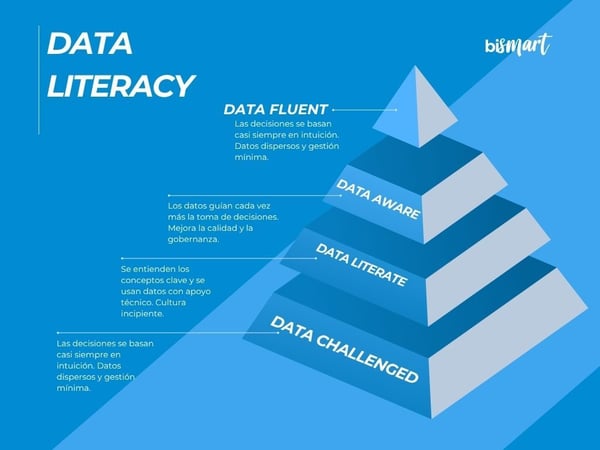
Data Literacy is the critical competency that enables individuals and organizations to read, work with, interpret, and communicate data-driven information in a meaningful and responsible way.
It is not about mastering highly technical skills, but about understanding — at a functional level — where data comes from, how it is processed, when it can be trusted, and how to transform it into insights that drive strategic action.
The international consulting firm Gartner defines it as:
“Data Literacy is the ability to read, write and communicate data in context, including an understanding of the sources, the constructs, the analytical methods applied, and the ability to describe the resulting use and value.”
In practice, a professional with strong data literacy skills can:
- Assess whether data comes from reliable sources and understand its limitations (biases, data integrity, update frequency).
- Interpret metrics, identify anomalies or suspicious correlations, and question underlying assumptions.
- Communicate findings clearly, translating numbers into actionable insights that the business can understand without losing analytical rigor.
- Know when to request deeper analysis or technical validation, distinguishing the appropriate level of intervention.
Differences between Data Literacy, data-driven culture, and data-driven decision making
For an integrated data strategy , distinguishing these three concepts is essential. They are not synonymous; each serves a different function:
For an integrated data strategy, distinguishing these three concepts is essential. They are not synonymous; each serves a different role within an organization:
| Concept | Function / nature | Condition |
|---|---|---|
| Data Literacy | Individual and collective ability to use data responsibly and effectively | Serves as the foundational capability |
| Data-driven culture | Organizational ecosystem —values, incentives and processes— that promote data use | Requires widespread data literacy across teams |
| Data-driven decision making | Observable behavior when decisions are guided by data and analytics | Only possible when culture and literacy are in place |
- Data Literacy is the lever: without it, a data-driven culture remains just aspirational, and data-driven decision making ends up depending on a few experts rather than empowering the entire organization.
- A data-driven culture sets the rules of the game: it prioritizes evidence over intuition, encourages data curiosity, and legitimizes questioning assumptions.
- Data-driven decision making is the result: when managers and teams validate hypotheses, compare scenarios, and operate with data as a strategic foundation.
Beyond these terms, data literacy is also connected to data storytelling — the ability to communicate insights clearly and persuasively to drive understanding and action.
Data Literacy and Data Storytelling: Where Do They Meet?
Data Storytelling is an advanced skill within the broader domain of data-driven communication. While it is not a strict requirement for Data Literacy, it plays a crucial role in helping business users understand, interpret, and act on data.
According to the Effective Data Storytelling framework — which directly connects data literacy with data storytelling — data literacy can be analyzed through a 3×3 matrix where capabilities are articulated across three domains: Read, Work With, and Communicate, each applied at three levels of abstraction: data, information, and insights.
- In the Read domain, a person is expected, at a basic level, to understand elementary numerical concepts and business-relevant metrics; at higher levels, to interpret patterns, trends, and ask critical questions.
- In the Work With domain, the skill evolves from simple data manipulation (filters, segmentations) to descriptive analysis and diagnostics.
- In the Communicate domain, the individual must be able to share findings clearly and present actionable insights. Data Storytelling is positioned here as an advanced and specialized skill, especially relevant when the goal is to mobilize change and influence decisions.
Important: being data literate does not mean becoming a data scientist or building complex predictive models. The goal is to achieve a minimum viable competency; the essential data literacy skills that allow professionals to confidently participate in data-driven decision making.
Data Literacy & Data Maturity

It’s important to note that data literacy is typically assessed at an individual or team level, focusing on people’s ability to understand and use data effectively.
For an organizational-level assessment, companies should instead rely on a data maturity model, which evaluates the overall data strategy, culture, and capabilities needed to become a truly data-driven organization.

Why Data Literacy Is Strategic in 2025
The importance of data literacy is not just theoretical. In a context where data trends are driving AI-powered digital transformation, failing to develop strong data literacy skills exposes organizations to serious strategic, compliance, and competitive risks.
1. Data is increasingly complex and volatile
With the rapid growth of structured, unstructured, and real-time data, organizations now operate in an environment of high uncertainty. For executives and decision-makers, it is more critical than ever to discern which information is valuable and which is simply noise.
2. Skills gap threatening the return on investment in data
According to the Data & AI Literacy Report 2025, a significant percentage of business leaders identify a lack of data literacy skills as a major barrier to the successful adoption of artificial intelligence.
Organizations with higher data literacy maturity report stronger financial performance driven by better decision-making, smarter investments, and more efficient use of data and analytics.
3. Trust, governance and regulatory compliance
In highly regulated industries such as finance, healthcare, and energy, it is not enough to simply process data. Organizations must demonstrate traceability, transparency and controlled bias to meet strict compliance requirements and build trust.
Without strong data literacy, AI-driven decisions risk becoming opaque black boxes that are difficult to audit, challenge, or defend in front of regulators and stakeholders.
4. Cultural transformation and strategic impact
According to McKinsey’s report The Data-Driven Enterprise of 2025, one of the seven pillars defining the most successful companies in the coming years will be the rise of data literacy as a key enabler for human–machine collaboration and workflow optimization.
Organizations that advance their data maturity level can accelerate value capture, optimize operations, and reduce friction between teams — turning data into a real strategic asset rather than a technical resource.
5. Sustainable competitive differentiator
In markets where many companies invest in similar data and analytics tools, the true competitive advantage comes from human capital.
Empowering employees with data literacy skills enables them to ask better questions, spot anomalies, challenge automated results when necessary, and make smarter, evidence-based decisions. This human judgment layer becomes a sustainable differentiator that technology alone cannot replicate.
Benefits of Data Literacy for Decision Makers
For executives and managers, investing in data literacy is far from an academic exercise — it is a strategic lever to improve business results, mitigate risks, and accelerate competitive advantage.
1. Evidence-based vs. intuition-based decisions
One of the most significant transformations driven by data literacy is the shift from intuition-driven decisions to evidence-based decision making. Leaders no longer have to rely solely on gut feeling or oversimplified reports when making critical strategic calls.
With strong data literacy skills:
- You can ask better questions, uncover hidden assumptions, and detect biases or inconsistencies in the data informing your decisions.
- You gain greater confidence when reviewing internal or external reports, avoiding poor outcomes caused by misinterpretation of data.
- In AI-driven contexts, you can validate algorithmic outputs, understand which variables influence results, and challenge black-box models when needed.
2. Increased operational efficiency and reduced friction
When business and technical teams share a common foundation of data understanding:
- The number of basic requests directed to BI or analytics teams decreases, freeing specialized resources for higher-value work.
- Response times for strategic adjustments improve because stakeholders understand the flow of data, metrics, and dashboards more quickly.
- Repetition of data cleansing or revalidation tasks is avoided, as downstream users know how to ensure data quality from the source.
By fostering data literacy, companies also strengthen risk management. Employees become better equipped to spot anomalies, challenge flawed assumptions, and respond more effectively to change — a crucial advantage in today’s fast-moving, data-driven business landscape.
3. Innovation, experimentation, and value creation
An organization with increasing levels of data literacy can:
- Foster internal experimentation: teams that can interpret data are able to test hypotheses, measure results, and pivot quickly without depending on a few data experts.
- Identify improvement opportunities or new market niches using operational data (e.g., customer patterns, process efficiencies, emerging segments).
- Develop new products or services based on internal insights that were previously invisible.
- Create a culture where data curiosity drives fresh ideas and incremental improvements.
Forbes highlights that companies investing in data literacy and data storytelling better combine the quantitative with the persuasive, significantly multiplying their capacity for innovation.
4. Better collaboration between areas and stronger strategic alignment
When management, finance, marketing, operations, and technology share a common data competency framework:
- Ambiguity around metrics is reduced, eliminating strategic misunderstandings between teams.
- Cross-functional decision making accelerates because leaders can interact with, interpret, and discuss data using a shared language.
- Strategic alignment strengthens: each area understands its contribution to the organization’s global KPIs and how its decisions impact the bigger picture.
5. Risk management, reliability and compliance
For executives, it is no exaggeration to say that data literacy acts as an institutional defense mechanism:
- It helps detect errors, outliers, and inconsistencies before they impact financial results or strategic decisions.
- It facilitates data traceability — understanding how data has been transformed, who modified it, and what assumptions underpin its use.
- In regulated industries such as finance, healthcare, and energy, data literacy is essential for demonstrating compliance, explaining algorithmic decisions, and auditing AI models effectively.
- It strengthens internal data governance by enabling leaders to demand higher data quality, clearer standards, and stronger metadata management.
According to Gartner, low levels of data literacy rank among the top five obstacles preventing data and analytics investments from delivering real business value.
6. Sustainable competitive advantage
In today’s market, simply having data is no longer a competitive edge — the real advantage lies in knowing how to use it strategically.
Organizations with high levels of data literacy:
- Adapt faster to changing markets and emerging opportunities.
- Leverage data as a strategic asset, not just an operational tool.
- Attract and retain top talent eager to work in data-driven environments, strengthening the organization’s internal ecosystem.
- Differentiate themselves in navigating technological disruption, as their internal leaders are less dependent on external consultants.
How to Implement a Successful Data Literacy Program
Designing an effective data literacy program is not about offering a few isolated training courses. It requires a strategic, business-aligned approach backed by strong executive sponsorship.
Organizations that reach higher data literacy maturity combine rigorous assessment, a clear definition of required competencies, contextualized training, and continuous impact measurement to ensure adoption and long-term results.
Below, we outline four key steps to foster data literacy in the corporate environment.
1. Assess the current level of data literacy
The starting point should be a realistic assessment of your organization’s existing data literacy capabilities. Without reliable insight into the current state, any initiative will remain unclear and hard to measure.
- Surveys and structured self-assessments: to capture how employees perceive their own skills (e.g., understanding of metrics, basic data analysis, data storytelling).
- Interviews with leaders and middle managers: to identify gaps between expectations and actual data competencies.
- Analysis of data tool usage: review which dashboards are used, what reports are requested, and how many technical support tickets or requests are recurrent.
- Specialized frameworks: tools such as the Data Literacy Index (Qlik), downloadable Data Maturity Models, or custom internal frameworks based on literacy levels can help quantify and segment capabilities by role or department.
This diagnostic phase helps prioritize critical roles and areas, avoiding generic training that fails to solve real business challenges.
2. Define objectives and key competencies
Once the data literacy gaps have been identified, the next step is to establish concrete, measurable goals that align with the organization’s strategy and generate real business impact.
- Strategic objectives: e.g., reduce core requests to the BI team by 30%, increase corporate dashboard adoption by 50%, or improve the quality of reported tactical decisions.
- Competencies by role:
- Managers: interpret strategic KPIs, validate predictive model assumptions, demand quality and traceability.
- Operational managers: use data to optimize processes, segment customers, understand performance indicators.
- Support profiles: understand integrity and sources, collaborate with technical teams to refine inputs.
- Common standards: define a living glossary, official metrics and procedures for requesting, validating and reporting data.
A common mistake is setting training-only objectives (e.g., “everyone takes a course”). True impact comes from defining KPIs linked to business outcomes, not just training attendance or completion rates.
A practical first step to align metrics and terminology is to use the Data-Driven Dictionary. This free resource helps create a shared data language between technical and business teams, improving communication and reducing misunderstandings in your data initiatives.

3. Ongoing training and practical resources
Data literacy is not achieved through a single workshop. It requires a continuous learning experience, tailored to the organization’s context and evolving needs.
- Modular and contextualized training: start with fundamentals (key concepts, critical reading of charts and dashboards) and progress to analytics applied to each business area — marketing, finance, operations, and beyond.
- Real internal cases: use your own company’s data so participants can analyze the indicators that impact their daily decision-making.
- Mentors or “data champions”: internal reference figures who reinforce learning, guide teams, and promote a data-driven culture.
- Self-learning resources: e-learning platforms, microlearning sessions, BI tools with interactive guides, and easy access to data dictionaries.
- Data storytelling: include training on how to communicate insights with clarity and impact, especially for leadership and strategic roles.
At Bismart, we specialize in helping companies advance their data-driven maturity — not only through technical and analytical expertise, but also by designing tailored data literacy training programs that empower employees at every level.

4. Measuring progress and strategic adjustments
An effective data literacy program must be measured, adjusted, and scaled over time to ensure real business impact. Tracking the right metrics helps organizations refine their approach and maintain momentum.
Recommended key indicators include:
- Adoption indicators: percentage of employees who use dashboards autonomously, reduction in simple requests to the BI team, and an increase in data-driven projects.
- Quality and consistency of metrics: reduction of duplicate or conflicting definitions, and improved compliance with data governance standards.
- Impact on decisions: average analysis time before key decisions, reduction in errors detected after implementation, and improved ROI of data and AI projects.
- Engagement and satisfaction: results from internal surveys measuring confidence and comfort when working with data.
Continuous monitoring helps detect cultural or technological barriers and make timely program adjustments — such as adding new training modules, reinforcing communication, or improving data governance practices.
Common challenges in driving Data Literacy — and how to overcome them
Implementing a successful data literacy program goes far beyond offering a few courses or workshops.
It represents a cultural and organizational transformation that often faces deep-seated barriers. Identifying and addressing these challenges at the leadership level is key to ensuring the initiative doesn’t remain a training exercise with no real business impact.
1. Resistance to change and fear of data
For many employees, data can feel intimidating. In some organizations, working with data is associated with technical complexity or the risk of making mistakes, which leads to resistance and a strong dependency on expert teams.
How to overcome it:
- Communicate purpose and benefits: clarify that data literacy is not about turning everyone into analysts, but about improving the quality of decision-making across the company.
- Normalize progressive learning: emphasize that mistakes are part of the learning process and that it’s safe to practice and experiment.
- Recognize and reward progress: celebrate employees who use data to solve real problems, creating a multiplier effect that inspires others.
- Visible leadership: managers should lead by example — using data in their communication and demonstrating that perfection is not expected from the start.
2. Lack of management support and internal sponsorship
Without visible support from senior management, any data literacy program risks being perceived as optional training or a minor IT initiative. Data literacy only takes root when it is positioned as a strategic business priority.How to overcome it:
- Explicit C-level sponsorship: the CEO, CIO, or CDO should formally present the program and clearly link it to business objectives such as innovation, efficiency, or regulatory compliance.
- Include metrics in executive dashboards: report data literacy progress alongside financial, operational, or digital transformation KPIs to keep it on the leadership agenda.
- Integrate into professional development plans: ensure managers know that strengthening data skills directly impacts their career growth, evaluation, and leadership potential.
3. Lack of tools and democratized data access.
Training employees in data literacy without guaranteeing adequate and governed access to data leads to frustration and disengagement. If users can’t experiment with real, reliable information, learning remains theoretical and adoption fails.
How to overcome it:
- Design a data democratization strategy with security: provide segmented but agile access, ensuring strong privacy and data quality controls.
- Unify language and sources: create a data catalog and a corporate glossary to reduce confusion, duplication, and misinterpretation.
- Offer intuitive tools: enable interactive dashboards, self-service BI, and natural language explanations that make data easier to explore and understand.
- Measure usage and experience: track how employees use data tools and sources to identify bottlenecks, improve accessibility, and refine the data environment.
Trends 2025–2026 in Data Literacy and Data-Driven Culture
Data literacy is not static: it evolves at the same pace as technology, data architectures, regulations, and business models.
For this reason, fostering data literacy must be treated as a continuous process, advancing in parallel with emerging data and AI trends.
The report The Data Landscape 2026: Data Trends highlights the 25 key trends that will shape the data and analytics market in the coming years. It also outlines the roadmap organizations should follow to adapt to these changes and strengthen their data-driven culture.

Conclusion
Data literacy has evolved from being an aspirational concept to becoming a strategic imperative for any organization seeking to compete in a market increasingly dominated by artificial intelligence and advanced analytics.
Data alone does not generate value. It is people — with the ability to interpret, challenge, and transform data into intelligent decisions — who make the difference.
Driving data literacy at all levels — and especially among senior management — is essential to close the gap between technology investment and real business impact. It means reducing reliance on intuition, accelerating innovation, strengthening data governance, and building a competitive advantage that is difficult to replicate.
Organizations that cultivate a true data-driven culture, built on a strong foundation of data literacy, will be the ones able to integrate people and technology with agility, confidence, and sound judgment.
In an environment where the speed of change is exponential, mastering the language of data is no longer optional — it is the prerequisite for leading with reliable information, ensuring compliance, and turning strategy into sustainable results.
Take your data strategy to the next level
Download the Data-Driven Dictionaryand start building a solid foundation of data literacy in your organization. A shared vocabulary is the first step toward creating a real data-driven culture and transforming the way decisions are made.
Data-Driven Dictionary
Learn the 20 essential data terms every business leader should know.
.png?width=352&name=MicrosoftTeams-image%20(7).png)