A practical, decision-centric framework to build an enterprise data strategy, improve data-driven decision making, and increase speed and confidence across complex organizations.
In many large enterprises, becoming a data-driven organization has become a well-established strategic objective.
However, a recurring tension remains at executive and board level: there is data, there are executive dashboards, and there are analytics initiatives; yet decisions are still slow, heavily debated, or overly dependent on intuition.
Not because intuition lacks value, but because in complex enterprise environments, intuition without evidence introduces a level of risk that is difficult to sustain at scale.
A data-driven strategy —an enterprise data strategy— is not about adding more analytics or deploying new data technologies.
Building a decision-centric, data-driven leadership model is more demanding, and at the same time more valuable: it requires aligning business strategy with a data-driven decision-making system in which evidence reduces ambiguity, accelerates time-to-decision, and improves the quality of the repeatable decisions that drive day-to-day business performance.
This article is aimed at executive leadership, executive committees, Chief Data Officers, and transformation leaders who are not looking for operational instructions or tactical solutions, but for a clear framework to define and activate an enterprise data strategy.
An approach that enables organizations to become data-driven in a sustainable way, avoiding common pitfalls such as dependence on isolated initiatives, pilots that fail to scale, and data bureaucracy that ultimately erodes trust in information.
In short, an enterprise data strategy in large organizations is not about “having more data”, but about building a decision system where evidence is consistent, shared, and actionable for executing business strategy.
When this does not happen, organizations tend to show familiar symptoms: slow decision-making, disputed metrics, dependence on key individuals or teams, and an inability to scale initiatives beyond pilots.
This article explains what a data-driven strategy is —and what it is not— why it often fails in complex organizations, how to define it step by step starting from decisions, and how to assess data maturity in a realistic way.
The goal is to help leadership teams transform their organizations into truly data-driven enterprises, reducing uncertainty while improving decision speed and the quality of both strategic and operational decisions.
Making decisions with data is not about having more information. It is about having the right decision criteria.
In large enterprises, many strategic decisions are made with data, but without a clear framework that allows those decisions to scale, be compared, and executed with confidence.
This guide presents eight practical principles for data-driven decision making, helping organizations avoid the most common mistakes that undermine strategic coherence and slow down execution.

What is an enterprise data strategy in large enterprises (and what it is not)?
A data-driven strategy in large enterprises is the framework through which leadership defines which decisions must be supported by data, what evidence is required to inform them, and how that evidence is consistently integrated into real decision-making processes.
The goal is to turn data into a sustainable enterprise capability, not into a collection of isolated initiatives.
Unlike approaches focused primarily on analytics or reporting, an enterprise data strategy directly connects data, governance, and execution, with the aim of reducing uncertainty, accelerating time-to-decision, and improving the quality of both strategic and operational decisions.
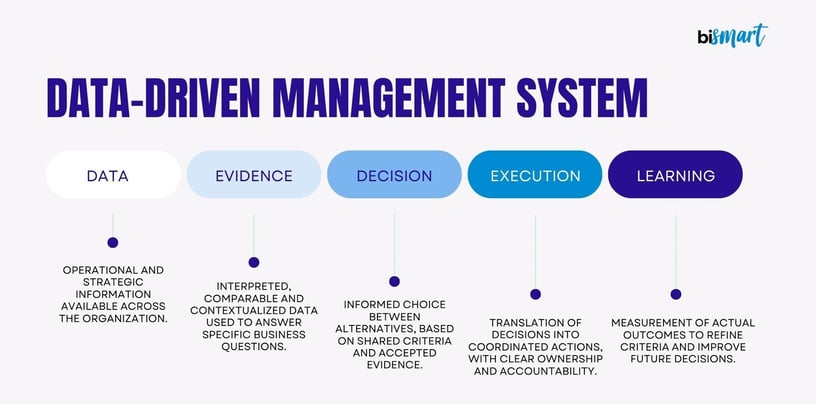
An enterprise data strategy is the set of decisions and mechanisms that ensure the organization:
- defines which decisions must be supported by evidence,
- knows what data is required to make those decisions,
- trusts that data (with a sufficient level of quality),
- and turns that evidence into execution (not just reporting).
What matters is also understanding what it is not:
- It is not “having BI.”
- It is not “building a data lake.”
- It is not “hiring a data scientist.”
- It is not “tracking more KPIs.”
When an organization claims to be “data-driven” but executive meetings repeatedly include statements like “these numbers don’t match,” “my area has a different figure,” or “let’s recalculate,” the company is not data-driven. It is a company with reporting — and a weak decision-making system.
A data-driven organization is not the one with more data, but the one that makes decisions with less friction and greater consistency.
Why data-driven transformation fails in large organizations?
In large organizations, the transformation toward a data-driven organization rarely fails due to a lack of data or technology. It fails because of how decisions are made and how evidence is integrated into business leadership.
In other words, becoming truly data-driven requires changing the decision-making system, not just modernizing analytics capabilities.
The most common mistakes in large enterprises include:
1) Confusing “strategy” with “project”
Organizations launch data programs with technical deliverables, but without a leadership-level question: Which decisions do we want to improve, accelerate, or de-risk?
Without that connection, data becomes a cost that is hard to justify, and the initiative loses relevance when priorities shift.
2) Measuring progress by deliverables, not by better decisions
At C-level, outcomes matter: lower risk, higher speed, better margins, greater resilience.
When success is defined as “we migrated X data sources” or “we published X dashboards,” the strategy focuses on output rather than impact.
3) Lack of alignment between data and business strategy
Alignment between data and strategy means that data is designed to support leadership decisions: investment, pricing, expansion, risk, productivity, and customer strategy.
When this alignment is missing, data is perceived as an IT concern, and executive teams revert to narrative-driven decision making.
4) Trying to change without changing how decisions are made
This is a critical point: organizations can modernize platforms and still make decisions the same way.
A real data-driven strategy changes behaviors: what questions are asked, what is accepted as evidence, how debates are resolved, and how decision impact is measured over time.
How to build an enterprise data strategy step by step
These steps to become a data-driven organization start from a simple premise: an enterprise data strategy should be defined from decisions, not from data.
Step 1: Map the decisions that drive the business
Before talking about data, define which decisions carry the most impact and concentrate the most risk. For example:
- investment allocation (CAPEX/OPEX),
- pricing and profitability by channel,
- geographic or portfolio expansion,
- risk management and compliance,
- operational efficiency and productivity,
- commercial strategy and segmentation,
- customer experience and churn.
You don’t need an endless list. You need a map of critical decisions and executive prioritization of where better evidence can change outcomes.
Step 2: Turn decisions into “governable questions”
A data-driven decision is not a KPI. It’s a question that can be answered consistently.
Examples of governable questions:
- “Which levers are eroding margin—and why?”
- “Where should we invest to maximize impact over the next 12 months?”
- “What risk are we taking without seeing it?”
- “Which business units are executing the strategy best—and why?”
The difference between a mature and an immature organization is that the mature one reduces ambiguity: it defines the questions, defines the evidence, and defines the decision criteria.
Step 3: Define the “minimum data set” that makes each question decidable
This is where a critical mindset shift happens: it’s not about having all the data. It’s about having the right data, with a sufficient level of quality, for the priority decisions.
In large enterprises, trying to cover everything from the start is the fastest path to paralysis. An enterprise data strategy must be ambitious, but execution needs to be incremental and sharply focused.
Step 4: Establish a clear ownership model (because without ownership, there is no data)
A data-driven strategy requires real ownership: someone must be accountable for definitions, data quality, and availability of critical data assets.
In complex organizations, data is usually distributed. That is not the problem.
The real issue is that responsibility is also distributed—but informally, and informal ownership does not scale.
Without a clear data ownership and decision ownership model, trust erodes and decision-making slows down.
Step 5: Measure success by decision impact (not by “data deliverables”)
The most honest indicator of data maturity is this:
How many relevant executive decisions are currently made with solid, shared evidence?
If your data strategy does not increase that number, you are improving reporting, not decision-making.
In other words: you may be delivering more data, but you are not yet building a decision-centric enterprise data strategy.
Data-driven maturity in complex organizations: clear signals (without self-deception)
The data-driven maturity of an organization is not measured by its technological sophistication, but by how systematically data influences executive decision-making.
In complex organizations, scale amplifies every inconsistency: weak definitions, unclear accountability, or lack of follow-through turn data into friction rather than leverage.
That is why at Bismart we work with our own data maturity model, focused on decision behavior and executive capability, not on tools or platforms.
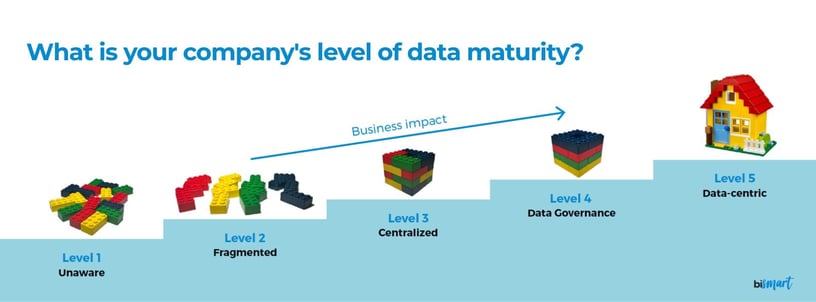
Talking about data maturity is not talking about technology. It is talking about decision capability. A useful way to understand it is through observable decision behaviors:
Level 1: “We have data, but it does not truly shape decisions”
Data exists, but it is not considered a critical asset for steering the organization. Decisions are driven mainly by experience, intuition, or contextual pressure.
Data is reactive, not structural.
Level 2: “We have reporting, but we debate the numbers”
Dashboards and reports exist, but definitions are not shared. Executive meetings focus on validating figures instead of making decisions.
Data adds friction instead of accelerating decision-making.
Level 3: “We decide with evidence in critical areas”
Key decisions rely on a shared and trusted set of data. The conversation shifts from metrics to trade-offs.
At this stage, data starts to govern specific decisions, but only partially.
Level 4: “Evidence guides execution”
Critical decisions are supported by data with clear ownership, shared definitions, and agreed quality criteria. Evidence is embedded into real decision processes, not just into reporting.
Data moves from being informative to being operational.
Level 5: “The organization learns and improves systematically”
The organization does not only decide with data. It measures decision outcomes, detects deviations, and continuously adjusts criteria.
Data becomes a corporate learning system and a sustainable competitive advantage.
A critical warning
Many organizations perceive themselves as highly mature because of the number of dashboards they produce.
In practice, they operate at Level 2: abundant reporting, slow decisions, and constant metric disputes.
Data maturity is measured by the influence of data on decisions, not by technological sophistication.
Common mistakes in data-driven strategy (and how to avoid them)
Mistake 1: Treating “data-driven” as a cultural slogan
Culture matters, but culture without a system evaporates (as seen in intelligent corporate purpose).
An organization becomes data-driven when it changes how decisions are made:
who decides, based on what evidence, using which definitions, under what criteria, and with what follow-up.
In short, building a data-driven culture requires changing the decision-making system, not just the mindset.
Mistake 2: Turning it into a transversal program with no priorities
In large enterprises, “transversal” often means owned by no one.
Without clearly prioritized decisions, there is no focus—and the transformation turns into a set of disconnected initiatives with limited impact.
Mistake 3: Measuring “data maturity” by the number of KPIs
More indicators do not mean better decisions.
Often, they mean more noise.
At C-level, what matters is not volume, but a small number of strategic, consistent, and actionable metrics that support decision-making.
Mistake 4: Ignoring the alignment between data and business strategy
If leadership does not clearly see how data improves investment decisions, risk management, margin, or execution, the data strategy loses sponsorship as soon as budget pressure appears.
A strong enterprise data strategy must be visibly connected to business outcomes.
Mistake 5: Underestimating the cost of lack of trust
When the executive committee loses trust in data, it returns to politics and narrative.
This does not only slow decisions—it also creates inconsistent decisions across business units.
When the committee debates metrics, it is not deciding.
It is compensating for a structural weakness in the data and decision system.
When executives debate metrics, they are not making decisions. They are compensating for a structural weakness in the data and decision-making system.
From “data-driven organization” to a data-driven business model: when monetization really appears
Not every company should monetize data as an external product.
However, almost every large enterprise can capture business value from data internally and, in the right conditions, evolve toward a data-driven business model.
In practice, returns usually appear first inside the organization: more accurate pricing and margin management, better risk control, higher operational efficiency, and more consistent commercial execution.
A data-driven business model emerges when data stops being a support function and becomes a competitive advantage:
- it enables faster decisions than the market,
- reduces systematic decision errors,
- increases personalization and operational efficiency,
- and turns operations into a measurable and optimizable system.
The critical point is this: data monetization —internal or external— does not scale without a reliable decision foundation. If data is debated, inconsistent, or lacks ownership, value creation stalls.
A data-driven strategy is not a trend. It represents a shift in the enterprise decision model.
Organizations that are progressing fastest in their data-driven transformation are not doing so because of technology alone, but because of how data is integrated into strategic decision-making.
How to activate a data-driven strategy: from the executive committee to the organization (without bureaucracy)
A data-driven strategy must be executable. In large enterprises, three practices consistently make the difference:
1) “Lighthouse decisions”: few, but decisive
Select 3–5 decisions where impact is clear and success can be measured.
This creates real traction and prevents the strategy from becoming diluted.
2) A shared business language
Technical integration without semantic integration pushes conflict to the executive committee.
If each business unit defines “margin” or “customer” differently, the organization will never be truly data-driven—it will be a collection of local truths.
3) Pragmatic, decision-oriented governance
Governance is not about slowing things down. It is about eliminating recurring debates.
Effective data governance defines clear minimums: ownership, shared definitions, acceptable data quality, traceability, and resolution mechanisms, just enough to enable fast, controlled decision-making.
From “having data” to leading with data: our approach
At Bismart, we start from a clear premise: an organization does not become data-driven by accumulating data, but by consistently improving the quality and speed of its decisions.

Conclusion: Being data-driven is not about having more data; it is about leading better
In large enterprises, a data-driven strategy is ultimately a leadership strategy:
how to reduce uncertainty, accelerate decision-making, and execute with consistency at scale.
If today your organization:
- takes too long to make decisions,
- debates numbers instead of decisions,
- depends on specific teams to access “the truth”,
- or struggles to scale initiatives beyond pilots…
the problem is not a lack of data.
The problem is the absence of a decision system supported by data: clear priorities, defined ownership, a shared business language, and systematic measurement of decision impact.
If you want to activate a data-driven strategy and need clarity to prioritize decisions, identify structural bottlenecks, or validate your roadmap with the executive committee or board, an executive-level conversation often delivers more value than launching yet another data initiative.