
Descubre las 15 tendencias de datos e inteligencia artificial que marcarán 2027-2028: agentes de IA, tiempo real, ontologías, soberanía, AI FinOps, gobierno y más.
For years, enterprise data strategies have focused on bringing fragmented information together, moving it to the cloud, improving data quality and making it easier to use through Business Intelligence and analytics tools.
Today, that is no longer enough.
Advances in artificial intelligence are transforming not only how data is used, but also the requirements data must meet in order to generate value. At Bismart, we have therefore analyzed the data and AI trends that are likely to shape the market over the next two years.
Between 2027 and 2028, one of the biggest challenges will be ensuring that data can be used reliably not only by people and dashboards, but also by AI models, copilots, agents, applications and processes capable of recommending, deciding and even acting autonomously.
This shift is reshaping enterprise data priorities. Semantics, context, permissions, observability, sovereignty, real-time access and inference costs are moving from the margins to become essential components of any infrastructure designed to operate AI at scale.
This is one of the main conclusions of our report The Data and AI Industry in 2027–2028: Trends, Challenges and Opportunities, where we explore the technological, business and regulatory forces that could transform the market over the coming years.
From Storing Data to Building Systems That Can Use It
The data industry is entering a new phase. Over the past decade, the dominant objective has been to bring more information together, move it to the cloud, accelerate processing and broaden access to analytics.
In 2027–2028, the challenge will be different: ensuring that data can be reliably used by AI models, agents, applications and processes that do more than analyze what has already happened. They will also recommend, decide and act.
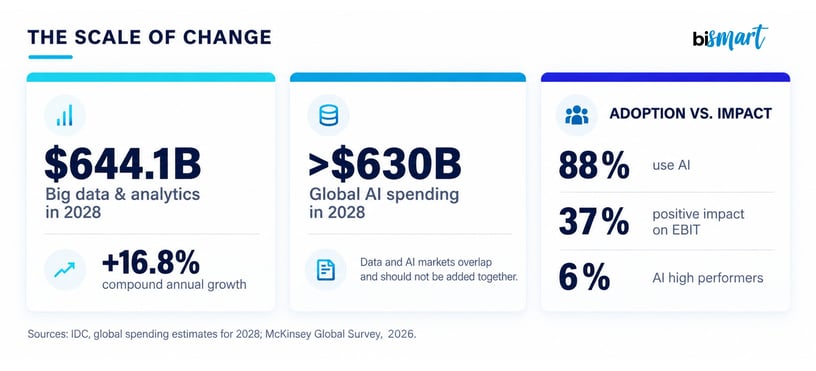
The economic scale of this transformation is significant. IDC estimates that global spending on big data and analytics technologies could rise from approximately $354 billion in 2024 to around $644.1 billion by 2028, representing a compound annual growth rate of roughly 16.8%.
Meanwhile, global spending on artificial intelligence could exceed $630 billion by 2028.
Adoption, however, does not automatically translate into impact.
In McKinsey's 2026 global survey, 88% of organizations reported using AI, yet only 37% said it was having a positive impact on EBIT, while just 6% qualified as AI high performers.
Key takeaway: The bottleneck in 2027–2028 will not be access to AI. It will be having the data, governance and operating model required to turn AI into repeatable, secure economic value.
The biggest opportunities will not necessarily come from building another dashboard or another foundation model.
They will increasingly emerge in the layer that allows enterprise AI to operate reliably: data products, observability, semantic layers, context engineering, agent security, computational privacy, streaming, synthetic data, automated governance and infrastructure optimization.
Against this backdrop, we have identified 15 data and artificial intelligence trends that will define the enterprise landscape in 2027–2028.
1. Agentic Data Lifecycle Management
Data engineering automation will evolve towards systems capable of acting autonomously across different stages of the data lifecycle.
AI agents will do more than generate code. They will be able to discover sources, propose pipelines, create transformations, validate quality rules, update metadata, optimize workloads and assist with incident resolution.
This represents the natural evolution of DataOps. Platforms already automate deployments, testing and monitoring. The difference is that the next generation will be able to interpret the context of an incident, formulate hypotheses and execute corrective actions within predefined boundaries.
Business implication: The goal will not be to replace the data engineering function, but to shift its focus away from repetitive execution and towards the design, supervision and continuous improvement of increasingly autonomous data systems.
|
Expected Capability |
Required Controls |
|
Source discovery and automated documentation |
Source verification and classification |
|
Pipeline generation and modification |
Sandboxing, testing, versioning and rollback |
|
Incident detection and diagnosis |
Evidence, explainability and confidence thresholds |
|
Performance and cost optimization |
Consumption limits and approval for critical changes |
2. Universal Semantic Layers and Enterprise Ontologies
The semantic layer will no longer be associated exclusively with Business Intelligence. By 2027–2028, it will increasingly become shared infrastructure for analytics, applications, copilots and agents.
The consolidation of ontologies and knowledge graphs, together with governed metrics, will allow organizations to reuse the same business context across BI, search, automation and AI applications.
Initiatives such as Microsoft Fabric IQ reflect this move towards a shared operational model of entities, relationships and business rules.
Business implication: AI readiness is not simply about moving data to the cloud. It requires turning business knowledge — currently scattered across people, documents, code and dashboards — into a governed, reusable semantic layer.
|
From the Traditional Semantic Layer |
To the Universal Semantic Layer |
|
Metrics for reporting |
Metrics for reporting, applications and agents |
|
Modelos centrados en BIBI-centric models |
Entities, relationships, processes and rules |
|
Consumo principalmente humano |
Human and machine consumption |
|
Maintained by analytics teams |
Shared governance between data and business teams |
3. Context Engineering, GraphRAG and Agent Memory
The emerging discipline of context engineering will focus on dynamically selecting and assembling the information, instructions, tools and memory required for each interaction.
Traditional RAG, based primarily on vector search across documents, will remain relevant, but it will not be sufficient for many enterprise use cases.
Architectures will increasingly move towards hybrid retrieval: lexical search for exact matches, vector search for semantic similarity, graphs to capture relationships between entities, and temporal mechanisms to understand which information was valid at a specific point in time.
GraphRAG will make it possible to answer questions that require traversing relationships and combining evidence distributed across multiple sources.
Memory adds another layer. Agents will be able to retain episodic information about previous interactions, semantic knowledge about the business and procedural knowledge about how a particular task should be carried out.
Business implication: The advantage will not come from storing more documents in a vector index. It will come from building a context system capable of retrieving the right evidence, grounding responses in that evidence and using it under the appropriate permissions.
4. Agentic Data Streaming and Operational Intelligence
Streaming will evolve from feeding real-time dashboards to powering systems capable of interpreting events and acting on them.
An agent could detect an anomaly, retrieve relevant history, evaluate business rules, recommend a response, execute an action within its permitted boundaries and escalate the decision when human intervention is required.
For this model to work, a data platform needs more than speed. It must also manage schema evolution, consistency between events and systems of record, deduplication, traceability and end-to-end data observability.
Business implication: The relevant metric will no longer simply be how many events can be processed per second. It will be how quickly the organization can detect, decide and act — and the business impact generated by that response.
5. The Convergence of Operational, Analytical and AI Data
Durante décadas, los sistemas transaccionales y analíticos se diseñaron para funciones distintas. Los primeros priorizaban la consistencia y la ejecución de operaciones; los segundos, la agregación y el análisis histórico.
For decades, transactional and analytical systems were designed for different purposes. Transactional systems prioritized consistency and operational execution, while analytical systems focused on aggregation and historical analysis.
In 2027–2028, the gap between them will continue to narrow through managed CDC, mirroring, zero-ETL architectures, zero-copy access, operational databases connected to lakehouses and hybrid transactional/analytical processing systems.
Artificial intelligence is accelerating this convergence because agents need to combine the current state of a process with historical information and broader business context.
Business implication: Organizations will need to design architectures around decision flows rather than legacy technology categories. The key question will be where each workload should run to meet its SLOs while minimizing data movement and duplication.
| Mechanism | What It Reduces | Key Consideration |
|---|---|---|
| CDC and mirroring | Synchronization latency | Consistency and schema evolution |
| Zero-ETL | Custom pipelines | Ecosystem dependency |
| Zero-copy | Physical data copies | True interoperability between engines |
| HTAP | Strict OLTP/OLAP separation | Isolation and performance |
| Unified governance | Duplicated policies | Coverage of operational systems |
6. Multimodal and Unstructured Data Engineering
Most enterprise knowledge does not live in tables. It is distributed across contracts, emails, presentations, images, video, audio, blueprints, geospatial data, telemetry and conversations.
The expansion of multimodal models will turn this content into an active source for analytics, automation and AI agents.
Data engineering will need to incorporate document extraction, transcription, computer vision, classification, chunking, embedding generation and linkage to enterprise entities. Simply storing a document will no longer be enough.
Organizations will also need to understand its version, provenance, language, confidentiality level, usage rights and relationship with other assets.
Business implication: Activating unstructured data could unlock a substantial share of corporate knowledge, but it will require the same level of governance discipline currently applied to structured data.
7. Open Table Formats and Interoperable Catalogs
Formats such as Apache Iceberg, Delta Lake and Apache Hudi have established a table layer on top of object storage. The next step will be to increase interoperability between catalogs, engines and platforms, allowing organizations to use different services on the same data assets without continuously duplicating them.
The separation of storage, data catalogs and processing is changing the balance of the ecosystem. Data can remain in an open format while different engines are used for engineering, analytics or AI workloads.
Catalogs will evolve from descriptive inventories into active control planes. In addition to enabling search and lineage, they will be able to enforce policies, validate contracts, trigger workflows and provide context to applications and agents.
Metadata standards such as DCAT 3 could support federated discovery and interoperability between catalogs, particularly in public-sector organizations and data spaces.
Business implication: A data strategy should not rely solely on a vendor claiming to support an open format. Organizations should test the actual ability to read, write, govern, export and recover data outside the primary platform.
| Layer of Openness | Validation Question |
|---|---|
| Format | Is the data stored using an open specification? |
| Catalog | Can other engines discover and govern the tables? |
| Processing | Can multiple engines use the data without replication? |
| Security | Are permissions and auditability preserved across platforms? |
| Exit | Is there a tested process for export and recovery? |
8. Small Language Models and Edge AI
Smaller, specialized models will gain ground as organizations move away from the assumption that every task requires the largest model available.
Small Language Models can provide a more efficient balance between capability, cost and latency, particularly when the problem is well defined or inference needs to run frequently.
Combined with edge computing, these models make it possible to run inference close to where data is generated: factories, vehicles, stores, medical devices, telecommunications networks or energy infrastructure. This can reduce latency, data transfer and dependence on permanent connectivity.
Business implication: Model selection should become an architectural decision based on risk, complexity, cost, latency and data location — not a race to deploy the most powerful model available.
9. Sovereign AI and Regional Data Planes
Sovereignty will move beyond legal departments and become an architectural consideration.
Organizations will need to understand not only where data is stored, but also where it is processed, which model uses it, where logs are retained, who controls the encryption keys and which metadata crosses jurisdictional boundaries.
Regional data planes will make it possible to separate workloads and assets according to jurisdiction. Policies could determine which information remains within a region, which data can be aggregated, which models run locally and under what conditions data may be transferred.
The concept of sovereign AI extends this logic to compute, models, operations and knowledge. It can include local infrastructure, regional models, customer-controlled keys, confidential computing and separation between content and metadata.
Business implication: Data residency is only one part of the challenge. Organizations need to be able to demonstrate the complete path of data storage, processing, access, inference and retention.
10. AI FinOps and Cost- and Energy-Aware Architectures
Artificial intelligence introduces a more dynamic cost structure than traditional analytics.
Consumption depends on the model, context size, number of calls, tools used, caching, latency, infrastructure and the number of steps completed by each agent. Measuring tokens or GPU consumption alone does not reveal the profitability of a process.
You may also be interested in: Microsoft Fabric Is Changing How AI Consumption Works in October 2026
AI FinOps will extend cloud FinOps practices by connecting technical consumption with business outcomes. Platforms will increasingly use dynamic model routing, semantic caching, quantization, batching, context limits and automatic infrastructure selection.
A simple query may be handled by a smaller model, while a high-risk decision may require a more advanced system and additional controls.
Business implication: Financial measurement needs to move from cost per token to cost per outcome: claim resolved, incident prevented, document processed, order optimized or process completed.
| Technical Metric | Operational Metric | Economic Metric |
|---|---|---|
| Tokens, GPU, storage and latency | Tasks completed, retries and escalations | Cost per completed process |
| Cache hit rate | Response time | Productivity or conversion |
| Capacity utilization | Service availability | Incremental margin or savings |
| Energy consumption | Workload processed | Energy per outcome |
Want to Explore These Trends in More Depth?
Our report The Data and AI Industry in 2027–2028 explores all 15 trends, their business implications and the major changes organizations should start considering today.
11. Identity and Authorization for AI Agents
AI agents will become non-human identities with access to data, APIs and applications. Sharing service credentials or inheriting all of a user's permissions will not be compatible with secure deployment at scale.
Each agent will need its own identity, a defined purpose and permissions aligned with the task it performs. Authorization will need to distinguish between retrieving information, making recommendations and executing actions.
Organizations will also need to manage delegated authority, temporary credentials, spending limits and immediate revocation.
Traceability should link the human identity, the agent, the model, the tools used and the final action. This chain will be essential for incident investigation, non-repudiation and compliance.
This becomes particularly relevant in the context of the EU AI Act, which introduces stronger requirements around traceability, human oversight, risk management and documentation for certain AI systems.
Business implication: Before increasing an agent's autonomy, an organization should be able to answer five basic questions: who created it, why it exists, what it can access, which actions it can perform and how it can be disabled.
Is your organization ready for the EU AI Act? Read our Complete Guide to the EU AI Act to understand the main obligations, timelines and requirements organizations need to consider.
12. Decision Governance and Runtime Controls
An agent can use accurate data and an approved model and still make a decision that is inappropriate for the context.
This is why a dedicated layer of decision governance will emerge: policies that define which decisions a system can make, what evidence those decisions require, which limits apply and when human approval is necessary.
Policy-as-code, data contracts and rules engines will make it possible to block actions that fall outside established policies, record exceptions and adapt thresholds according to risk.
Human oversight will need to be designed selectively. If every action requires approval, much of the value of automation disappears. If no action requires approval, exposure increases.
The solution is to scale autonomy according to impact, reversibility, confidence and sensitivity.
Business implication: The question will no longer simply be whether an agent works. Organizations will need to determine how much authority it should have and how they can prove that its decisions remain within established boundaries.
| Level | Capability | Example Control |
|---|---|---|
| 1. Assistance | Retrieves and summarizes information | Read-only access and approved sources |
| 2. Recommendation | Proposes a decision | Supporting evidence and human approval |
| 3. Limited Action | Executes reversible tasks | Thresholds, limits and rollback |
| 4. Supervised Autonomy | Manages end-to-end workflows | Continuous monitoring and escalation |
13. Data Observability and AI Assurance
Data observability will evolve from monitoring pipelines and tables to evaluating the entire chain connecting data, context, models, agents and outcomes.
Freshness, completeness, schema integrity and lineage will remain essential, but organizations will need to connect these signals to their impact on a particular decision or business process.
AI assurance adds another layer, covering groundedness, safety, robustness, bias, policy compliance, cost and task success.
These evaluations cannot be limited to pre-deployment testing because data, prompts, tools and models change continuously.
One of the biggest risks will be generating more telemetry than teams can realistically interpret. Observability systems will therefore need to prioritize alerts according to impact, group related causes and recommend appropriate responses.
Business implication: An AI application is not truly production-ready if the organization cannot measure when it fails, why it fails, who is affected and how much remediation costs.
14. Computational Privacy and Synthetic Data
The need to use sensitive information for analytics and AI will accelerate the adoption of technologies designed to reduce exposure without preventing collaboration.
Differential privacy, federated learning, multiparty computation, homomorphic encryption, confidential computing and clean rooms provide different mechanisms for working with data without directly sharing all raw records.
There is no single technology that works for every scenario. Some protect aggregated outputs. Others enable distributed model training. Others make it possible to perform computations on encrypted data or within isolated environments.
The right approach will depend on acceptable levels of risk, accuracy, latency and cost.
Synthetic data will complement these capabilities. It can support testing, development, training or data sharing when real-world data is scarce or sensitive. Its usefulness depends on preserving the relevant properties of the original data without memorizing or exposing individual records.
Business implication: Privacy needs to be engineered as a measurable technical property. Every use case requires an explicit assessment of threat, utility, cost and evidence of protection.
| Approach | Common Use Case | Main Trade-Off |
|---|---|---|
| Differential privacy | Statistics and model training | Accuracy vs. protection |
| Federated learning | Distributed training | Coordination and heterogeneity |
| Clean rooms | Cross-organization collaboration | Limited use cases and platform dependency |
| Confidential computing | Protected processing | Cost and compatibility |
| Synthetic data | Testing, development and data sharing | Fidelity and memorization risk |
15. Data Products, Marketplaces and Monetization
A data product is an asset designed to be repeatedly consumed by a defined group of users. It has an owner, documentation, a contract, quality standards, permissions, SLOs and support mechanisms.
Internal marketplaces will make it easier to discover assets, request access and promote reuse.
Their success will not depend on how many assets are cataloged, but on the quality and adoption of the assets that support critical business processes.
Externally, Data-as-a-Service will evolve from selling static datasets towards continuously updated APIs, signals, features, scores and endpoints. Business models will combine subscriptions, consumption, compute, API calls, agents or outcomes.
Monetization does not only mean selling information. It also includes capturing internal value through lower fraud, reduced inventory, less downtime, better pricing or faster time to market.
Every data product should therefore connect technical, operational and economic metrics.
Business implication: Data needs to be managed as a portfolio. Every product requires investment, users, cost, service levels, impact and an explicit decision about whether it should continue to exist.
Other Emerging Technologies to Watch in 2027–2028
Beyond the 15 trends explored above, the report identifies several additional technologies worth keeping on the radar for 2027–2028, including Physical AI and world models, confidential computing, and new applications of artificial intelligence for scientific discovery.
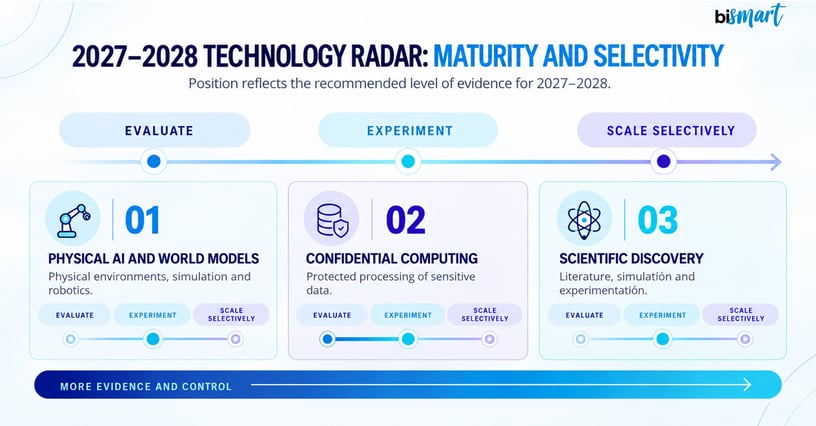
Their evolution will depend on factors such as technological maturity, the availability of robust use cases, security and regulatory requirements, adoption costs and, above all, the ability to demonstrate tangible business impact.
Anticipating the future of data and AI is therefore not about adopting every new technology that appears. It is about identifying which technologies can create a genuine advantage for each organization, when they should be adopted and under what conditions.
The Real Challenge for 2027–2028: Moving From Available AI to Operational AI
The enterprise race to adopt artificial intelligence is changing.
Competitive advantage is unlikely to come simply from gaining access to a more powerful model. Models will become increasingly accessible and interchangeable.
The real differentiator will be an organization's ability to connect them with reliable data, business knowledge, processes, controls and business metrics.
That requires organizations to address architecture, governance, quality, security, observability, cost and internal capabilities simultaneously.
It also helps explain why some of the biggest adoption risks over the coming years will not be problems with AI models themselves, but issues such as poor data quality, unclear ownership, uncontrolled costs, agent security, integration debt, sovereignty and technology dependency.
The evolution of Data & AI between 2027 and 2028 will therefore be less about racing to adopt every new development and more about deciding which technologies make sense for each organization — and building the conditions required to use them safely, repeatedly and profitably.
Download the Report: 'The Data and AI Industry in 2027–2028'
Which capabilities should organizations prioritize? Which technologies are mature enough to invest in? Where is business value likely to emerge? And which risks could prevent adoption from scaling?
In The Data and AI Industry in 2027–2028: Trends, Challenges and Opportunities, we analyze the five forces transforming the industry, the 15 trends organizations should be watching and what they could mean for businesses over the coming years.
The report also includes an emerging technology radar, an industry value-creation map, an adoption risk matrix and a 2026–2028 executive roadmap designed to help organizations turn emerging trends into concrete priorities.