Microsoft Fabric will change AI consumption in october 2026. Learn how it affects Copilot, Data Agents, AI Functions, CUs and enterprise AI costs.
Starting October 1, 2026, Microsoft will update the way consumption is measured for selected artificial intelligence capabilities in Microsoft Fabric.
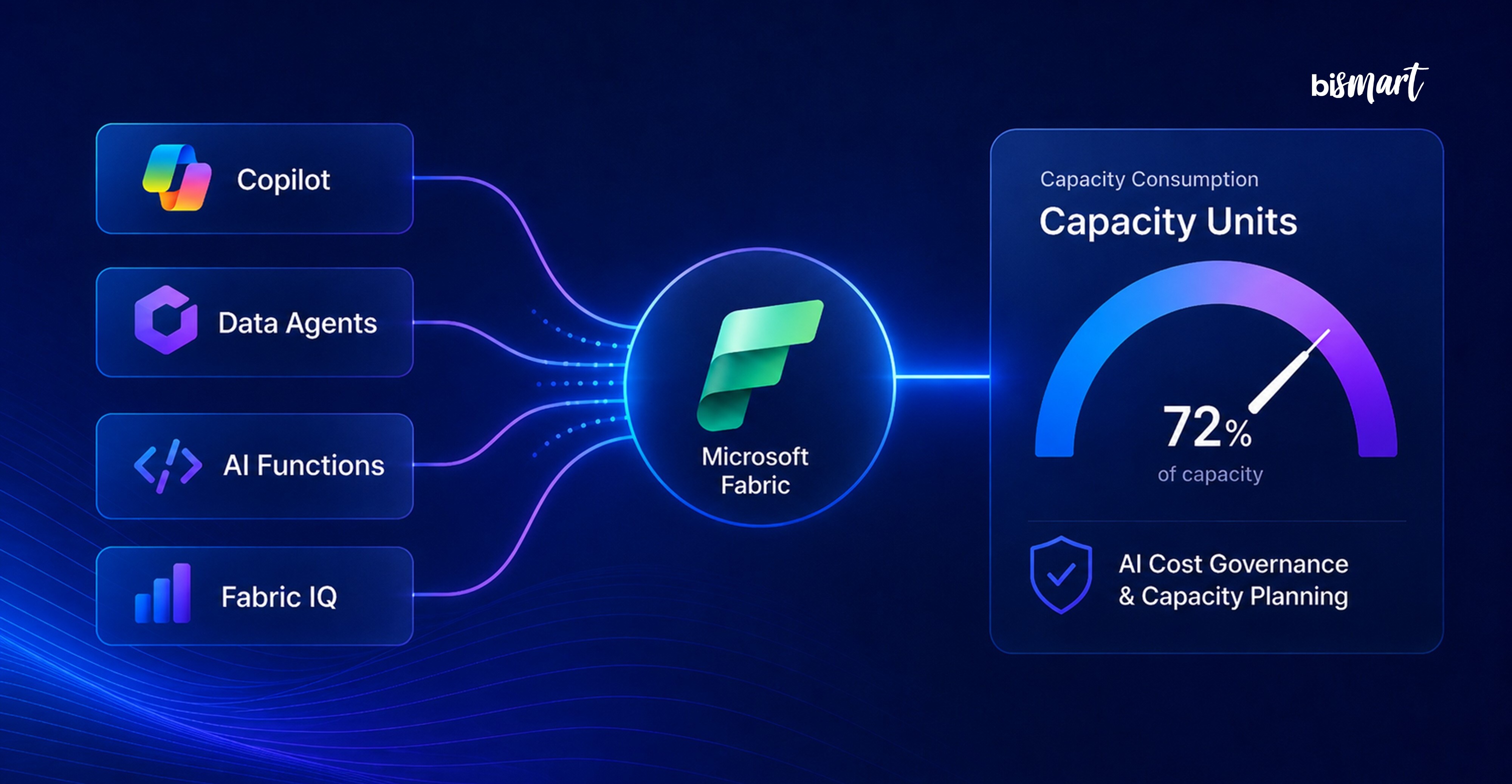
The change affects AI experiences that rely on large language models, including Copilot in Fabric, Fabric Data Agents, AI Functions and Fabric IQ ontologies.
At first glance, the announcement may look like a technical billing update.
For organizations already deploying generative AI inside Microsoft Fabric, or preparing pilots with Copilot, data agents and AI-powered functions, the real question is more operational:
How is AI cost calculated in Fabric today, and what will change when consumption becomes more dynamic? This article explains what companies need to know.
Artificial intelligence in Microsoft Fabric is becoming a workload that consumes capacity. That means it must be measured, planned and governed like any other strategic data workload.
The change announced by Microsoft will take effect on October 1, 2026. From that date, selected AI capabilities in Fabric will move to a dynamic consumption model based on the resources required to complete each task.
This means consumption may vary depending on factors such as the AI model used, reasoning effort, prompt complexity, tools involved and the processing required to complete the operation.
For now, Microsoft has not yet published all the exact conditions of this new model. There is also no dedicated calculator to anticipate the final price of these AI capabilities, unlike what exists for other cloud services.
The message for enterprises is clear: today, it is not yet possible to calculate the exact final cost of the new AI consumption model in Microsoft Fabric.
What organizations can do is prepare: review which AI capabilities they are already using, monitor consumption in the Fabric Capacity Metrics App and build a baseline before October 1, 2026. Once Microsoft releases more details, that visibility will allow companies to adjust capacity planning with much greater precision.
If you have not yet explored our Complete Guide to Microsoft Fabric, you can use it to understand the platform’s role in unifying data, analytics and AI in a modern enterprise data environment.
Complete Guide to Microsoft Fabric
Explore how Microsoft Fabric can help you unify data management, modernize business analytics, and optimize licensing, costs, and the transition to a more efficient data platform.
What Is Changing in Microsoft Fabric AI Consumption?
Starting October 1, 2026, selected AI experiences in Microsoft Fabric will move away from a fixed consumption approach and shift towards a dynamic consumption model more closely tied to the actual resources required by each task.
Consumption will depend on task complexity
In practice, two AI interactions will not necessarily have the same impact on capacity.
A simple request with limited context and a short response may consume less than a complex prompt that needs to interpret enterprise data, consult additional tools, reason across multiple business entities or generate a more detailed answer.
Consumption will still be measured in Fabric Capacity Units (CUs), but it may vary depending on the AI model used, reasoning effort, request complexity, tools and services involved, and the processing required to complete the task.
The new AI consumption model in Microsoft Fabric creates a more direct relationship between task complexity and the capacity required to execute it. For enterprises, this means that the operational cost of AI will increasingly depend on how AI workloads are designed, used and governed.
This change in approach is especially relevant for large organizations.
In a small environment with a limited number of users and tightly controlled use cases, consumption may remain relatively predictable. In an enterprise with multiple departments, hundreds or thousands of users, distributed workspaces, complex semantic models and agents connected to corporate data, consumption can grow in a much less linear way.
AI Capabilities Affected by the New Microsoft Fabric Consumption Model
The new consumption model will apply to selected Microsoft Fabric operations that use large language models, or LLMs. Microsoft specifically mentions four experiences: Copilot in Fabric, Fabric Data Agents, AI Functions and Fabric IQ ontologies.
This list should not be interpreted as definitive. Microsoft has indicated that additional AI capabilities may adopt the new consumption model as more AI functionality becomes available in Fabric.
Copilot in Fabric
Copilot in Fabric already has a documented consumption model. Its consumption is measured in Fabric Capacity Units (CUs), and each interaction is calculated based on the number of tokens processed.
As a reference, approximately 1,000 tokens equal around 750 words. This should be understood as an approximation only. It does not allow companies to calculate the final price of an interaction on its own, but it helps explain why a long prompt, an extensive answer or a conversation with a large amount of context may consume more capacity.
For a broader view of Copilot’s role within the Fabric ecosystem, you can consult our guide Everything You Need to Know About Microsoft Fabric and Copilot.
Fabric Data Agents
Fabric Data Agents are also directly connected to this change. When a user queries a Data Agent in natural language, Fabric generates tokens from the user’s question and from the context needed to process it.
The total consumption of these operations appears in the Fabric Capacity Metrics App under the name AI Query. This makes it easier to isolate agent-related usage and understand how it affects capacity.
The difference with a simple text interaction is important. A data agent may need additional context, access corporate data and produce an answer grounded in business information. For that reason, its consumption should be analyzed as part of the full workload, not merely as an isolated model call.
AI Functions
In AI Functions, calls to Fabric’s integrated LLM endpoint are charged against Fabric capacity under the Copilot and AI meter. In the Capacity Metrics App, this usage appears as an AI Functions operation.
These operations allow organizations to observe metrics such as input_tokens, cached_tokens, output_tokens, reasoning_tokens, model and client_type. These variables are important because they anticipate the logic behind the new model: AI consumption does not depend only on whether a feature is used, but also on the model selected, the tokens processed, the reasoning applied and the type of operation being executed.
Fabric IQ Ontologies
Fabric IQ ontologies add a different dimension to AI consumption in Fabric.
Fabric IQ works as a semantic layer designed to make data and business context consistently available across Fabric workloads, Foundry, Copilot Studio and custom applications.
The more AI experiences depend on semantic models, ontologies and agents, the more important it becomes to understand what context they use, what processing they trigger and how they affect capacity consumption.
To explore the role of ontologies, graphs and the semantic layer in Microsoft Fabric, you can consult our guide to Fabric IQ and its impact on business intelligence.
How to Estimate the New Cost of AI in Microsoft Fabric
The new AI consumption model in Microsoft Fabric will come into effect on October 1, 2026, which means it is not yet possible to calculate the exact final cost of every scenario.
We know that consumption will depend on the resources required to complete each task. However, Microsoft has not yet published the exact conditions of the new model, and there is currently no dedicated calculator to estimate the final price of these AI capabilities.
What companies can do today is prepare by using the consumption logic already documented for some existing experiences, such as Copilot in Fabric.
This logic helps organizations understand how part of the consumption is measured through tokens and Fabric Capacity Units (CUs), although it should not be confused with a complete formula for the future dynamic model.
In some current experiences, Microsoft uses a token-based formula:
CU seconds = (input tokens × input rate + cached input tokens × cached input rate + output tokens × output rate) / 1,000The currently documented rates for Copilot in Fabric are:
| Token type | Documented consumption |
|---|---|
| Input tokens | 100 CU seconds per 1,000 tokens |
| Cached input tokens | 10 CU seconds per 1,000 tokens |
| Output tokens | 400 CU seconds per 1,000 tokens |
For example, a request with 2,000 input tokens and 500 output tokens would consume:
(2,000 × 100 + 500 × 400) / 1,000 = 400 CU secondsThat means 400 CU seconds, equivalent to 6.67 CU minutes.
Why can’t companies calculate the exact price of AI consumption in Fabric yet?
The token-based formula makes it possible to estimate the technical consumption of some current interactions, but it does not accurately predict the cost of the new model that will take effect on October 1, 2026.
The reason is that the new consumption model will not depend on tokens alone. It will also take into account factors such as the model used, reasoning effort, request complexity, tools involved and the processing required to complete each task.
Today’s CU seconds should be understood as a reference point for building a consumption baseline, not as a complete calculator for the new AI price model.
The New AI Cost in Microsoft Fabric Depends on the Complete Workload
With that in mind, the next step is to look beyond the formula and understand what actually drives consumption in an AI use case.
In many scenarios, an AI experience in Fabric does not simply receive a prompt and generate a response. It may also activate other components of the platform.
A Fabric Data Agent, for example, may need additional context, generate a query, execute it against a data engine, retrieve results and then produce a natural language response. In that scenario, consumption does not end with tokens. It may also include operations on Data Warehouse, SQL analytics endpoint, semantic models, DAX or other Fabric engines.
The same logic applies to AI Functions. The model call may appear under the Copilot and AI meter, but the end-to-end process may rely on Spark, Dataflow Gen2, Data Warehouse or data preparation and transformation pipelines. That additional consumption is also part of the real cost of the use case, even if it does not always appear under the same AI operation.
That is why the right question is not only “how many tokens does this interaction consume?”, but “which Fabric resources are activated to complete this task?”
In Fabric, choosing an AI model will not be only a technical decision. It will also be a decision about capacity, cost and governance.
Factors that will influence AI cost in Fabric
- AI model used
- Input, output and cached tokens
- Reasoning effort
- Queries generated by agents
- DAX operations or semantic model queries
- Processing in Spark, Dataflow Gen2 or Data Warehouse
- Usage frequency and number of users
- Context complexity
- Data architecture design
To estimate the real cost of AI in Microsoft Fabric, companies will need to measure the full use case: model, tokens, reasoning, generated queries, data engines involved and the capacity consumed by the processes that prepare, query or serve the data.
How to Prepare for the New AI Consumption Model in Fabric
Preparation should not begin on October 1, 2026. By then, organizations should already have a clear consumption baseline, a view of their AI workloads and an initial governance model.
The central tool will be the Fabric Capacity Metrics App. Microsoft recommends reviewing current AI workload usage in Fabric, monitoring Capacity Unit consumption after the update, evaluating utilization trends and adjusting capacity planning when needed.
But monitoring alone is not enough. The key is to turn those metrics into governance, architecture and capacity decisions.
1. Identify AI capabilities, operations and consumption peaks
Before the new model comes into effect, organizations should review five areas:
- Which AI capabilities they are currently using: Copilot, Data Agents, AI Functions or other experiences connected to language models.
- Which operations appear in the Capacity Metrics App, such as Copilot in Fabric, AI Query or AI Functions.
- Which workloads combine AI consumption with Spark, Dataflow Gen2, Data Warehouse, semantic models or SQL queries.
- Which users, departments or workspaces concentrate the highest consumption.
- Which use cases justify that consumption because of their operational or strategic value.
This review should distinguish between experimentation, pilots, recurring processes and critical workloads. A one-off Copilot exploration does not have the same weight as a Data Agent used regularly by a business team to query corporate KPIs.
2. Evaluate the design of AI use cases
In AI, architecture matters. An agent connected to well-modeled sources, with clear semantic context and appropriate permissions, can respond more effectively and more efficiently.
By contrast, an AI experience built on fragmented data, conflicting definitions or poorly governed models may require more context, generate more queries and produce less reliable answers.
3. Align business teams
AI cannot be governed only by IT if users do not understand that every interaction may have an impact on capacity. This does not mean restricting adoption. It means educating usage with clear criteria: which use cases are prioritized, which models are used, what limits exist and how generated value will be measured.
4. Plan Microsoft Fabric capacity
Finally, companies will need to translate observed consumption into capacity planning. If an organization expects to scale data agents, automate transformations with AI Functions or extend Copilot to more business areas, that growth should be incorporated into capacity planning before the new model comes into effect.
The Capacity Metrics App should not be used only to control costs. It should become the starting point for deciding which AI experiences to scale, which ones to redesign and what capacity the organization will need to sustain them.
Complete Guide to Microsoft Fabric
Assess how Microsoft Fabric can help your organization unify data management, modernize business analytics, and optimize licensing, costs and the transition to a more efficient data platform.
Conclusion
Microsoft Fabric will change the consumption model for selected AI capabilities starting October 1, 2026. The update will affect experiences that use large language models, including Copilot in Fabric, Data Agents, AI Functions and Fabric IQ ontologies.
The announcement matters because it forces companies to answer an increasingly important question: how do we estimate and govern the real cost of AI in our data platform?
For now, the answer is not a single rate or a fixed calculator. The new cost will depend on the resources required to complete each task and will need to be analyzed through real consumption, the workloads involved and the business value generated.
This change should not be interpreted as a barrier to AI adoption. On the contrary, it is a sign of maturity. AI in Fabric will continue to grow, but that growth will need to be more governed, more observable and more closely connected to business value.
The difference between efficient adoption and costly adoption will not be whether a company uses more or less AI. It will be whether the organization knows which AI is being used, how much it consumes, what value it creates and how it is governed.
Prepare Your Microsoft Fabric Environment for the New AI Consumption Model
The change coming on October 1, 2026 should not be approached only as a billing update. It is an opportunity to review how AI is being used, measured and governed in Microsoft Fabric.
At Bismart, we help companies assess their Fabric environment, analyze AI workloads, build a consumption baseline and define a governance model to scale Copilot, Data Agents, AI Functions and other AI capabilities with control, efficiency and business vision.