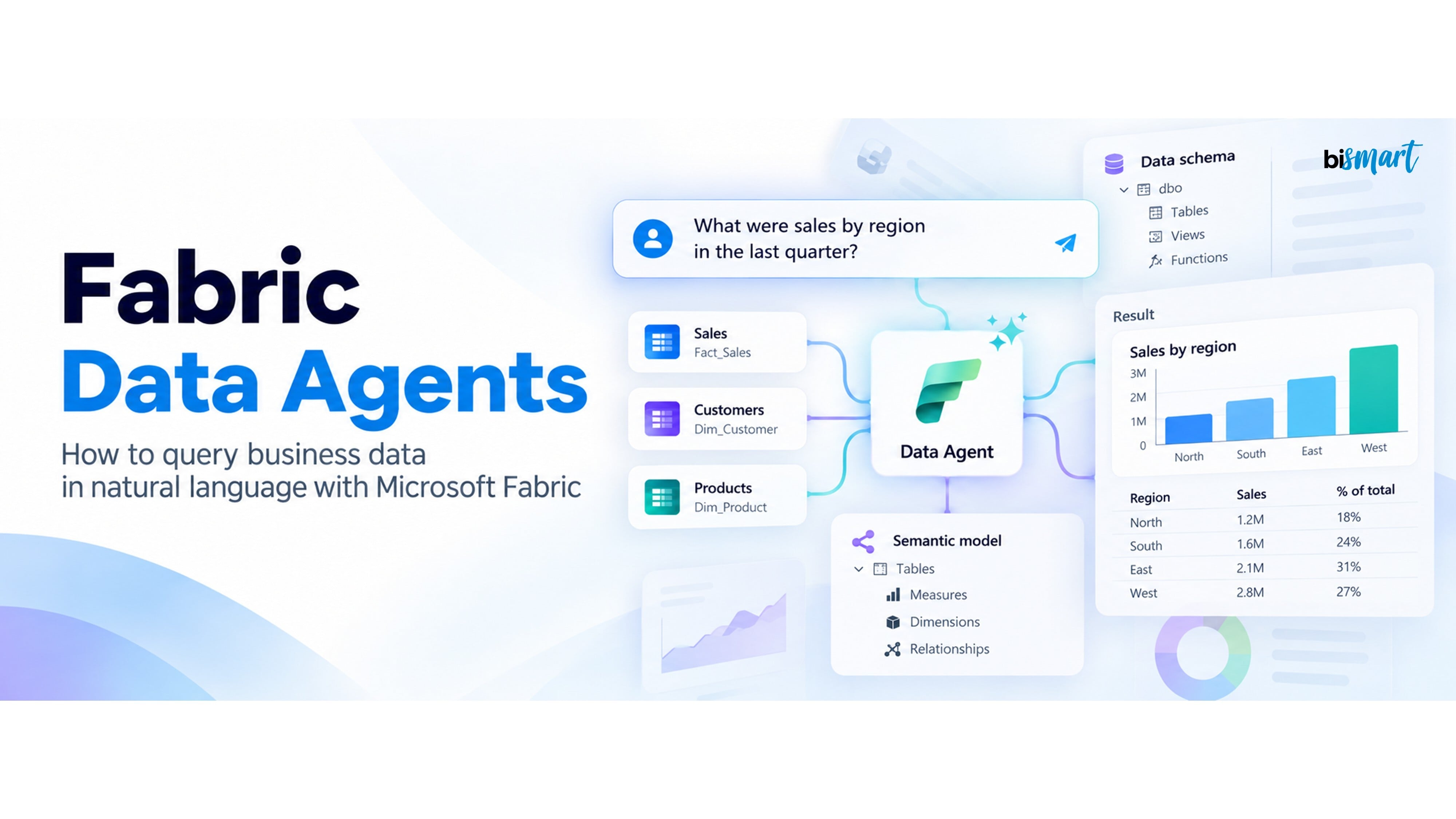
Learn how Microsoft Fabric Data Agents work, what’s new in 2026, how Fabric IQ adds business context, and how they compare with Bismart AI Query.
What are Fabric Data Agents, and what are they used for?
Microsoft Fabric Data Agents allow users to query business data using natural language instead of writing SQL, DAX or KQL. A user asks a question, the agent identifies the appropriate data source, generates the required query and returns an answer based on the resulting data.
The goal is straightforward: make enterprise data easier to access for the people who need it to make decisions, without requiring them to understand the technical structure behind the data platform.
For example, a sales manager could ask:
“Which regions saw sales decline compared with the previous quarter, and what are the main differences?”
Instead of searching for the right report or requesting a new data extract, the user can ask the question directly.
This way of interacting with data —often described as Talk to Data or conversational analytics— is not exclusive to Microsoft Fabric. Other solutions can provide similar capabilities while offering different levels of customization, infrastructure requirements and user experience.
One example is AI Query by Bismart, a conversational AI solution that allows business users to query enterprise data using natural language from within their own Azure environment, without requiring a Microsoft Fabric capacity.
AI Query also includes a customizable user experience, conversational querying, data visualizations, project organization, feedback mechanisms and tools for validating response quality.
Both approaches address the same underlying need. The main differences lie in their infrastructure requirements, user experience, customization options and the availability of specific capabilities.
Do Fabric Data Agents Require a Microsoft Fabric Capacity?
Yes.
To use Fabric Data Agents, organizations need a paid Microsoft Fabric F2 capacity or higher, or a compatible Power BI Premium P1 capacity or higher with Fabric enabled, together with the relevant configuration, permission and availability requirements.
This means that even if an organization simply wants to let employees query business data through natural language, it still needs compatible Fabric infrastructure.
For companies already using Microsoft Fabric, that requirement may fit naturally into their existing architecture.
For organizations that have not yet adopted Fabric, however, it introduces an additional technology dependency that should be considered as part of the overall solution design.
What about AI Query?
AI Query does not require an organization to purchase a Microsoft Fabric capacity in order to provide natural-language access to enterprise data.
The solution is deployed within the customer’s own Azure tenant and integrates with its data sources and authentication mechanisms.
This makes it possible to implement conversational AI use cases without adopting Microsoft Fabric solely to enable this functionality.
AI Query still requires the corresponding Azure resources, however, so any cost comparison should consider the total cost of both architectures, rather than looking at Fabric capacity alone.
What’s New in Fabric Data Agents?
At FabCon Europe 2026, Microsoft introduced several new capabilities for Fabric Data Agents.
Among the most relevant announcements were interactive visualizations, advanced DAX generation, improved business context, SQL object descriptions, query examples, topics and greater integration with Fabric IQ and ontologies.
Discover the Latest Microsoft Fabric Announcements at FabCon Recap Madrid
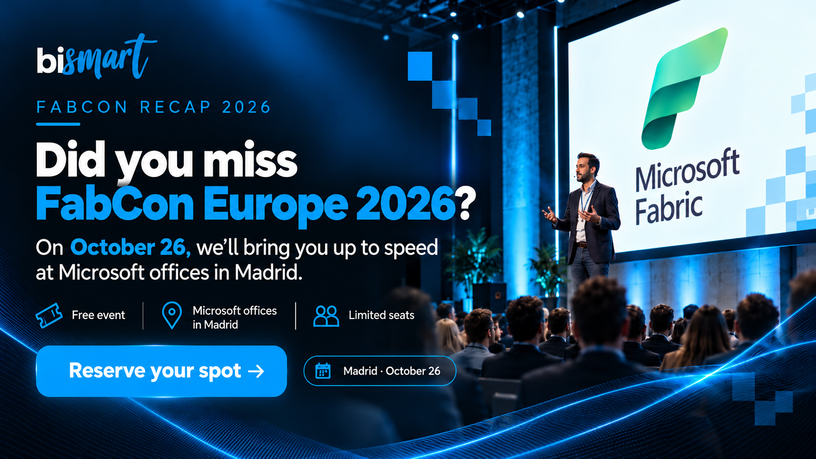
On Monday, October 26, Bismart is hosting FabCon Recap Madrid at Microsoft’s offices in Madrid.
During the session, we will review the most important announcements from FabCon Europe 2026 and, more importantly, discuss what they mean for businesses and where they can create real value.
📍 Microsoft offices in Madrid
🎟️ Free in-person event
⚠️ Limited seats
1. Interactive Visualizations in Fabric Data Agents
One of the most significant new capabilities is the ability for Fabric Data Agents to return interactive charts alongside text and tables.
A user could, for example, ask for:
- Sales performance by region
- Monthly revenue trends
- Margin evolution over time
- A comparison between business units
The agent can then generate a visual representation that makes the result easier to interpret.
These visual responses use Fabric Visuals and can be generated either when the user explicitly asks for a chart or when a visualization is considered appropriate for explaining the answer.
However, interactive visual responses are still in preview. Their availability depends on the requirements and limitations of the preview functionality and should not be confused with a generally available production capability.
How Does AI Query Handle Data Visualizations?
AI Query already allows users to query data in natural language and receive results in visual formats, including automatically generated charts.
These capabilities do not depend on the preview visualization functionality currently being introduced for Fabric Data Agents.
The experience can also be adapted to the needs of different business users and the visualization requirements of each organization.
This is particularly useful for teams such as sales, finance or operations, where users need access to information without having to work directly with technical analytics tools.
2. Advanced DAX Generation in Fabric Data Agents
Advanced DAX Generation is designed to improve the way Fabric Data Agents generate DAX queries against Power BI semantic models.
Instead of simply generating a query in a single step, the capability can perform several reasoning steps to:
- Inspect model metadata
- Interpret the user’s question
- Resolve ambiguities
- Identify relevant measures
- Refine the resulting query
Imagine a user asking:
“How has our commercial margin evolved compared with the previous period?”
Answering that question may require the agent to identify the correct measures, apply the right filters and determine which time comparison should be used.
Advanced DAX Generation is intended to make these more complex queries easier to resolve.
The functionality is currently in preview and requires the preview runtime.
It is also important to remember that more reasoning does not automatically guarantee a correct answer or faster execution. Validation remains essential.
How Does AI Query Handle Business Queries?
AI Query uses artificial intelligence to interpret questions written in natural language and transform them into queries against the configured data sources.
One of its capabilities is allowing technical teams to inspect the generated SQL scripts.
This helps organizations understand how an answer was obtained and provides greater transparency when validating the system.
AI Query also includes testing and monitoring mechanisms that can be used to evaluate answers against representative business questions.
Both approaches are designed to improve query reliability, although the underlying execution technologies and validation mechanisms are different.
3. How do SQL descriptions, examples, and topics help?
Fabric Data Agents provide instructions and context to help the agent understand enterprise data sources.
Query examples link natural-language questions to reference queries, making it easier to generate complex operations.
SQL object descriptions help explain what tables, columns, and other schema elements represent. They are especially useful when there are ambiguous technical names or fields that require specific interpretation.
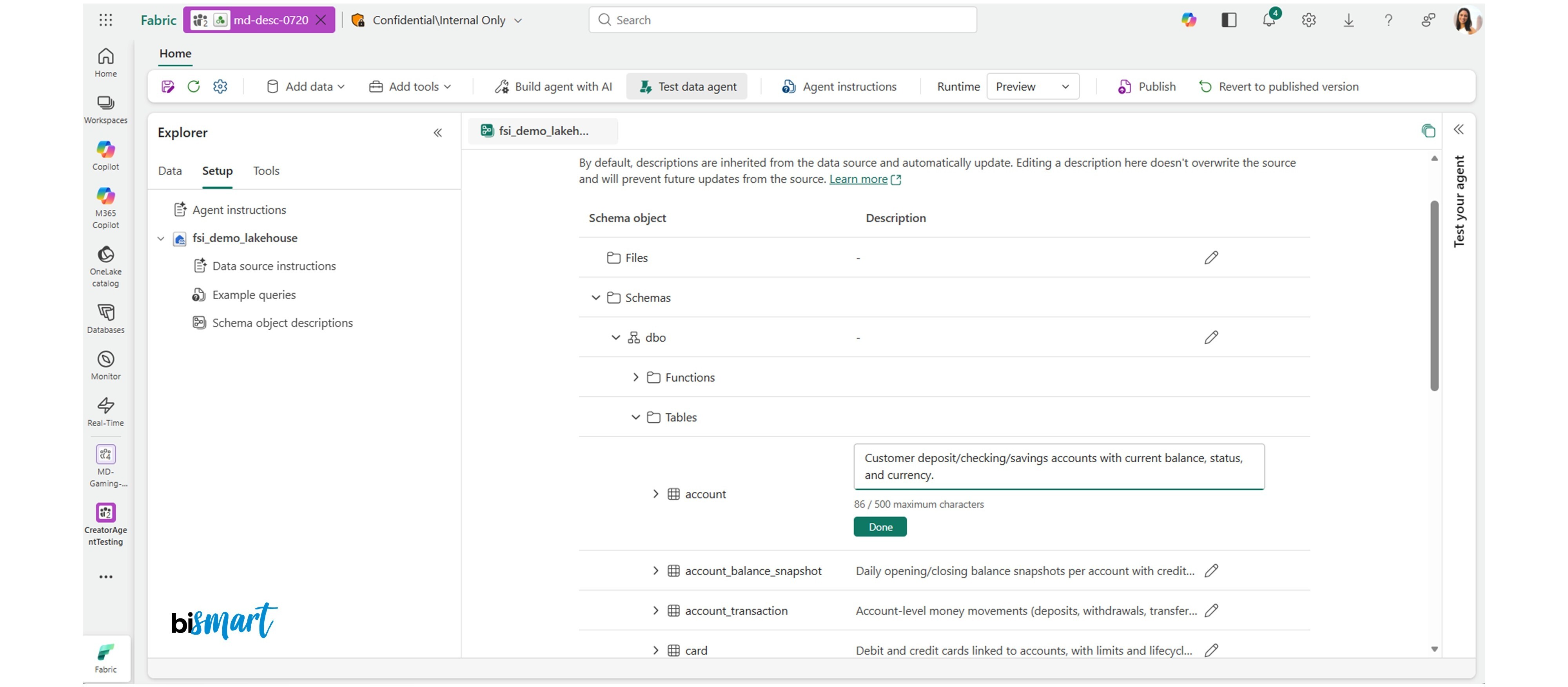
For example, a column named `status_code` may need a description to clarify whether a particular value means “order shipped,” “closed,” or “canceled.”
Topics, on the other hand, allow you to organize instructions by business area and retrieve the most relevant ones for each query.
It is important to distinguish between their availability statuses: general instructions and query examples are part of the supported configuration options, while SQL object descriptions and Topics remain in preview and have restrictions depending on the data source and runtime used.
AI Query also allows you to work with metadata and configure access to data sources by project or topic, making it easier to run queries within the appropriate context.
Also, its customizable architecture allows you to tailor the application and conversational experience to your organization’s specific processes.
Fabric Data Agents vs. AI Query: What Are the Differences?
Although both solutions allow users to query enterprise data through artificial intelligence, they take different approaches.
Fabric Data Agents are deeply integrated into Microsoft Fabric and can be especially attractive to organizations already using Fabric services, semantic models and analytics capabilities.
AI Query, by contrast, is designed as a customizable enterprise conversational AI solution deployed within the customer’s Azure tenant, with a strong focus on helping business users independently access their data.
| Feature | Fabric Data Agents | AI Query |
|---|---|---|
| Natural-language queries | Yes | Yes |
| Requires Fabric capacity | Yes, or a compatible Premium P1+ | No |
| Environment | Microsoft Fabric | Customer's Azure tenant |
| Interactive visualizations | Feature in preview | Chart generation available |
| Conversational queries | Yes | Yes |
| Business context | Instructions, models, and ontologies in preview | Metadata, per-area configuration, and customization |
| User experience | Native Microsoft interface and integrated experiences | Interface tailored to business users |
| Response validation | Assessment tools, some in preview | Large-scale testing and feedback mechanisms |
| Functional customization | Configuration within Fabric’s capabilities | Development and adaptation based on customer needs |
The table highlights differences in approach and availability, but this does not mean that Microsoft lacks customization or validation capabilities. In fact, Microsoft is also incorporating tools to evaluate agents and tailor their instructions.
The most significant difference lies in what each organization needs to use these features and to what extent it wants to tailor the experience to its own processes.
What Does AI Query Offer Business Users?
Beyond natural-language querying, AI Query includes features designed to make conversational analytics easier to use, customize and govern in day-to-day business environments.
Customizable user experience
The interface can be adapted to the needs of the organization and the users who will actually interact with the solution.
Continuous conversations
Users can ask follow-up questions and continue exploring a result without starting again from scratch.
Conversation management
Conversations can be renamed, pinned and organized, making previous analyses easier to retrieve.
Projects and business areas
Data sources and conversations can be grouped by project, department or business topic.
Data visualizations
Query results can be presented through automatically generated charts to make information easier to interpret.
Bulk validation testing
Organizations can run sets of representative questions to evaluate response quality and identify problems before expanding adoption.
User feedback
Built-in feedback mechanisms help teams identify incorrect or low-quality responses and prioritize improvements.
Functional customization
New capabilities can be added and the experience can evolve according to the requirements of each customer.
Azure-integrated security
AI Query is deployed within the customer’s environment and uses Microsoft Entra ID and access-control mechanisms to protect enterprise information.
To learn about all its features, downlaod AI Query's product brochure below.
Why is it important to integrate Fabric Data Agents with Fabric IQ?
Fabric IQ provides a layer of business knowledge that helps agents interpret what the data means, how entities relate to one another, and what concepts the organization actually uses.
One of the challenges of applying AI to business data is that the meaning of a question is rarely fully captured in table and column names. The data may be technically available, yet still ambiguous to an AI model.
What exactly does “active customer” mean? Are sales recorded when an order is received, when it is delivered, or when the invoice is issued? Which date should be used to calculate quarterly growth?
These decisions are not minor details. They can completely change the outcome.
Fabric IQ addresses part of this problem through business concepts, relationships, definitions, and rules that enable the construction of a shared interpretation of the data.
Within this approach, ontologies allow for the representation of business entities, their properties, relationships, synonyms, and mappings to physical sources.
When a Data Agent uses an ontology as context, it can interpret questions phrased in business terms without relying exclusively on the technical names of tables and columns.
For example, a person might ask about a customer’s profitability without knowing that the calculation depends on a sales table, a costs table, and specific relationships between them. The ontology provides the context needed to interpret the concept and locate the related data.
It is important to distinguish between responsibilities: Fabric IQ provides meaning; the Data Agent interprets and coordinates the query; and the underlying data source executes SQL, DAX, or KQL, as appropriate.
Integration with ontologies is in preview, and its specific capabilities depend on the configuration and supported sources.
Why Do AI Agents Still Need a Strong Data Foundation?
Both Fabric Data Agents and AI Query depend on the quality of the data and the business context in which they operate.
A tool can interpret natural language queries, generate queries, and present visual results. However, none of these capabilities alone can compensate for incorrectly defined metrics or a flawed data architecture.
What does the company mean by “active customer”? How is the margin calculated? What date determines the period for a sale? Which transactions should be excluded from net revenue?
If there is no agreed-upon answer to these questions, any agent can generate results that are technically valid but incorrect from a business perspective.
Why Do Semantic Models and Ontologies Matter?
Semantic models, business rules, clearly defined metrics and ontologies help establish a consistent interpretation of enterprise data.
This work requires organizations to:
- Identify the right data sources
- Define relationships between entities
- Validate calculations
- Document business definitions
- Establish governance mechanisms
For Fabric Data Agents, Microsoft provides contextual and configuration tools that help guide how queries are interpreted.
For AI Query, metadata, business-area configuration and customization help adapt the solution to the organization’s data structure and operating processes.
In both cases, reliable answers require a well-prepared data foundation and clearly defined business logic.
AI agents do not eliminate the need for strong data architecture. They make it even more important.
What Happens When Companies Invest in AI Agents but Not Their Data Foundations?
Many organizations are willing to invest in artificial intelligence because it promises automation, productivity, and new ways to access information.
However, investments in data quality, semantic models, documentation, and data governance often receive less attention.
The problem arises when the agent is deployed on inconsistent data, ambiguous metrics, or sources without a clear definition.
In such a scenario, a tool may offer seemingly convincing answers but lose credibility when its results do not match official indicators.
That’s why implementing a conversational AI solution also means investing in the data, rules, and processes that make it reliable.
Can Fabric Data Agents Work Together?
Fabric Data Agents can be part of broader solutions in which different AI components collaborate to solve tasks.
For example, a multi-agent architecture could use one component to obtain business metrics and another to analyze operational data. An orchestration system could combine the results to answer a more complex question.
However, this does not mean that multiple Data Agents automatically learn from one another or autonomously modify their knowledge.
Coordination among agents requires defining responsibilities, integration mechanisms, and validation processes.
It is important to distinguish between sharing information, coordinating tasks, and automatically learning from other agents’ responses. These are different capabilities.
What Should Companies Review Before Implementing Conversational AI?
Before integrating a solution such as Fabric Data Agents or AI Query into business processes, it’s a good idea to evaluate both the technological requirements and the user experience.
Among the most important aspects are:
- Data sources: Identify what information you want to access and where it is stored.
- Business context: Document metrics, relationships, and business rules.
- Security: Verify permissions and authentication mechanisms.
- User experience: evaluate ease of use, navigation, and the presentation of results.
- Performance: Measure response time using real, representative queries.
- Validation: Have mechanisms in place to verify accuracy and collect feedback.
- Customization: Determine which features the organization actually needs.
- Availability: Distinguish between general capabilities, preview features, and specific developments.
- Costs: Consider infrastructure, licensing, maintenance, and the solution’s evolution.
The recommendation is to start with a specific business domain, define the questions you want to answer, and conduct tests with real users before expanding the project.
Conclusion - Fabric Data Agents or AI Query: Which Option Should You Choose?
Fabric Data Agents represent an important step forward for conversational analytics within Microsoft Fabric. They allow users to interact with enterprise data using natural language and reduce the need to understand the underlying technical data structure.
New capabilities such as interactive visualizations, Advanced DAX Generation and ontology integration broaden their potential considerably. At the same time, several of these capabilities are still in preview and are not yet generally available.
For organizations already using Microsoft Fabric, Data Agents may be a natural way to introduce conversational AI into the existing data platform.
But querying business data using natural language does not necessarily require Microsoft Fabric.
Solutions such as Bismart AI Query address the same business need from the customer’s Azure environment and provide a customizable experience that already includes conversational querying, visualizations, conversation management and validation capabilities.
The right choice therefore depends on:
- Your existing data architecture
- Your Microsoft Fabric adoption strategy
- The experience you want to provide to users
- Your customization requirements
- The capabilities available when the solution is implemented
Rather than choosing based on the technology alone, organizations should start with the business use case and the experience their users actually need.
Discover all the latest news about Microsoft Fabric at FabCon Recap Madrid
On October 26, Bismart is hosting FabCon Recap Madrid, a free session at the Microsoft offices where we’ll analyze the key new features announced at FabCon Europe 2026 and their application in business projects.
Bring conversational AI to your data with Bismart
At Bismart, we help organizations democratize access to their data through artificial intelligence, combining expertise in data architecture, business analytics, and AI solution development.
With AI Query, our conversational AI solution, business users can query their data using natural language, explore results, and gain insights to make decisions without constantly relying on technical teams.
If your organization already uses Microsoft Fabric or is considering implementing it, you can also learn about our Microsoft Fabric consulting services to design an AI-ready data architecture.