Learn how to govern AI agents with clear permissions, approval workflows, audit trails, and human oversight. Includes a practical CRM example.
n AI agent can access sales information, draft a proposal, and update customer records in a CRM. But permission to read information does not automatically authorize it to change records, apply discounts, or send an offer.
Each capability requires a clear decision: what can the agent do, which data can it use, when does it need approval, and who can intervene if something goes wrong?
AI agent governance turns those decisions into defined responsibilities, access permissions, approval workflows, and controls that can be tested. It helps organizations stay in control of systems that use tools and take action within business processes.
This article explains how to set boundaries for agent autonomy, which controls to check before deployment, and how to oversee AI agents once they are in production.
What Is AI Agent Governance??
AI agent governance is the set of responsibilities, policies, and controls an organization uses to define what an AI agent can do, which resources it can access, when it needs approval, and how its activity can be monitored or stopped.
An AI governance framework should answer five questions:
- Who is accountable for the agent?
- Which data and tools can it access?
- Which actions can it take without human approval?
- When must it request approval?
- How can the organization reconstruct its actions and revoke its access?
These decisions need to be enforced through application settings, connected tools, and access controls. For example, if an agent needs approval to send an offer, the system must verify that approval before allowing the offer to be sent.
AI agent governance is part of AI governance, the broader framework for directing and overseeing AI use across an organization.
Does Your AI Agent Have Clear Boundaries?
What Changes When AI Can Take Action?
A system that generates a response needs controls over information access and output quality. When an agent uses that response to update a record, send a message, or trigger a workflow, the organization also needs to control the action and its consequences.
AI agent autonomy should be defined at the task level. An agent might be allowed to review orders and propose changes while still requiring approval to modify a customer’s commercial terms.
Agents can also carry out a sequence of operations across multiple tools. Oversight therefore needs to connect the original request with the tools used, the approvals granted, and the actions taken.
Legal and compliance teams should assess the obligations that apply to the use case alongside these operational decisions.
For more detail on obligations, implementation timelines, and business implications, read our EU AI Act Guide for Businesses. It explains the main requirements and how to prepare your organization for compliance.
Why Does Data Governance Matter for AI Agents?
Data governance establishes how information is defined, maintained, protected, and used. AI agents need that foundation to interpret business data correctly and use it within an approved scope.
Before preparing an offer, for example, an agent needs to identify current prices, the customer’s applicable terms, and the approved definition of margin. Outdated information or an ambiguous metric can lead to an incorrect action.
Agent governance adds controls over what the agent can do with that information. Access to data does not automatically authorize changes or downstream actions. Each connected tool should allow only the operations approved for the task.
Who Is Responsible for AI Agent Governance?
Every AI agent needs an accountable use case owner who understands the business process, defines its boundaries, and coordinates decisions about how it operates.
Leadership should establish who can approve deployment, accept remaining risks, and authorize greater autonomy. Data, technology, security, and compliance teams translate those decisions into requirements and controls.
| Function | Responsibility for the agent |
|---|---|
| Business | Define the purpose, permitted actions, and operations that require approval. |
| Data | Validate sources, definitions, quality, and access requirements. |
| Technology | Implement integrations, operating limits, and approval checks. |
| Security | Manage identities, credentials, permissions, and incident response. |
| Privacy and compliance | Assess personal data processing and obligations applicable to the use case. |
The organization must know who can grant additional permissions, approve an exception, and suspend the agent’s activity. Effective oversight requires people with enough information and authority to intervene.
What Should You Define Before Deploying an AI Agent?
Before approving an AI agent, the organization needs to understand its purpose, the tools it will use, and the actions it will be allowed to take. The same review should apply to agents already in production.
1. Inventory AI Agents, Connected Tools, and Permissions
An AI agent inventory should cover in-house developments, pilots, third-party agents, and agent capabilities embedded in business applications. It should also identify agents adopted by teams outside established approval processes.
For each agent, record:
- Its purpose and accountable owner.
- The provider, model, and version, where available.
- The identity it operates under and its assigned permissions.
- Connected data sources, tools, and applications.
- Permitted actions and operations requiring approval.
- Its status: under review, approved, restricted, or retired.
The inventory should help teams identify which access rights and business processes need review when a tool changes, autonomy increases, or an agent is retired.
2. Define the Agent’s Purpose and Limits of Autonomy
Every agent needs a specific objective and an approved scope. Define which task it should improve, who will use it, who could be affected, and which uses are excluded.
Set acceptance criteria and intervention triggers: what constitutes an acceptable result, and which errors require the agent to be reviewed, restricted, or stopped?
For example, an agent that summarizes orders for internal review needs controls over access and accuracy. If it can also modify those orders, the organization must define which changes it may make and which require approval.
3. Assess Agent Risks and Vendor Dependencies
An AI risk assessment should consider the consequences of an incorrect response or an unauthorized action. Review which sensitive information is involved, who could be harmed, and whether actions can be corrected or reversed.
When using an external provider, check what data it receives, how it may use that data, how long it retains it, and how it communicates changes or incidents. Establish which controls your company can implement and which depend on the provider.
The findings should determine the oversight, testing, and operating limits the agent needs.
Assess what could happen if the agent repeats an operation, selects the wrong tool, or continues after an error. Use these scenarios to define operating limits, test cases, and conditions that require execution to stop.
What Controls Do You Need for AI Agent Governance?
AI agent governance must connect the information an agent uses with the decisions and actions it is allowed to carry out. An incorrect business definition can distort a proposal and trigger the wrong operation.
Controls over data, outputs, permissions, approvals, and audit trails should be reviewed together. If an agent is already in production, check its access rights and mechanisms for stopping further actions from day one.
1. Data: Control What the Agent Can Access
An organization must know what information its agent uses, where it comes from, who owns it, and how it has been transformed.
Data quality should be assessed against the intended use. A duplicate record can distort a customer count; an outdated date can lead a system to apply commercial terms that are no longer valid.
It is also important to distinguish training data from information an application retrieves when generating a response. Adding documents to a retrieval-augmented generation (RAG) solution does not necessarily retrain the model. Both scenarios require data and access controls, although the components under review differ.
2. Business Meaning: Use Approved Definitions and Rules
AI agents need approved definitions for the concepts and metrics they use.
For example, an “active customer” might be someone who has made a recent purchase, holds a current contract, or uses a service. Without an agreed definition, the system may return different figures for seemingly identical questions.
A semantic layer can connect questions to shared metrics and business rules. To remain useful, it needs clear ownership, version control, and testing whenever changes are made. When a request is ambiguous, the system should ask for clarification or use an explicitly approved definition.
3. Outputs: Validate Results Before Taking Action
AI output evaluation should establish whether responses are supported by evidence and fit the intended task. A convincing answer can still contain errors, even when it includes citations.
For a document-based assistant, check whether the sources support its claims. For financial analysis, also compare calculations, filters, and reporting periods against reference results.
Testing should cover ambiguous questions, conflicting information, and requests for which there is insufficient evidence. Performance should also be assessed across languages, user groups, and scenarios: strong overall results can conceal significant failures in specific situations.
Effective human review requires people who have the information, time, and authority to correct or reject an output.
When an output will be used to trigger an action, validation should also cover the operation’s parameters, such as the recipient, amount, affected record, and applicable conditions.
4. Autonomy: Limit Permissions and Enforce Approvals
An AI agent that takes action needs its own identity, an accountable owner, and permissions limited to its task. It must be clear what the agent can access, change, or send, and which operations require approval.
Restrictions must be enforced through technical controls in connected tools and services. Telling an agent in a prompt not to delete records will not prevent deletion if its credentials still grant that permission.
For example, a sales agent might be allowed to prepare a proposal but need approval to apply an exceptional discount and send it. That approval must be tied to the content, recipient, and approved version. If any of these changes, the system must check whether a new approval is required.
Organizations must also test access revocation and their ability to block further actions.
Depending on the use case, operating limits may also cover transaction amounts, the number of operations, or execution time. Connected tools and services should enforce these limits, with a defined procedure for blocking further actions.
5. Traceability: Record Tool Use, Approvals, and Actions
AI agent traceability should connect the original request with the identity used, tool calls, approvals, and actions taken. Logs should capture the information needed to verify each operation, with appropriate protection and retention controls.
This requires protected logs that can be linked across system components. If an agent can modify or delete its own history without leaving a trace, verifying what happened becomes difficult.
Permissions to execute actions should be separated from permissions to administer the evidence records. Those records should support error investigations, complaint resolution, and decisions about the system’s continued operation.
Which Controls Does Your AI Agent Need?
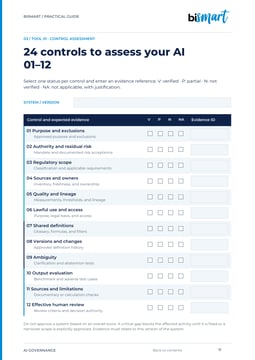
Assess an agent your business already uses with the guide’s 24-control checklist. Record supporting evidence, identify gaps, and assign improvements to the right teams using the fillable tools in Bismart’s Practical Guide: AI Governance:
|
|
Start by assessing one
|
How to Monitor and Govern AI Agents in Production?
An approved agent’s behavior can change when its model, instructions, data sources, or connected tools are updated. AI agent oversight should identify these changes and determine whether existing permissions, tests, and approvals are still appropriate.
1. Review Changes Before Expanding Autonomy
Significant changes should trigger a reassessment of the tests and approvals they affect.
For example, making an employee assistant available to customers changes its operating context. The organization must review what information it can disclose, how it communicates its limitations, and what oversight it needs.
Approval for one use should not automatically extend to another.
2. Track Metrics That Trigger Action
AI agent governance metrics should help teams detect problems and decide when to intervene. Useful measures include:
- The proportion of active agents with a named owner and reviewed permissions.
- The proportion of actions requiring approval that were executed with valid approval.
- The proportion of sampled outputs that lack sufficient supporting evidence.
- The time required to revoke access.
- The number of unresolved incidents and complaints.
Each metric needs a defined measurement period, calculation method, owner, and criteria for action. These are suggested management measures, not universal thresholds or a score that can independently justify deployment.
3. Train the People Who Use and Oversee Agents
AI literacy should reflect each person’s responsibilities. Users need to recognize an agent’s limitations. People who approve actions need to understand their consequences. Technical teams need to test whether the controls work as intended.
Training should use the agents, tools, and situations each team encounters in practice, including when to question a result, reject a proposed action, or escalate a problem.
4. Plan for Shutdown, Recovery and Agent Retirement
Organizations need to define how they will suspend an agent, restore its service safely, or retire it.
Stopping an agent does not undo actions it has already taken. Teams may need to correct records, resolve pending tasks, or intervene in the underlying business process.
Retiring a system should include revoking access, documenting the decision, and managing data and evidence in accordance with applicable retention requirements.
AI Agent Governance in Practice: A CRM Example
A sales agent can review customer information, prepare an offer, and record the outcome in a CRM. Governing that agent requires clear conditions for each operation and checks that connected tools enforce them.
| Operation | Control to verify |
|---|---|
| Access a customer record | Access is limited to approved customers and data fields. |
| Prepare an offer | The agent uses current prices and approved commercial terms. |
| Apply an exceptional discount | A person with the appropriate authority approves the discount. |
| Send the offer | The content and recipient match what was approved. |
| Update the CRM | Permissions cover only the required fields, and the change is logged. |
| Stop the agent | Further operations are blocked, and pending tasks are reviewed. |
Approval should apply to the specific operation. If the price, recipient, or terms change after review, the system must check whether renewed approval is required.
This makes governance testable: can the agent send an offer without approval? Can it change a restricted field? What happens to pending tasks when its access is revoked?
Conclusion: How to Get Started with AI Agent Governance?
Start with one agent and one business process. Identify who is accountable, which information the agent uses, which tools it can access, and what actions it can take.
Then check that its permissions match the approved scope, that actions requiring approval cannot proceed without it, and that you can reconstruct what happened. Turn any gaps into improvement actions with named owners and deadlines.
Assess Your First Use Case with Bismart’s Practical Guide
Governance in the Age of AI gives business, data, and technology teams practical tools to assess a use case and plan improvements:
- A 24-control checklist to assess governance.
- Six practical tests to check whether controls work as intended.
- Fillable templates to document evidence, approvals, and improvement actions.
- A 90-day action plan to organize the work and assign responsibilities.