RAG can be part of a Company Brain. Compare their scope, shared knowledge and governance, and learn what to assess before investing in business AI.
What does an artificial intelligence solution need to answer a business question reliably?
Access to documents is a starting point. Many decisions also require information from different departments, a way to identify the current version and checks on which data each user is allowed to access. These requirements determine the scope of the solution and the work needed to maintain it.
Two concepts are relevant here: RAG (retrieval-augmented generation) and Company Brain.
RAG grounds AI responses in information retrieved from sources outside the model. Company Brain describes a shared enterprise knowledge capability, with agreed sources, definitions and responsibilities.
Both can be part of the same design. The distinction becomes clearer when preparing a contract renewal: finding a clause, checking it against commercial policy and authorising new terms are different tasks with different requirements.
Using this example, this article explains the difference between RAG and Company Brain, when a focused solution may be enough and what business leaders should expect a proposal to demonstrate before investing in AI.
What Is the Difference Between RAG and Company Brain?
How they fit into the same AI solution
Retrieval-augmented generation (RAG) is an AI technique that retrieves information from external sources and provides it to a model to support more accurate, contextually relevant responses.
Company Brain is an approach to organising, connecting and managing enterprise knowledge so that different AI applications and agents can access and use it.
The main difference is that RAG is a technique for retrieving information and generating responses, while Company Brain describes an enterprise knowledge architecture. The two are complementary: a Company Brain solution can use RAG to retrieve enterprise knowledge and answer questions based on company information.
To understand how they work together, consider a company that wants to use AI to manage customer contract renewals.
If an employee asks, “What renewal terms does this contract specify?”, a RAG system can find the relevant clauses and generate an answer based on them, including references to the original document.
If an AI agent is intended to manage the wider renewal process, it will also need information from other sources: the contractual terms, current commercial policies, the customer’s history and the applicable business rules.
A Company Brain approach would organise that knowledge and make it available to the agent, which could use RAG to retrieve the information it needs.
The choice depends on the scope of the solution. RAG may be sufficient for questions about specific documentation. When different AI applications and agents need to share knowledge across departments, it may be useful to consider a Company Brain architecture.
In either case, sources need to be reliable and current, and access permissions must be managed. Company Brain is not a universal technical standard, so its scope and capabilities depend on how each solution is designed and implemented.
Generative AI produces the responses. Their reliability depends on the information available and on how that information is retrieved and managed.

What Business Problems Can RAG Address?
Accessing Enterprise Knowledge and Getting Answers Based on Data
RAG allows businesses to query information held in documents, knowledge bases and other enterprise sources using natural-language questions. Its main purpose is to make relevant information easier to access without manually searching through multiple files or applications.
Business applications include searching internal documentation, consulting policies and procedures, supporting employees and retrieving technical or commercial information.
For example, a RAG assistant can help a customer service team find the terms of a service or allow an employee to check an internal procedure without reviewing several documents.
The system retrieves information from connected sources and provides it to the AI model as context for a response. This process, covered in the article on how RAG works, makes it possible to use information beyond the model’s training data.
RAG does not, by itself, guarantee that retrieved information is correct, current or available only to authorised users. Reliability depends on source quality, version management, updates and access permissions. Like any enterprise AI solution, RAG needs to be supported by data governance and AI governance to protect the reliability, security and traceability of the information used.
Not All RAG Systems Deliver the Same Quality
Connecting documents to an AI model is not enough to produce reliable answers. A system can generate a convincing explanation from an incomplete passage, an outdated version or information that mentions the subject of the question without providing what is needed to answer it.
Consider the question, “Can the price of this contract be revised?” The system might find a clause allowing an annual price adjustment, while an addendum establishes an exception for that customer. If it retrieves only the general clause, the answer may omit a decisive condition, even if it accurately reflects the passage found.
The quality of a RAG solution therefore depends on both answer generation and its ability to find and select the necessary information while preserving its context. Three techniques help improve this process:
| Technique | What does it contribute? | Application to the example |
|---|---|---|
| Hybrid search | Combines meaning-based retrieval with searches for relevant terms, names and codes. | Connects “price review” with “rate adjustment” while locating references to the specific contract. |
| Reranking | Reassesses the retrieved passages and prioritises those most relevant to the question. | Helps select the applicable renewal terms over other passages that also mention prices. |
| Context-enriched chunks | Retain the source document, section, version and information needed to interpret each passage. | Identify a condition as part of that contract’s exceptions addendum and clarify which clause it affects. |
How Does Bismart Apply These Techniques in Its RAG Solutions?
Bismart’s RAG solutions incorporate hybrid search, reranking and context-enriched chunks to improve information retrieval and selection before generating an answer.
Hybrid search combines meaning and relevant terms to find the documentation. Reranking reassesses the passages found and prioritises those most pertinent to the question. Context-enriched chunks retain information about their source and the content they belong to, making them easier to interpret.
In the contract renewal example, these techniques help locate the contractual terms and any exceptions, select relevant passages and retain the references needed to review the answer. The aim is to give the AI sufficient, relevant information to answer the question, rather than simply produce a convincing explanation.
Evaluation should test this behaviour with real business questions, including incomplete documents, outdated versions and conflicting sources. Incorporating these techniques improves the solution’s design; their effectiveness needs to be verified for each use case. Data governance, access controls and AI governance remain necessary alongside the retrieval mechanisms.
For a documented business application, Bismart’s intelligent RAG search engine case study presents the objective, strategy and outcomes of a project supporting the management of court notifications.

What Is a Company Brain Intended to Provide?
A Shared Knowledge Foundation for AI Applications and Agents
The aim of Company Brain is to allow different AI applications and agents to use enterprise knowledge consistently, securely and with current information, reducing the risk of each solution working with isolated, duplicated or conflicting sources.
For example, if sales, finance and customer service use the same commercial policy, their AI assistants should be able to consult the current version. When each application keeps a separate copy, a policy change can lead to inconsistent answers.
This requires agreement on which information sources are authoritative, who is responsible for maintaining them and how updates are managed. The same applies to business definitions of metrics and key performance indicators (KPIs): applications using a measure such as customer margin need shared rules for its meaning and calculation to avoid conflicting interpretations.
This does not mean that all information must be stored in one system. Documents and data can remain on different platforms, provided AI applications can access the appropriate sources under shared quality, security and governance criteria.
Context engineering helps select and organise the information each AI application or agent needs for a task. The purpose is to identify the knowledge relevant to each situation rather than supply all available documentation.
Building this foundation also requires enterprise data preparation: integrating the necessary sources, checking their quality and defining how they are governed before extending their use across AI applications.
RAG vs Company Brain: What Is Being Compared?
Differences in Scope, Operation and Business Application
RAG and Company Brain can be part of the same solution, but they address different needs. The table summarises their main differences and the factors a business should assess before implementing either approach.
| Aspect | RAG | Company Brain |
|---|---|---|
| Main purpose | Retrieve relevant information to generate grounded answers. | Organise and share enterprise knowledge across AI applications and agents. |
| Approach | An information retrieval technique combined with generative AI. | An approach to enterprise knowledge architecture and management. |
| Scope | Can use one or multiple sources and support different processes. | Can span different departments, systems and applications. |
| Information management | Requires reliable, current sources that are accessible under agreed permissions. | Requires authoritative sources, responsibilities, shared criteria and update mechanisms. |
| Common applications | Intelligent search, document assistants and information query systems. | Ecosystems of AI assistants and agents that need to share enterprise knowledge. |
| Relationship | Can operate independently or as part of a Company Brain. | Can incorporate RAG as an information retrieval mechanism. |
Example of RAG Within an Enterprise Knowledge Architecture
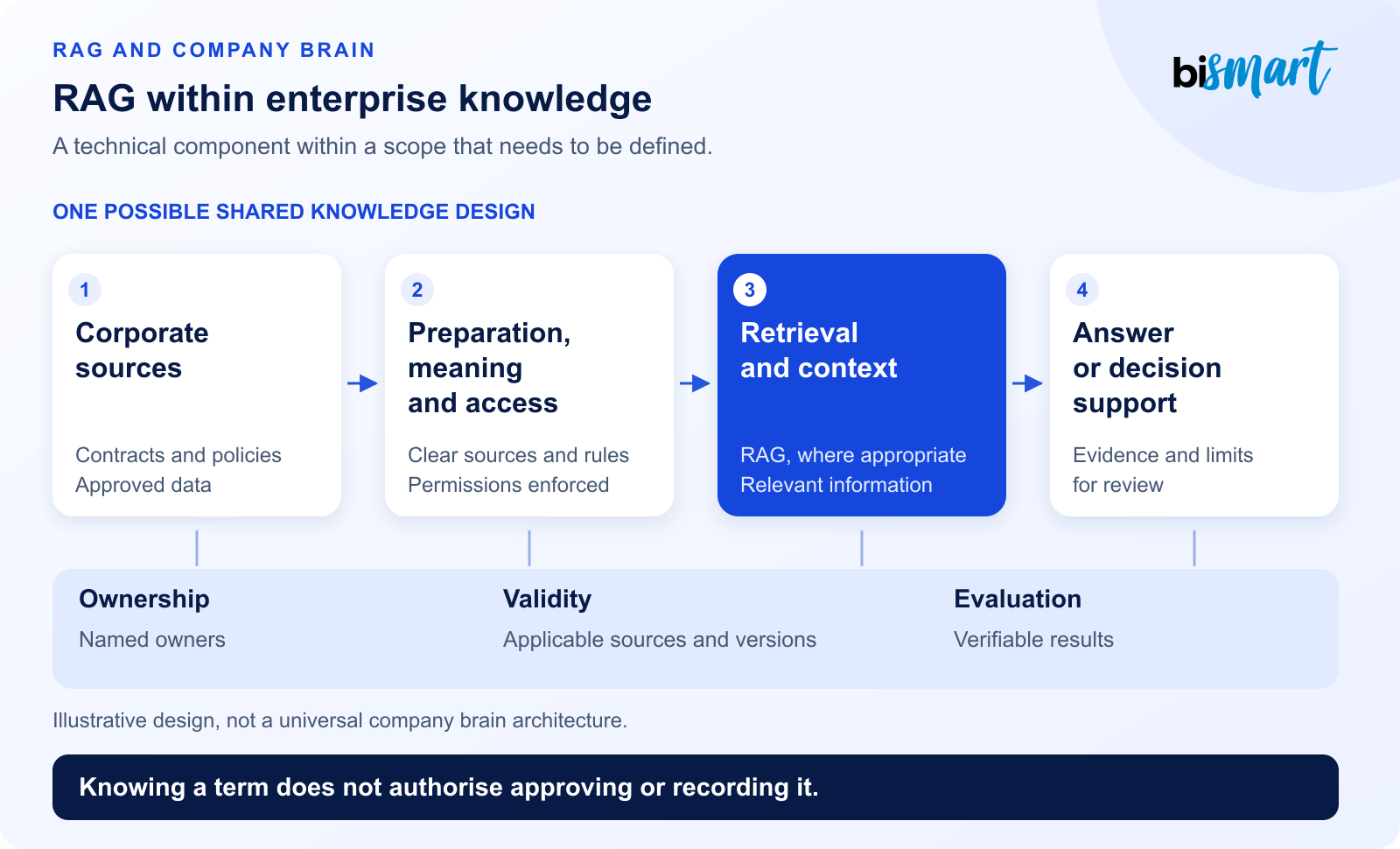
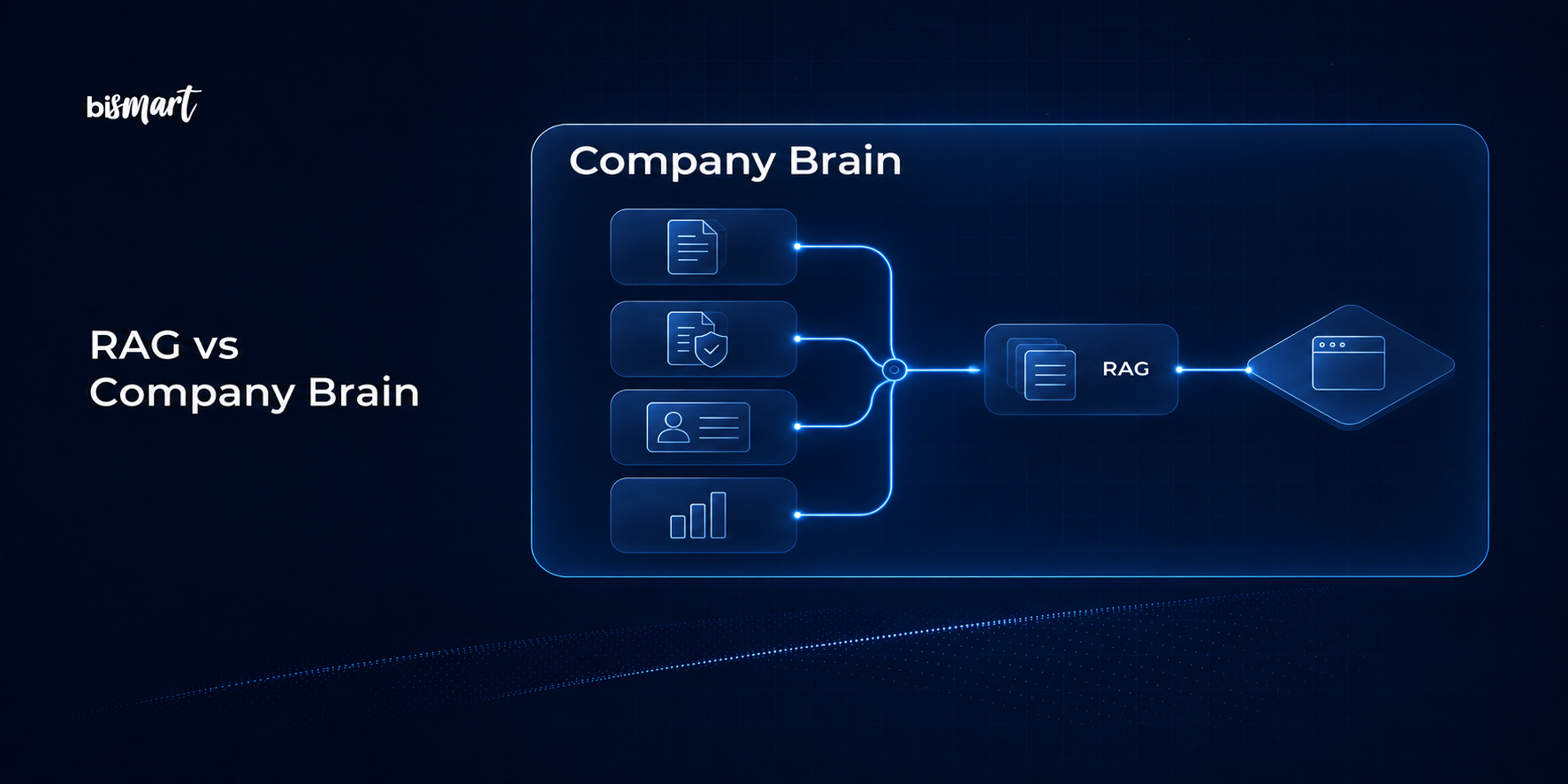
The diagram shows how RAG can operate within a shared knowledge environment: enterprise sources are prepared and managed so that AI applications can retrieve relevant information and use it in responses or to support decisions. It illustrates one possible design, not a universal Company Brain architecture.
Practical Example: Using RAG and Company Brain for a Contract Renewal
Consider a company using AI to prepare a customer’s contract renewal. It needs to consult the current contract, check commercial policies and review relevant customer data before producing a proposal for an authorised person to validate.
1. Use RAG to Check the Contract Terms
The first task addresses a specific question: “What does the contract say about price reviews?”
A RAG solution can find the relevant clause, retrieve its content and generate an answer with references to the original document. This makes it possible to check contractual information without manually reading the entire document, provided the system can access the correct version.
2. Use Company Brain to Combine Business Information
The next question requires a broader context: “What terms can we offer this customer for the renewal?”
To answer, the AI needs to combine the contractual clauses with current commercial policies, customer data and the applicable business definitions.
A Company Brain architecture organises these sources and business rules for reuse across different AI applications and agents, which can use RAG to retrieve the information they need.
For example, if the proposal depends on the customer’s commercial margin, the system needs to use an approved, consistent definition of that measure. If sources disagree, it should identify the discrepancy rather than generate a recommendation based on conflicting information.
3. Validate and Approve the Renewal Proposal
Once the information has been gathered, the AI can produce a renewal proposal showing the recommended terms, supporting sources and any unresolved issues.
Access to enterprise knowledge does not confer authority to make decisions or execute actions. Approving the terms and recording them in enterprise systems must follow the company’s established procedures and controls.
RAG and Company Brain therefore play complementary roles. RAG retrieves relevant information to support grounded responses, while Company Brain helps organise and share enterprise knowledge across AI applications and agents.
Both require governance mechanisms to support reliable information and maintain control over AI decisions and actions.
When Is RAG Enough, and When Should a Business Consider Company Brain?
Three Scenarios for Choosing an Appropriate Approach
1. A specific need with well-defined sources. If the goal is to check clauses across a set of contracts or answer questions about internal documentation, a RAG solution may be sufficient. There is no need to connect all company information from the outset. The sources used do need to be reliable, current and subject to appropriate access permissions.
2. Several processes or departments share knowledge. If sales, customer service and finance need the same policies, data and business definitions, a Company Brain approach may be appropriate. It provides a basis for coordinating enterprise knowledge management and reuse across AI applications and agents, helping to avoid duplication and inconsistencies.
3. Information is fragmented, conflicting or lacks clear ownership. When there are multiple versions of a policy, inconsistent data or unclear business definitions, improving information quality and governance takes priority over expanding AI access. The article on preparing data for AI explains the integration, quality and governance work needed to establish a reliable information foundation.
There is no mandatory progression from RAG to Company Brain. The choice depends on business needs, the number of applications that need to share knowledge and the organisation’s data maturity.
An organisation can start with RAG for a specific use case and expand its knowledge architecture as business needs justify the investment.
What Should a RAG or Company Brain Solution Demonstrate Before Investment?
Testing, Responsibilities and Maintenance Costs
Before investing in RAG or Company Brain, a business should verify that the solution addresses real business needs, uses reliable information and meets the agreed security and governance requirements.
A demonstration with apparently correct answers is not enough. Evaluation should cover routine situations, changes to information and potential incidents.
A proof of concept (PoC) should use representative use cases and acceptance criteria agreed in advance.
| Test scenario | What the solution should demonstrate | Purpose |
|---|---|---|
| Information updates | Uses the current version of a document or data item within the agreed time. | Verify that updates are reflected correctly. |
| Conflicting information | Identifies discrepancies between sources and applies approved rules or requests a review. | Avoid answers based on inconsistent information. |
| Access control | Prevents unauthorised users from retrieving restricted information. | Protect data security and confidentiality. |
| Incomplete information | Recognises when data is missing or there are insufficient sources to answer. | Reduce the risk of fabricated or unsupported answers. |
| Business definitions | Uses the organisation’s approved metrics and calculation rules. | Support consistent answers across departments. |
| Answer traceability | Allows the sources used to generate an answer to be identified and checked. | Support review and validation of the results. |
Business owners and technical teams should evaluate the solution together, agreeing which results are acceptable and which situations require human intervention.
Responsibilities also need to be assigned for maintaining sources, monitoring the solution and managing incidents.
Another key factor is the total cost of ownership (TCO). Investment extends beyond initial development and integration to include maintaining connections, updating information, managing permissions and ongoing oversight. A proposal should specify which services are included and which will incur additional costs.
Success criteria need to reflect the use case. There is no universal accuracy percentage that establishes the reliability of every RAG or Company Brain system.
A decision to implement or expand the solution should be based on verifiable results, acceptable risks and concrete business benefits.
Conclusion: Choose RAG and Company Brain According to Business Needs
The choice between RAG and Company Brain depends on the problem the business needs to solve, rather than which approach appears more advanced. Information retrieval may be sufficient for some tasks. Others require knowledge to be organised and shared across different AI applications and agents.
Both require reliable information, clear responsibilities and appropriate controls. Before investing, the business needs to identify which processes it intends to improve, which sources are needed and which decisions or actions the AI will be allowed to support or perform.
The value lies in the solution’s ability to address specific business needs reliably, securely and at an appropriate scale.
At Bismart, we help organisations prepare their data, integrate their systems and develop business AI solutions aligned with their objectives.