
Discover how to prepare your organization’s data for Agentic AI through governance, quality and Microsoft Fabric. Build a foundation for intelligent automation.
In recent months, the debate around artificial intelligence has taken a decisive turn. The conversation is no longer just about models that generate text or images, but about systems capable of acting autonomously, planning and making decisions independently.
This is the rise of Agentic AI, a new stage in which intelligent agents become active collaborators within organizations.
This revolution is set to redefine business intelligence and how companies manage information, automate decisions, and scale their analytical capabilities.
However, the promise of Agentic AI comes with prerequisites. Behind every successful agent lies a governed, secure, and reliable data foundation. The real frontier of Agentic AI is not algorithmic — it’s infrastructural.
"The adoption of agentic AI starts long before algorithms: it starts with data."
Agentic AI: From Assistant to Decision-Maker
Agentic AI is the natural evolution of generative AI. While traditional models wait for explicit instructions, intelligent agents understand goals, plan actions and make decisions based on contextual information.
Technology companies such as Microsoft, OpenAI and Anthropic are already experimenting with agents capable of executing complete workflows or coordinating interactions between systems.
For example, the London Stock Exchange Group has begun exploring this approach with Anthropic to integrate agents that analyze financial data in real time and make automated decisions in regulated environments.
Yet for an agent to operate reliably, it needs a prepared environment: accessible, structured, and governed data, a flexible architecture, and a security model capable of ensuring compliance.
That’s where the real enterprise challenge begins.
The raw material: reliable and governed data
No agent can function without a solid data foundation. Agentic AI is not powered by prompts, but by interconnected data ecosystems. For a company to implement this type of system, it must have information that meets three conditions: quality, traceability and context.
In other words, the data must be clean, up-to-date and correctly cataloged. This requires well-defined governance policies, a metadata catalog that makes it possible to locate and understand each set of data, and access control mechanisms that prevent leakage or duplication.
This is not just a technical requirement. In practice, data governance becomes the ethical and operational framework that makes it possible for AI to function reliably and securely. In a context where automated decisions can have legal, financial or social impact, this governance is not a luxury, but a necessity.
In this sense, more and more organizations are smartly betting on the implementation of governance frameworks that ensure the quality, traceability and consistency of data throughout its lifecycle.
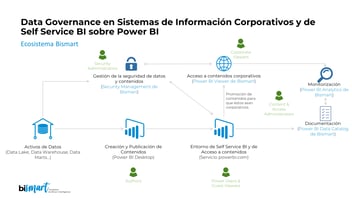
In environments such as Power BI, where information supports critical decisions, it is essential to have mechanisms that offer real visibility of the ecosystem, access control and functional documentation of content to ensure reliability and compliance.
At Bismart, we have developed Governance for Power BI with a very specific purpose: to bring order and control to the entire Power BI environment.
The solution centralizes and organizes metadata (datasets, reports, tables, columns and measures), automatically documents datasets and dataflows with business descriptions, and monitors usage activity without limits of time, users or workspaces.

Governance for Power BI Datasheet
Governance for Power BI provides a comprehensive governance framework that allows organizations to audit, document, and control the use of reports and datasets.
It automatically documents datasets, ensuring an orderly and secure Power BI environment.
In an increasingly automated environment, having tools that reinforce the transparency and integrity of data consumption is a critical step in preparing enterprises for agentic AI.
Microsoft Fabric and the New Paradigm of Data Infrastructure
Modern data platforms are evolving precisely to meet these new demands. Microsoft Fabric is one of the most significant examples of how infrastructure is adapting to the agentic paradigm.
In recent months, Microsoft has introduced new integrated governance capabilities, public APIs for data domains, and improvements in data lineage and interoperability with Pureview.
These capabilities make Microsoft Fabric a key tool for preparing data for agentic AI, ensuring that every system can access governed and trusted information.
This kind of integration between architecture, governance and automation is the missing piece in moving from theory to practice. It is no longer a matter of connecting tools, but of building a platform capable of understanding the business and acting on it.
The paradigm shift is profound: from dashboards that describe the past, to intelligent agents that anticipate the future.
At Bismart, we have been working for years with data architectures that facilitate this type of transformation. In addition to being experts in ad-hoc data integrations for each use case and business environment, we have developed an integration framework so that companies can optimize their processes in a fast, simple and organized way.
Data Integration Framework automates and orchestrates data integration processes, ensuring data quality and consistency from source to target. This technical foundation enables systems - and future intelligent agents - to access reliable and up-to-date information to generate real business value.
Your Data Architecture Ready for Artificial Intelligence

Data Integration Framework
Data Integration Framework automates extraction, transformation, and loading (ETL) processes, guaranteeing quality and consistency throughout the data lifecycle.
Use Cases: From Analysis to Autonomous Behavior
In corporate environments, Agentic AI can take many forms — from agents that monitor profitability in real time and adjust budgets automatically, to systems that coordinate supply chains or personalize marketing campaigns with unprecedented autonomy.
Companies experimenting with these technologies are discovering that value lies not in the algorithm itself, but in connecting intelligence with action.
An agent that analyzes data but can’t act on it is just an observer. An agent with access to reliable information and operational systems becomes a true decision-maker.
Reaching this level of maturity, however, requires more than technology.
It demands a cultural shift: moving from data as a resource to data as the corporate nervous system. Only then can agents learn, collaborate, and evolve alongside the organization.
In this process, semantic coherence is as important as data quality. At Bismart, we developed the Indicators & Dimensions Definition Tool to help organizations define and document indicators and dimensions in a centralized way.
This semantic standardization ensures that teams —and AI agents — interpret information consistently, reducing ambiguity and enabling a shared understanding of the business.
How to Prepare Your Company for the Adoption of Agentic AI
The adoption of Agentic AI cannot be improvised. It requires vision, investment, and a coherent data strategy.
Companies looking to advance in this direction should begin by auditing data quality, reinforcing governance, and adopting open, scalable architectures.
The second step is to introduce automation gradually, integrating AI agents into areas where they can deliver tangible value, such as customer service, operations, finance, or risk management.
Finally, new frameworks for responsibility and transparency must be established.
As agents make increasingly complex decisions, traceability and human oversight will become critical factors for maintaining trust.
A New Horizon for Business Intelligence
Agentic AI will not replace business intelligence: it will extend it. Dashboards will continue to exist, but it will be the agents who query, interpret and act on them.
Platforms such as Microsoft Fabric will consolidate as the infrastructure layer that links data to action, and governance will become the guarantor of a sustainable ecosystem.
The real change will not be technological, but conceptual. The enterprise will stop asking questions of data and start conversing with it. And in that conversation, the agents will be the new knowledge interlocutors.
Do you want to talk to your data in your language? It's already possible! With AI Query.

Prepare for the Era of Agentic AI
The new generation of business intelligence won’t just analyze information, it will act on it. Organizations that understand this shift early —and prepare their data, platforms, and culture— will lead the next decade.
Agentic AI represents a turning point: an intelligence that understands context, collaborates with people, and turns data into action.
But getting there requires more than technology. It means structuring, governing, and understanding data strategically; building infrastructures that support autonomous decision-making; and fostering a culture of trust and transparency.
Companies that invest in data quality, governance, and integrated platforms today will be ready to deploy intelligent agents that act with context and purpose.
Those that don’t will keep looking back while the future automates itself before their eyes.
At Bismart, we believe preparation for Agentic AI starts today — with every well-defined dataset, every controlled data flow, and every decision that transforms information into real business value.