Discover what OpenAI Prompt Packs are and how they can boost your company's productivity. Learn how to implement them step by step with a practical guide.
While practically everyone already knows and uses ChatGPT, many people complain that ChatGPT and other generative artificial intelligence engines don’t meet their expectations.
According to AI experts, the issue doesn’t lie in the technology itself, but in the quality of the instructions we give to the AI — the so-called prompts. ChatGPT, like any other generative AI model, can only deliver good results if we clearly explain what we want. The clearer, more detailed, and more contextualized a prompt is, the more useful the response will be.
In this article, you’ll discover what Prompt Packs are, how they work, and how they can help boost your company’s productivity. You’ll also find a free downloadable template that you can use to adapt and build your own internal prompt library without needing technical expertise.
The importance of a good prompt is such that the rise of generative AI has led to the emergence of a new professional role: the prompt engineer, dedicated to crafting highly efficient prompts to achieve optimal AI results.
This phenomenon raises an obvious issue: if truly benefiting from AI requires knowing how to design complex prompts, then the promise of an accessible, easy-to-use artificial intelligence for everyone is broken. Not everyone has the time or knowledge to learn how to create advanced prompts.
OpenAI has decided to solve this problem with the launch of Prompt Packs — curated collections of pre-built prompts organized by role and industry, designed so that any professional — whether in sales, HR, product, IT, the public sector, or education — can start working effectively with generative AI without a learning curve.
What Exactly Are “Prompt Packs”?
Prompt Packs are a new resource launched by OpenAI to help companies and professionals adopt generative AI quickly and in a standardized way.
A prompt is the instruction or message we write to tell a generative AI engine —such as ChatGPT— what we want it to do: write a report, create a market analysis, build a sales plan, or generate technical documentation.
Until now, each user had to learn how to craft good prompts on their own — something time-consuming that often leads to inconsistent results.
With the new Prompt Packs, OpenAI offers curated collections of pre-designed and tested prompts that can be copied, customized, and used directly in ChatGPT.
The Prompt Packs —now available through OpenAI Academy— are organized by business function and industry to cover specific use cases:
- Corporate roles: human resources, marketing, sales, product, engineering, IT, executive management…
- Specific industries: government, K–12 education, higher education, among others.
Each pack includes:
- Ready-to-use prompts you can copy, paste, and adapt to your own context.
- Best practices and safeguards on privacy, legal review, and quality control, ensuring outputs are professional drafts ready for validation — not unsupervised text.
- Implementation recommendations for business teams.
Using Prompt Packs Isn’t as Simple as It Seems
Although Prompt Packs are designed to simplify AI adoption in organizations, their real impact depends on how they are planned and managed.
Without a clear strategy — which packs to choose, how to personalize them, and how to integrate them into workflows — they can easily become unused collections that fail to deliver the expected value.
Key idea for enterprises: Prompt Packs allow you to industrialize the use of ChatGPT without having to train the whole team in prompts engineering.
You can easily integrate them into your internal hub (Teams, Confluence, SharePoint...) and guarantee consistency and quality from day one, without long projects or complex learning curve.
Why OpenAI launches Prompt Packs (and why you should adopt them now)
OpenAI has been strengthening enterprise-level prompt management for months with versionable prompt objects, templates and API reuse, so teams can work with stable and measurable prompts instead of "random copy-paste".
The Prompt Packs are the latest bet on this philosophy: less improvisation, more system.
In parallel, its official documentation promotes prompts generation/optimization techniques (meta-prompts, formats by output type, etc.) that are already appearing in Playground and training materials so that anyone can use Generative AI, not only experts.
Benefits of using Prompt Packs for companies:
- Speed in repetitive tasks (briefings, comparatives, executive summaries).
- Consistency across teams (same analysis template, same tone).
- Reduced risk of errors and omissions (checklists and safeguards).
- Accelerated onboarding for non-technical users.
What Prompt Packs are Available for Enterprises?
OpenAI Academy has recently launched a library of Prompt Packs that classifies collections of prompts by corporate role and by industry, making it easier for organizations to adopt generative AI without having to design prompts from scratch.
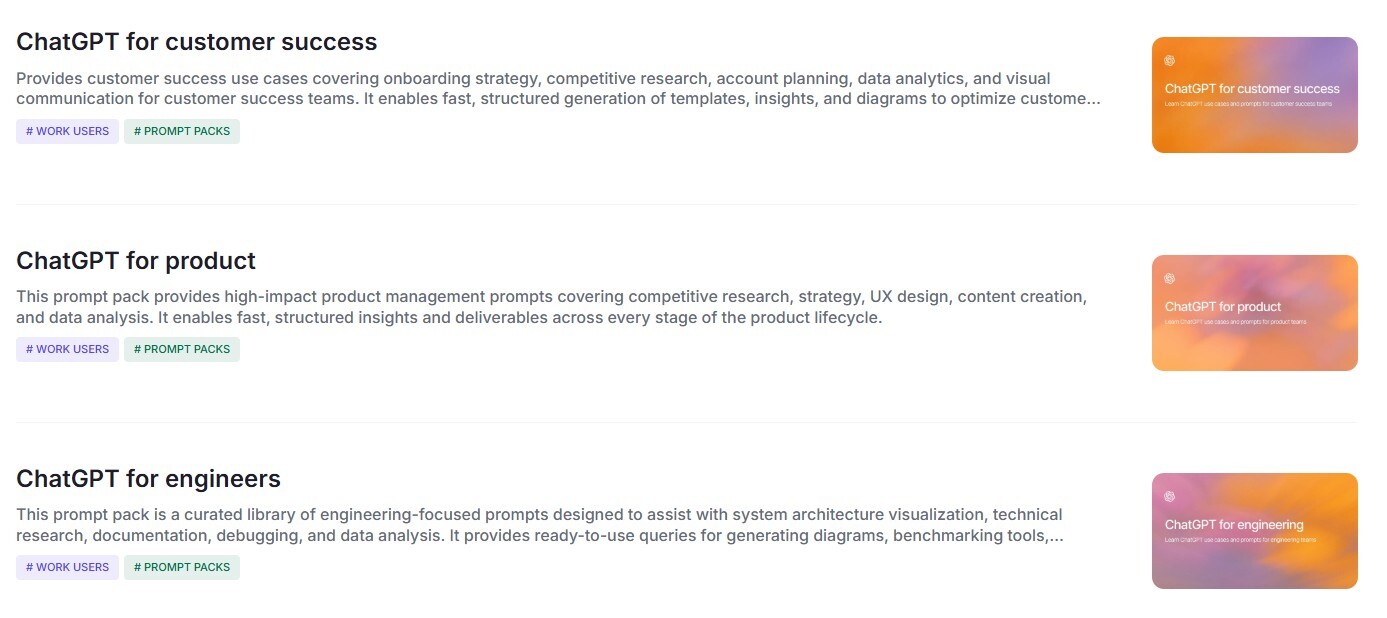
Some examples relevant to the enterprise environment include:
- Sales: Prompts to streamline prospecting, sales strategy, competitive analysis, customer intelligence and creation of sales materials.
- Product: High-impact prompts for competitive research, product strategy, UX design, content creation and data analysis.
- Marketing: Prompts for campaign planning, competitor research, creative development, performance analysis and data-driven brand building.
- IT: Key use cases for technical support, critical incident resolution, documentation and troubleshooting scripting.
- Managers: Prompts designed to support team leaders in setting strategic objectives, analyzing performance, communicating effectively and strengthening organizational culture.
- Executives: Prompts for leaders who need to accelerate research, market analysis, decision making and strategic communication.
- Customer Success & Support: Prompts that help document tickets, generate standardized responses and extract insights from the customer experience.
- Human Resources (HR): Prompts for recruitment, inclusive job description writing, internal communication and compliance policies.
Key advice for companies
No need to reinvent the wheel: start with the Prompt Pack that most closely matches your function (Sales, Marketing, IT, HR, Product...) and adapt it to your processes, internal data and brand tone.
You can explore the complete collection directly on OpenAI Academy.
How to Start Using Prompt Packs: A step-by-step guide to implementing Prompt Packs in your organization
Step 1 - Select the pack closest to your role
Start with the role that has the most pain. For example, HR if there is pressure to hire. HR if there's pressure to hire or improve engagement; Sales if you need to speed up sequences and story lines; IT if you want to alleviate tickets or generate documentation faster.
Step 2 - Locate 5-10 repetitive tasks
Convene 2-3 area leaders and ask them to identify frequent tasks (e.g. "bid summary", "quarterly competitor benchmarking", "internal policy writing"). Cross-reference these tasks with pack prompts and prioritize by impact (time savings × frequency × risk).
Step 3 - Customize prompts with your data and formats
Prompt Packs usually come with instructions on how to customize the content (replace brackets, attach datasets, etc.). Create 2-3 templates per task with: context, tone, quality criteria, validation checklist and output format (e.g., table + short narrative).
Step 4 - Define "safeguards" and responsibilities
Include a clear human review step (who reviews, what validates) and privacy/confidentiality rules (what data should not be pasted into ChatGPT, what sources you should use). This is explicitly recommended in public sector packs.
Step 5 - Publish an "internal library" and measure adoption
Centralize your corporate Prompt Packs in the internal repository (SharePoint/Confluence/Teams). Version and measure: number of uses, satisfaction, time saved, rework rate.
Use cases by area (with example prompts ready to be adapted)
Note: Below you will see sample prompts inspired by the logic of the OpenAI Prompt Packs; adapt them to your terminology, KPIs and internal sources. (Official Prompt Packs by role/sector are available at OpenAI Academy).
Sales (B2B)
- Discovery and prioritization
"Acts as a B2B sales analyst. Using information from [ideal customer profile], sort this list of accounts by potential and urgency. Returns a table with: company, need hypothesis, score 1-5, next steps." - Arguments and objections.
"Generate an 8-10 sentence script for a discovery call with [industry], emphasizing ROI on [key metric]. Add a 'frequent objections and response' section." - Meeting Summary
"Turn these meeting notes into 1) 120-word executive summary; 2) action by decision maker and date; 3) risks identified; 4) follow-up email in consultative tone."
Marketing
- Competitive Analysis
"Compare [3 competitors] on value proposition, pricing, key messages, and social proof. Deliver a table and a concluding paragraph with positioning opportunities." - AI-powered editorial calendar
"Generate 8 Top/Middle/Bottom funnel content ideas for [buyer persona], with main keyword, search intent and suggested CTA." - Landing Optimization
"Rewrite this hero to increase CTR: 1) value proposition in 1 sentence, 2) 3 benefit bullets, 3) button microcopy with realistic urgency."
PR. HH.
- Job description with reduced bias.
"Write a JD for [role] focused on skills. Add checklist of biases to avoid and objective evaluation criteria." - Internal communication.
"Write a clear and empathetic [policy/benefit] announcement, with FAQ and rollout timeline."
Product and UX
- Opportunity map
"Given this user feedback, group issues, estimate impact vs effort and propose 5 experiment hypotheses." - Interface design
"Propose 3 textual wireframes (structure, hierarchy, empty states) for [flow], with accessibility criteria."
IT and Support
- Runbooks and troubleshooting
"Create a standardized runbook for issue [X] with: symptoms, diagnosis, steps, commands and closure criteria." - Technical documentation
"Transform this ticket into 'how-to' documentation with sections: overview, prerequisites, numbered steps, validation, rollback."
Having a hard time finding IT talent?
Bismart finds it for you! Explore our Professional Services here.
Best practices to make your Prompt Packs work for real
1. Context and data
The best results come when the prompt includes context (who you are, who you are talking to, constraints and examples) and attached data (tables, PDFs, links). OpenAI documents the use of meta-prompts and formatting by output type (audio, structured, etc.).
2. Templates with variables
Standardize prompts with variables (e.g. [buyer_person], [KPI]), so that anyone in the team can fill them in without breaking the structure.
3. Checklists and "Do/Don't".
Include checklists: tone, verifiable facts, sources, confidentiality, human validation steps. In public sector packs, OpenAI emphasizes that outputs are drafts and require legal review/privacy.
4. Versioning and A/B testing
If you use API or Playground, take advantage of the versionable prompts and controlled testing that OpenAI promotes for teams.
5. Short training and "champions
Appoint 1-2 champions per area to maintain the pack, collect feedback and update it monthly.
Measuring Impact: 4 Metrics that Convince Management
-
Time saved per task (before/after, sample of 20 cases).
-
Rework rate (number of iterations to final version).
-
Consistency (compliance with templates, checklist and tone).
-
Adoption (active users/month, no. of internal prompts used).
With these four indicators you will be able to demonstrate ROI without complex implementations or long projects.
Practical tip: if your goal is to accelerate data-driven decisions, combine Prompt Packs with a solution oriented to data-driven business questions (e.g. prompts templates for customer, sales or profitability analysis) and with your semantic layer in BI. This way, ChatGPT produces consistent outputs and your analysts just validate and publish.
2 Week Roadmap
Week 1
- Day 1-2: Workshop to identify 8-12 tasks per area.
- Day 3-4: Selection of relevant official Prompt Packs (HR, Sales, IT) and first internal templates (3 per priority task).
- Day 5: Definition of safeguards (sensitive data, legal review, publication).
Week 2
- Day 6-7: Pilot test with 10 users (each executing 5 tasks).
- Day 8: Metrics collection (time, rework, satisfaction).
- Day 9: Adjustments and version 1.0 of the internal library.
- Day 10: Express training (30-45 min) + launch and CTA banner to training material/ebooks.
Risks and How to Mitigate Them
- Reliance on generic prompts → Mitigation: customize with KPIs, brand tone, internal policies and own examples.
- Sensitive data in prompts → Mitigation: clear rules on what not to share; use environments and plans compatible with your security requirements.
- Hallucinations or disputable facts → Mitigation: verification checklist (sources, figures, quotes); require executive summary + evidence.
- Misalignment with compliance → Mitigation: include in each template a "Compliance and review" section, as recommended by governance packs.
Conclusion
Prompt Packs is the fastest path from "playing with AI" to productizing high-impact use cases with consistency, governance and speed.
OpenAI already offers ready-made collections by role and industry - from Government to HR, Product to IT - with actionable examples. HR, Product or IT -with actionable examples and security recommendations. If you turn these into corporate templates and combine them with measurement, training and a partner to help you integrate them with your data, you'll be creating a tangible operational advantage within weeks.
Key sources to dig deeper
- Prompt Packs collection at OpenAI Academy (business and technical roles).
- Prompt management and versioning (OpenAI API): "long-life" prompts with universal team IDs.
- Prompt generation/optimization ( meta-prompts and best practices).