Fabric IQ introduces a new semantic layer in Microsoft Fabric that enables AI to interpret data with business context.
In the era of enterprise AI, many organizations are facing an uncomfortable reality: AI doesn’t truly understand their data.
Fabric IQ, the new semantic layer in Microsoft Fabric, addresses this challenge by structuring data through ontologies and knowledge graphs, enabling information to be interpreted with real business meaning.
This approach represents a fundamental shift: data is no longer treated as isolated elements, but as part of a knowledge model that connects entities, processes, and decisions across the organization.
In this article, we explore what Fabric IQ is in Microsoft Fabric, how its architecture based on ontologies and knowledge graphs works, and why it is becoming a strategic component in the age of AI.
Why Fabric IQ Will Be Key to Enterprise AI?
Fabric IQ will play a critical role in enterprise AI because it introduces a semantic context layer that allows AI to understand the meaning of data, not just process it.
Through ontologies and knowledge graphs in Microsoft Fabric, it connects data, processes, and business entities, enabling insights and decisions that are aligned with real business logic.
Data Alone Is Not Enough for Artificial Intelligence
The Role of Semantic Context in AI
The lack of a solid semantic foundation becomes a critical issue as organizations integrate artificial intelligence into their analytics and decision-making processes.
More and more companies are facing a new paradox:
AI Agents have access to data, yet they don't understand the business.
A Copilot or AI agent that can access data but lacks business semantics may generate immediate answers, but not necessarily reliable or business-aligned ones.
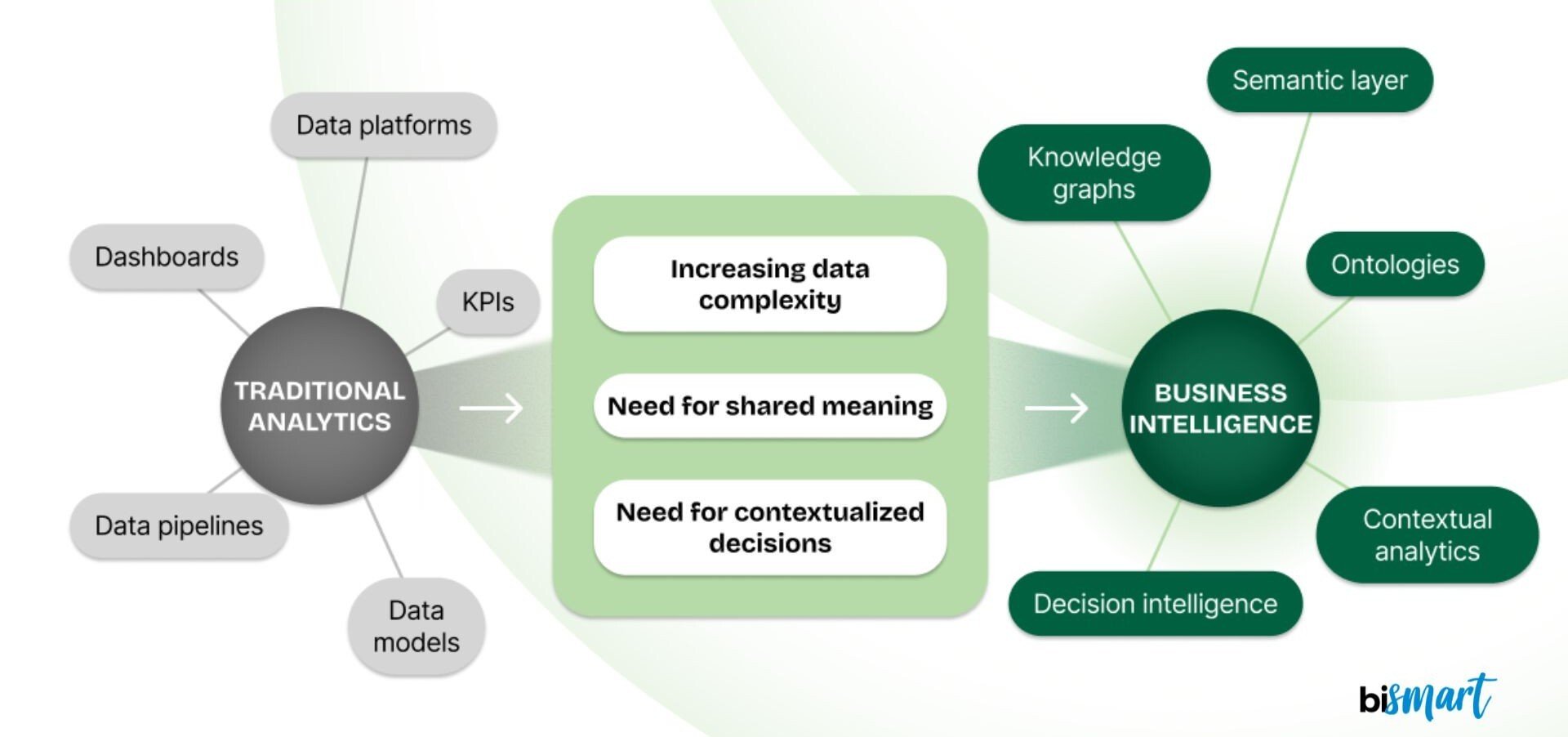
From traditional analytics to business intelligence: why organizations need semantic layers, knowledge graphs, and contextual decision-making.
At the same time, beyond AI, when there is no shared definition of key business concepts, each department develops its own analytical language.
Teams across finance, operations, marketing, or HR may use similar metrics or concepts that do not mean the same thing across the organization.
“What does this metric actually mean?”
“Why doesn’t it match what another team is seeing?”
“Where does this number come from?”
Ultimately, without a semantic layer, neither AI systems nor decision-makers can operate in alignment with the logic of the business.
Bridging this gap between data and meaning is precisely the purpose of Fabric IQ in Microsoft Fabric.
What Is Fabric IQ in Microsoft Fabric?
The Semantic Layer That Turns Data into Business Knowledge
Fabric IQ is the new semantic layer in Microsoft Fabric that organizes data according to the language of the business, enabling artificial intelligence to interpret it with context.
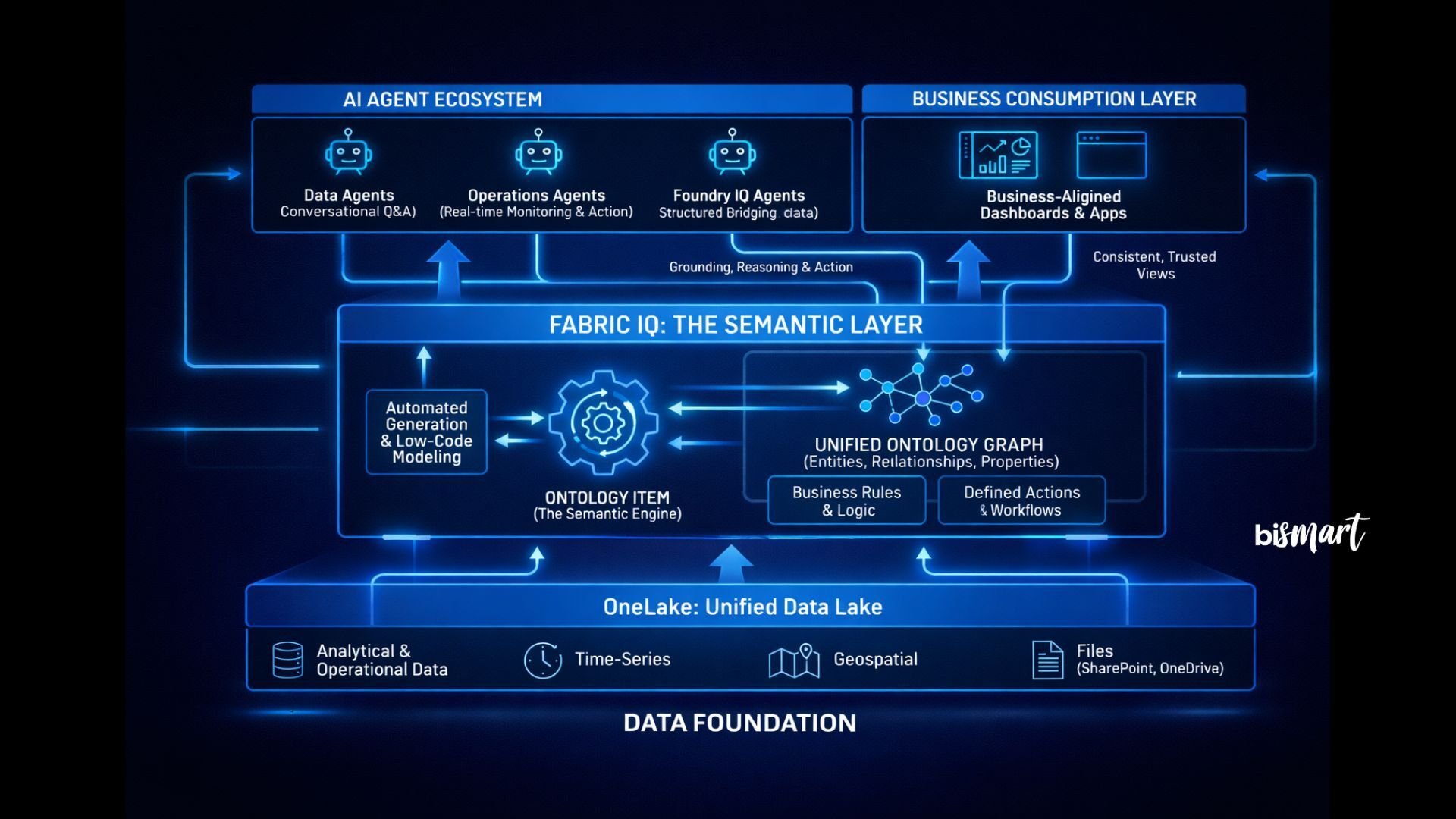
Fabric IQ architecture: a semantic layer that connects data, business knowledge, and AI agents within Microsoft Fabric
According to Microsoft’s official documentation, Fabric IQ unifies data stored in OneLake and structures it based on business semantics, making it accessible to analytics, applications, and AI agents with consistent meaning.
In practice, this represents a shift in approach. Data is no longer treated as isolated elements, but as part of a structured representation of business knowledge.
Concepts such as Customer, Product, or Order are no longer just technical tables. They become business entities connected within a governed semantic model.
As a result, information is no longer interpreted in isolation or within individual departments, but within the full context of the business.
In addition, this semantic layer integrates with real-time operational data in Microsoft Fabric, enabling a dynamic model of how the organization operates.
Each event —such as a new order, a logistics issue, or an inventory change— is incorporated into the model and can be evaluated based on its impact across the business.
On top of this foundation, AI agents and systems can generate more reliable, consistent, and explainable responses, aligned with the rules and relationships that structure the organization.
📘 If you want to go deeper into this approach, at Bismart we have prepared a strategic guide: “The New Layer of Business Intelligence: Fabric IQ, Ontologies, and Knowledge Graphs for Executive Decision-Making”
Ontologies and Knowledge Graphs: The Foundation of Fabric IQ
Fabric IQ is built on two key pillars: data ontologies and knowledge graphs. Together, they enable the creation of a semantic layer that connects data with the language of the business.
While ontologies define a shared business language, knowledge graphs represent the relationships between entities, processes, and events within the organization.
This approach is rooted in disciplines such as semantic intelligence and knowledge management, which have long been used in academic contexts but are now being brought into the enterprise mainstream through Microsoft Fabric and Fabric IQ.
Below, we explain both concepts in a simple way and their role in business intelligence.
Ontology: The Language of the Business
What Is a Data Ontology?
A data ontology is a formal model that defines key business concepts, their relationships, and the rules that structure their meaning within an organization.In other words, it is the mechanism that translates technical data into business semantics that can be understood by both people and AI systems.
A typical enterprise ontology includes three main elements:
- Business entities: Core concepts such as Customer, Product, Order, Supplier, Asset, or Employee
- Relationships between entities: For example, Customer places Order, Order contains Product, Product belongs to Category, Supplier provides Product
- Attributes and business rules: Properties and conditions that define how each entity behaves, such as order status, customer credit limits, or return policies
In practice, an ontology allows a system —or an AI agent— to understand that an “Order” is not just a table in a database, but a business concept connected to customers, products, inventory, margins, logistics issues, and service commitments.
In other words, an ontology establishes the conceptual framework that enables the entire organization to speak the same language when interpreting data:
- Creates a shared language across business, analytics, and technology
- Eliminates unnecessary debates about definitions
- Increases trust in data through a governed semantic framework
In addition, ontologies are essential for scaling advanced analytics and artificial intelligence, as automated systems require precise definitions to correctly interpret business context.
Knowledge Graphs: The Relationships Behind the Business
What Is an Enterprise Knowledge Graph?
A knowledge graph is the operational representation of an ontology within a data system.
While an ontology defines the meaning of business concepts, a knowledge graph represents the relationships between those concepts through a network of nodes (entities) and edges (relationships).
Fabric IQ includes a native graph engine (currently in preview) that allows organizations to store and query these connections directly on top of their enterprise data.
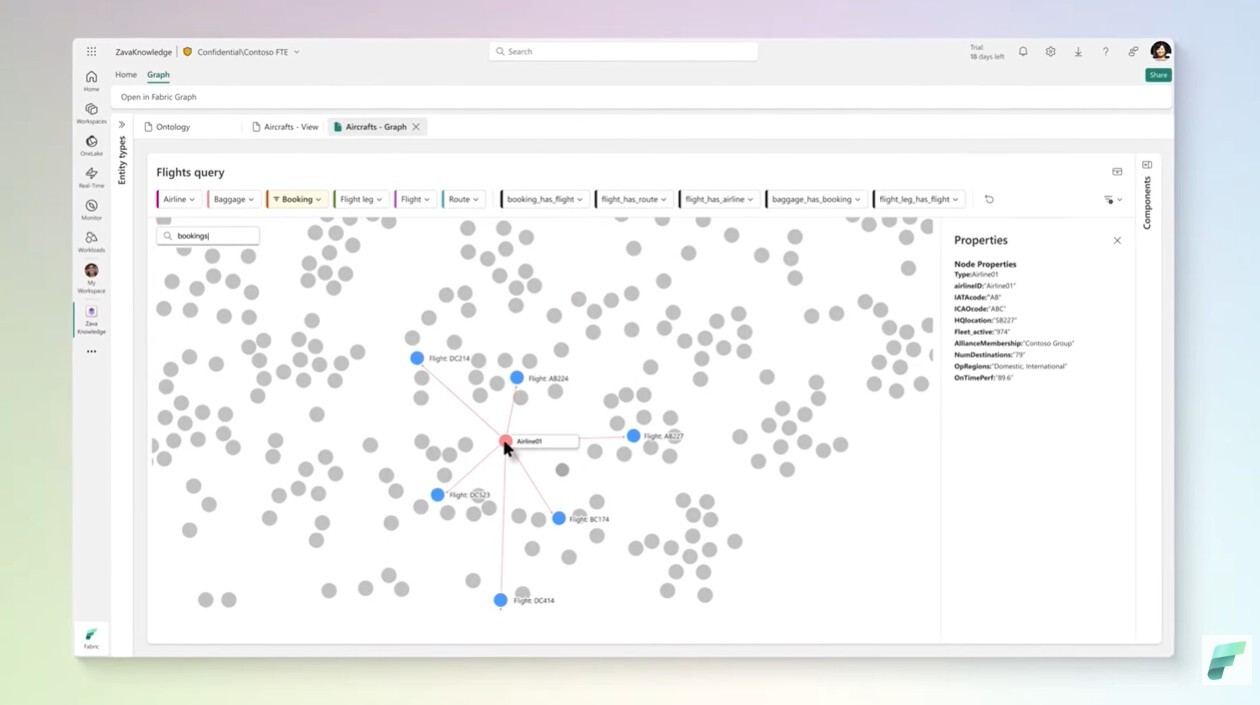
Why Knowledge Graphs Change the Way We Understand Data?
Knowledge graphs allow organizations to represent the business as an interconnected system of entities, processes, and events, rather than as a collection of isolated tables.
Strategic decisions depend on the relationships between multiple business variables:
- If on-time delivery declines, does it impact premium customers or price-sensitive ones more?
- If a supplier fails, which products, campaigns, or SLA commitments are affected?
- If churn increases, is it driven by customer experience, pricing, or operational issues?
Answering these questions requires understanding how customers, processes, decisions, and events are connected within the business system.
This is where knowledge graphs make a fundamental difference.
In traditional analytical models, relationships between data are represented in technical terms —keys, joins, or dimensions—. Both business users and AI systems must reconstruct those relationships to interpret the data.
A knowledge graph simplifies this process by explicitly representing business relationships.
For example: Customer → purchases → Product
Instead of inferring this relationship from tables and joins, the system already understands it.
This has two key implications:
- Business users can interpret data without relying on technical structures
- AI agents can reason directly on the business model, since relationships between entities are already defined
In other words, a knowledge graph transforms technical data relationships into business relationships that are understandable for both people and artificial intelligence.
AI Agents with Business Context
The combination of ontologies and knowledge graphs does more than improve how business knowledge is modeled. It also enables a new generation of AI agents capable of interacting directly with that knowledge.
When an AI agent accesses data without a clear semantic foundation, it may generate fast responses, but not necessarily reliable ones.
In contrast, when it operates on a model that already defines business concepts, relationships, and rules, it can better interpret questions, retrieve relevant context, and provide more consistent answers.
Data Agents: Querying Data in Natural Language
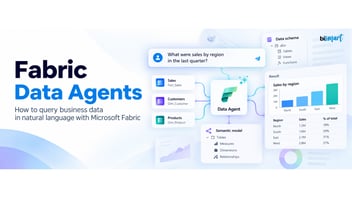
Data Agents allow users to interact with enterprise data using natural language, without relying solely on SQL or predefined reports.
Their value goes beyond translating questions into queries. They interpret those questions based on the underlying semantic model of the business.
As a result, queries like “Which products are generating the most logistics issues this month?” or “Which customers would be affected if this supplier fails?” are no longer technical searches, but contextualized business questions.
At Bismart, we have been working in this space with AI Query, a solution designed to let any user query business data in natural language and receive answers in the form of text, charts, or even full visuals.
In addition, AI Query not only provides answers, but also cites the sources and documentation behind them, giving users the context needed to validate, interpret, and expand on the information.
Operations Agents: Understanding the Impact of Events in Real Time
Within Fabric IQ, Operations Agents are designed to monitor events and operational processes in real time.
These agents can detect anomalies, identify patterns, and generate alerts when relevant issues occur in data flows or business processes.
Combined with the semantic layer and the knowledge graph, Operations Agents enable organizations to understand how operational events impact different areas of the business.
Fabric IQ Within the Microsoft Fabric Ecosystem
One of the key strengths of Fabric IQ is that it does not operate in isolation, but in combination with other components of the Microsoft Fabric ecosystem.
- Power BI semantic models remain essential for reporting, KPI definition, and self-service BI.
- The ontology provides a shared and consistent business language.
- The knowledge graph enables the analysis of relationships and impacts between entities.
- Data and operations agents use this framework to interact with information and act on it with greater context.
The value of Fabric IQ is not in replacing existing components, but in connecting them within a more intelligent architecture, where data, semantics, analytics, and action no longer operate as separate layers.
What Does a Company Actually Gain?
The important question is not just what Fabric IQ is, but what capabilities it enables within an organization.
When artificial intelligence operates without a solid semantic foundation, what gets automated are fast responses based on partial interpretations of the business.
When it operates on a governed semantic framework, what gets automated are decisions with greater context, consistency, and traceability.
For executive teams, the value does not lie in the technical sophistication of the model, but in its organizational impact:
- Increased trust in data
- Fewer debates over metric definitions
- The ability to evaluate decisions based on their real business impact
Conclusion: The Future of Microsoft Fabric Lies in Data Semantics and Context
Microsoft is pushing a clear idea forward: the next wave of value will not come from integrating data alone, but from integrating meaning.
This approach aligns with a broader market shift toward bringing organizational knowledge into a governed, connected layer that can be consumed by artificial intelligence.
The value of Fabric IQ is not just in how it organizes data, but in how it enables organizations to operate with a shared language across data, business and AI.
How to Start Building a Semantic Layer on Microsoft Fabric
Adopting artificial intelligence in the enterprise is not just a technology initiative.
It is a matter of designing a semantic architecture, where data semantics, ontologies, and knowledge graphs enable AI to understand how the business actually works.
At Bismart, we help organizations build these semantic layers on Microsoft Fabric, combining data integration, data governance, and business knowledge modeling.
If you want to go deeper into this approach, you can download our strategic guide:
If you want to explore how to design a semantic architecture tailored to your organization and business logic, at Bismart we can help you define and implement it on Microsoft Fabric.