Learn what Agentic AI is, how it works, and how AI agents automate complex workflows. Discover real enterprise use cases and implementation insights.
On a typical morning, a developer opens her workspace and reviews the pending tasks for a project. Her team is not made up of people alone, there are also AI agents working alongside her.
Through a Telegram bot, a user requests a change to her corporate website. That request doesn’t go directly to a human, but to a system of AI agents that handles it end to end as part of an automated AI workflow.
One agent interprets the request and translates it into specific tasks. Another modifies the code. A third validates the changes, while another manages the production deployment. This entire process is orchestrated through intelligent agents working in coordination.
Everything happens seamlessly: the agents assign tasks, exchange information, execute actions, and notify when the work is complete, enabling a fully automated agentic workflow.
In this model, the user no longer interacts with tools, but with outcomes. The AI agents determine how to execute the work, while the user can monitor the process, review decisions, or intervene when needed.
What matters most is not the technology itself, but the outcome: the website is updated in production from a single instruction, without manual intervention at every step, demonstrating the real potential of AI-driven automation.
What seemed like science fiction not long ago is already a reality. At Bismart, we are already applying Agentic AI and enterprise AI agents in real-world environments.
And this is exactly what defines Agentic AI.
This type of flow represents the shift from systems that respond to systems that execute.
Agentic AI is an approach to artificial intelligence that enables the creation of AI agents capable of interpreting goals, planning actions, and executing tasks autonomously using external tools, data, and systems.
Unlike generative AI, which responds to instructions, Agentic AI is designed to act and complete end-to-end processes. The difference is strategic: generative AI responds; Agentic AI executes.
This transition shifts the conversation from individual productivity to operational redesign, automation of complex processes, and new models of hybrid work between humans and AI agents.
All of this is driving rapid enterprise adoption of Agentic AI:
- 65% of enterprises already use AI agents, and all of them plan to expand their adoption in the coming years
- The enterprise Agentic AI market is expected to grow at a rate of over 46% annually through 2030.
- 40% of enterprise applications will include AI agents by 2026.
If your organization is exploring the implementation of AI agents to automate business processes, this guide provides a practical starting point: agent types, use cases by department, implementation phases, and best practices for secure deployment in enterprise environments.
What is Agentic AI?
Definition of Agentic AI
Agentic AI refers to artificial intelligence systems capable of acting as autonomous agents that interpret goals, plan actions, and execute tasks to achieve specific outcomes.
It is important to clarify a common point of confusion in the market: not every system powered by an LLM qualifies as Agentic AI. According to IBM, agentic AI systems combine the flexibility of LLMs with orchestration mechanisms, tools, and workflows capable of executing complex tasks autonomously.
An AI agent does not simply generate content or respond to prompts. It perceives context, determines the next step, accesses tools, retrieves data, executes actions, and evaluates the outcome.
In this sense, Agentic AI is not just about conversational interaction, it is a goal-oriented and outcome-driven architecture.
Key characteristics of Agentic AI systems
Agentic AI systems share three fundamental characteristics:
1. Autonomy
AI agents can operate with a certain degree of independence to achieve a defined goal. They do not rely solely on step-by-step instructions.
2. Planning
Agentic AI systems can break down complex problems into smaller tasks and design an execution plan.
3. Task execution
Agents can interact with tools, APIs, and databases to complete real-world tasks.
This approach transforms AI agents into active components within business workflows, especially when designed as autonomous AI agents with planning capabilities, tool access, and controlled task execution.
Why is Agentic AI emerging now?
The rise of Agentic AI is not accidental. It is driven by the convergence of three key technological advances:
1. Advanced Large Language Models (LLMs)
Models such as GPT, Claude, and Gemini have significantly improved reasoning, planning, and contextual understanding.
2. Agent frameworks
Frameworks and platforms for orchestrating AI agents have matured rapidly. Tools such as LangChain, CrewAI, and Semantic Kernel make it possible to build agentic systems in a structured and scalable way.
3. Advanced automation
Integration with APIs, enterprise tools, and data systems has enabled AI agents to execute actions in real-world environments. As a result, AI agents have evolved from an experimental concept into a technology with clear business applications.
All of this is happening in a context where organizations are looking to move beyond copilot agents and capture real operational value through Agentic AI.
What is an AI Agent?
Definition of an AI Agent
An AI agent (artificial intelligence agent) is an autonomous system designed to perceive its environment, analyze information, make decisions, and execute actions to achieve specific goals.
Unlike traditional rule-based systems, AI agents combine contextual understanding, reasoning, and execution capabilities, enabling them to operate dynamically in changing environments.
How do AI agents perceive their environment?
To operate effectively, AI agents must understand the context in which they act. To do so, they integrate information from multiple sources.
Key sources of perception include enterprise databases, APIs and digital services, documents and knowledge repositories, corporate systems (ERP, CRM, analytics platforms, etc.), search engines and external data sources, as well as sensors and connected systems in physical or IoT environments.
By integrating these sources, AI agents can work with contextualized, up-to-date, and relevant information; essential for making accurate decisions within complex processes.
In advanced enterprise environments, this capability is reinforced by semantic models, knowledge layers, and data governance frameworks, ensuring the consistency, reliability, and trustworthiness of the information used by agents.
How do AI agents make decisions?
AI agents use a combination of mechanisms to analyze available information and determine the most appropriate action in each situation.
The most common approaches include:
- LLM-based reasoning, which enables agents to interpret complex instructions and generate action strategies
- Task planning, where objectives are broken down into executable steps
- Contextual analysis, which evaluates the current state of the environment and its constraints
- Outcome evaluation, allowing agents to refine decisions based on previous results and accumulated experience
In Agentic AI architectures, these mechanisms are typically integrated into iterative reasoning–action loops. In each cycle, the agent analyzes the context, selects the next action, executes the task, and evaluates the outcome.
This approach enables AI agents to handle complex and dynamic problems, where decisions must continuously adapt to new information and changing conditions within the operating environment.
How does Agentic AI work?
Agentic AI systems typically operate through a structured execution cycle consisting of five stages:
Operational cycle of an AI agent
1. Goal interpretation
The agent is assigned an objective: preparing a competitive analysis, reviewing contracts, resolving an issue, or coordinating an operational task.
2. Planning
The agent breaks down the objective into steps or subtasks.
This is a key difference compared to GenAI: instead of simply producing an answer, the agent builds a sequence of actions.
3. Tool use
The agent can leverage external tools to achieve its objective, including databases, APIs, document retrieval systems, enterprise applications, search engines, and analytical tools.
4. Execution
The AI agent performs specific actions to complete the task: gathering information, generating a draft, updating a system, or escalating an exception.
5. Evaluation
The agent evaluates the outcome, corrects if necessary, and determines the next step. This cycle repeats until the objective is achieved.
This pattern aligns with how leading organizations describe Agentic AI systems: a combination of reasoning, tool use, memory, and orchestration to solve complex tasks.
How do AI agents collaborate in multi-agent systems?
In many enterprise environments, AI agents operate within multi-agent systems, where multiple specialized agents collaborate to execute complex processes in a coordinated way.
Each agent takes on a specific role within the workflow, enabling the distribution of responsibilities, optimizing task execution, and improving operational efficiency.
Within a multi-agent system:
- Each agent is designed to handle a specific type of task
- Agents exchange information and coordinate with one another
- Complex tasks are broken down into subtasks and executed in a distributed manner
For example, a multi-agent architecture may include:
- A research agent responsible for gathering relevant information
- A data analysis agent that processes and structures the collected data
- A reporting agent that synthesizes results and produces clear, actionable outputs
This approach enables organizations to orchestrate complex workflows using specialized AI agents, creating automation systems that are more flexible, scalable, and adaptable to dynamic environments.
Agentic AI systems architecture
In enterprise environments, agentic architecture should not be understood solely as a technical combination of models, memory, and tools, but as a governable operational layer capable of executing processes across corporate systems and enterprise applications.
Agentic AI systems operate by combining language models (LLMs), planning, memory, and external tools to achieve multi-step objectives.
In practice, this takes the form of an AI agent architecture that coordinates reasoning, execution, and access to enterprise systems.
Architecture of an Agentic AI system
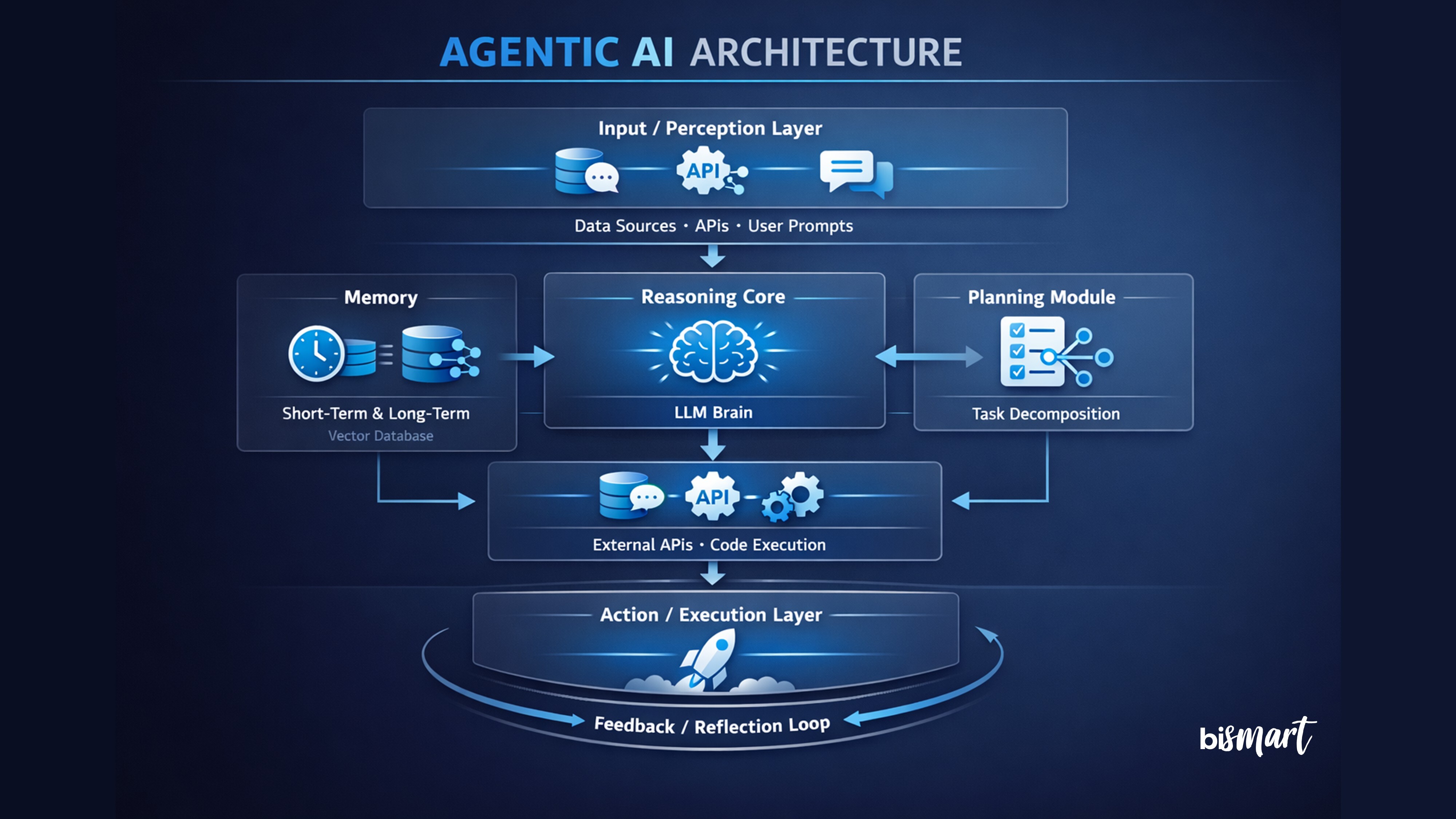
Components of an Agentic AI system
The architecture of an Agentic AI solution is typically organized into six layers:
- Objective or task – defines the expected business outcome
- Language model (LLM) – interprets instructions and generates reasoning
- Planning engine – breaks down tasks and determines execution sequences
- Memory – maintains context, history, and constraints
- Tools and APIs – enable interaction with real-world systems
- Orchestration and evaluation – coordinate agents, rules, and validation processes
Simply put: LLMs provide flexible intelligence, orchestration provides control, and tools enable execution.
Agent orchestration
In advanced AI agent architectures, multiple AI agents operate in coordination through agent orchestration systems, which manage how they interact, when they act, and which tasks they execute within an enterprise workflow.
Orchestration enables organizations to:
- Manage complex workflows by structuring different stages of a process
- Assign tasks to specialized AI agents based on their roles and capabilities
- Monitor and control execution, ensuring consistency and operational efficiency
Thanks to this coordination layer, organizations can integrate multiple AI agents into a unified AI operating model, allowing them to collaborate and solve more complex problems.
This approach is essential for deploying enterprise AI systems at scale, where coordination between agents is critical to ensuring reliable, scalable, and governable outcomes.
Agentic AI vs. Generative AI
What is generative AI?
Generative AI focuses on creating new content based on patterns learned during training. These systems can generate various types of content, including text, images, code, audio, and video, from an initial prompt.
However, most generative AI solutions require direct user interaction, meaning they depend on specific prompts to produce each output.
Main differences
While generative AI produces content in response to instructions, Agentic AI can autonomously execute multiple steps to complete complex tasks.
The key difference is simple: generative AI produces outputs; Agentic AI executes goals.
| Feature | Generative AI | Agentic AI |
|---|---|---|
| Primary Function | Generate content | Execute tasks and processes |
| Interaction | Prompt-based | Goal-driven |
| Autonomy | Low | Medium to high |
| Tool usage | Limited | Extensive |
| Applications | Text, images, code | Automation, operations, decision-making |
| Core value | Individual productivity | Operational automation and coordination |
Why do AI agents represent the next step?
Generative AI has proven highly effective at accelerating tasks such as writing, summarizing information, generating ideas, and supporting analysis.
However, many experts see Agentic AI as the natural evolution of generative AI. This shift is often summarized as:
Copilots → Agents
While copilots assist users in generating content, answering questions, or analyzing data, AI agents can execute complete processes autonomously.
In practice, Agentic AI goes a step further: it can investigate, make decisions, execute actions, and coordinate with other systems or agents to achieve a defined goal.
For this reason, the market is increasingly shifting from copilots to AI agents.
Microsoft, for example, has described 2025 as the beginning of the “era of agents” and the open agentic web, while Google positions its agent technologies as a foundational layer for building, deploying, and governing AI agents in enterprise environments.
Types of AI agents
Not all AI agents are the same. At a high level, it is useful to distinguish four main categories:
1. Reactive agents
Reactive agents respond directly to environmental stimuli without complex planning processes.
They are based on predefined rules or patterns and act immediately under specific conditions. While their capabilities are limited, they are efficient and reliable in well-defined and predictable environments.
2. Deliberative agents
Deliberative agents incorporate planning and reasoning capabilities to determine how to achieve a given goal.
Before acting, they can analyze different alternatives, evaluate possible outcomes, and select the most appropriate strategy. This makes them well suited for dynamic environments and complex problems.
3. Multi-agent systems
Multi-agent systems consist of multiple specialized AI agents working together within a shared architecture.
Each agent is responsible for a specific function and collaborates with others to solve complex tasks in a distributed manner. This model is increasingly common in advanced enterprise AI systems.
4. Autonomous LLM-based agents
Advances in large language models (LLMs) have enabled the development of autonomous AI agents capable of reasoning, planning, and executing complex tasks with greater flexibility.
Some of the most widely used technologies and frameworks in this space include AutoGPT, LangChain Agents, CrewAI, and OpenAI Agents.
In practice, most enterprise use cases do not require full autonomy. Instead, they rely on controlled autonomy, with clear rules, human oversight, and governed access to tools.
This is often the most effective approach for organizations looking to capture value from AI agents while minimizing operational risk.
Use cases of Agentic AI in enterprises
The potential of Agentic AI in enterprise environments lies primarily in its ability to automate complex processes, improve decision-making, and unlock the value of organizational knowledge.
1. Business process automation
Agentic AI systems enable the automation of processes that traditionally require multiple steps, rules, and human supervision.
This includes administrative and operational workflows, financial and compliance processes, as well as document management and classification.
Unlike traditional automation, AI agents can adapt to variations in processes and make decisions within defined boundaries, making them particularly effective in complex, dynamic environments.
2. Agents for analysis and decision-making
AI agents can collect data from multiple sources, analyze large volumes of information, and generate actionable insights and recommendations.
This is especially valuable in areas such as marketing and customer analytics, business strategy, and financial planning.
In this context, AI agents do not replace decision-makers, but enhance analytical capabilities and improve the quality of information available for decision-making.
3. Agents for operations and support
Enterprise AI agents can be integrated into internal operations to manage tasks such as employee support, incident classification and resolution, and IT operations automation.
For example, an agent can analyze an incident, retrieve relevant context, apply internal policies, execute actions, or escalate the case when necessary.
4. Enterprise knowledge management
One of the most impactful use cases of Agentic AI is the intelligent management of enterprise knowledge.
Organizations store information across multiple systems, including SharePoint, email, CRM platforms, internal wikis, shared drives, and SaaS tools.
AI agents can act as a unifying layer that contextualizes this information, enabling employees to quickly access relevant knowledge.
Agentic AI should not be seen as just another technology trend, but as a new operational layer for redesigning business workflows, especially in environments where multiple systems, rules, and data sources are involved.
Technologies and frameworks for building AI agents
From a technical perspective, the market is rapidly evolving around enterprise platforms and development frameworks for building AI agents. Tools such as LangChain, CrewAI, Semantic Kernel, OpenAI Agents, and various orchestration layers are increasingly central to this ecosystem.
Anthropic rightly points out that success depends less on the specific framework chosen and more on effective workflow design, the right tooling, and continuous evaluation.
LangChain
LangChain is one of the most widely used frameworks for developing LLM-based agents. It enables developers to connect language models with external tools, databases, APIs, and workflows, making it easier to build applications capable of reasoning and executing actions.
CrewAI
CrewAI is specifically designed for building multi-agent systems, where multiple specialized AI agents collaborate to solve complex tasks. The framework allows developers to define roles, responsibilities, and coordination mechanisms between agents.
Semantic Kernel
Semantic Kernel, developed by Microsoft, is a framework for building enterprise AI applications that combine language models with business logic, integrations with corporate systems, and process orchestration.
OpenAI Agents
OpenAI Agents platforms enable the development of AI agents capable of reasoning, using tools, calling APIs, and executing actions in external systems, supporting the creation of more autonomous, task-oriented AI applications.
Benefits of Agentic AI for organizations
The most visible benefit of AI agents is increased productivity, but the real impact goes far beyond that.
Their value is concentrated in three key areas: reducing the cost of coordination across tasks and systems, increasing the speed of process execution, and enabling new operating models based on collaboration between humans and AI agents.
Organizations such as IBM describe enterprise AI agents as a new paradigm capable of transforming how companies operate.
Increased productivity
AI agents can automate repetitive or low-value tasks, freeing up time for human teams to focus on higher-value activities such as strategy, analysis, and decision-making.
Automation of complex processes
Unlike traditional automation, Agentic AI enables organizations to manage processes involving multiple steps, rules, and data sources; reducing the need for constant human intervention.
New agent-based operating models
More organizations are exploring hybrid models in which humans and AI agents collaborate within the same workflows, combining the analytical capabilities of AI with human judgment and oversight.
Challenges and risks of Agentic AI
The greater the autonomy of an AI agent, the higher the need for governance. That is why enterprise-grade Agentic AI must be designed with human-in-the-loop, granular permissions, observability, auditing, and robust security policies.
The main risks are well understood:
- Unauthorized access to sensitive data
- Incorrect decisions or decisions based on incomplete information
- AI hallucinations
- Execution of unintended actions in connected systems
- Lack of traceability in automated processes
- Over-reliance on AI systems
Governance and control
As AI agents become more capable of decision-making and execution, it is essential to establish clear governance and oversight mechanisms.
This includes defining rules of engagement, operational boundaries, and monitoring systems to understand how and why decisions are made.
Security
AI agents interacting with enterprise systems, sensitive data, or internal APIs must comply with strict security standards.
Identity management, granular permissions, and access control are critical to preventing misuse and unauthorized access.
Human oversight
Although AI agents can operate autonomously, enterprise Agentic AI systems must incorporate human-in-the-loop models, ensuring that people retain the ability to supervise, validate, and intervene when necessary.
The future of Agentic AI
The rise of AI agents
AI agents are rapidly emerging as one of the most important areas of innovation in artificial intelligence, particularly with the development of autonomous AI agents capable of executing complex tasks with limited human supervision.
Major technology companies and leading software vendors are investing heavily in agentic architectures designed to automate processes, coordinate systems, and execute tasks with increasing levels of autonomy.
Agent-driven organizations
As these technologies mature, organizations will increasingly evolve toward agent-driven operating models, where AI agents manage significant portions of business processes—from data analysis to executing actions across enterprise systems.
Human-agent collaboration
The most significant transformation will not be the replacement of humans, but the emergence of human–AI collaboration as a core operating model.
In this new paradigm, AI agents will take on tasks related to analysis, coordination, and execution, while humans provide judgment, oversight, and strategic direction within business workflows.
Agentic AI in 5 key ideas
- Agentic AI enables the creation of AI agents capable of executing complex, multi-step tasks
- It combines LLMs, planning, memory, tools, and orchestration
- Its logic is based not only on prompts, but on goals and workflows
- Its greatest impact lies in business processes, analytics, operations, and knowledge management
- It represents the shift from copilots to autonomous AI agents in the enterprise
Frequently asked questions about Agentic AI (FAQ)
What is Agentic AI?
Agentic AI is an approach to artificial intelligence in which systems operate as AI agents capable of interpreting goals, planning actions, and executing tasks using tools and data.
Unlike traditional AI systems, these agents do not just generate responses. They can act on systems and processes to achieve specific outcomes.
What is an AI agent?
An AI agent is a system that perceives its environment, analyzes information, makes decisions, and executes actions to achieve a defined goal.
These agents can interact with data, enterprise applications, APIs, and other digital systems.
How does Agentic AI work?
AI agents typically operate through a continuous reasoning–action cycle, which includes:
- Interpreting the goal or request
- Analyzing context and available information
- Planning the necessary steps
- Using external tools or systems
- Executing actions and evaluating outcomes
This process allows AI agents to solve complex, multi-step tasks autonomously or with human supervision.
How does Agentic AI differ from generative AI?
Generative AI focuses on creating new content—such as text, images, or code—based on a prompt.
Agentic AI, in contrast, is designed to execute tasks and workflows by leveraging tools, data, and external systems to achieve a goal.
In simple terms:
- Generative AI → produces content
- Agentic AI → executes processes
What are some examples of AI agents?
AI agents are already used across multiple business contexts, including:
- Document automation and analysis
- Competitive research and information gathering
- Internal support and incident management
- Development agents that generate and review code
- Operations and data analysis assistants
Which companies are developing agentic AI?
Several technology companies are driving the development of AI agent platforms, including:
- Microsoft, with Copilot and enterprise agent platforms
- Google Cloud, with tools for building and managing agents in enterprise applications
- IBM, promoting enterprise AI agents as a new operating paradigm
- Anthropic and OpenAI, developing models and frameworks for Agentic AI systems
What technologies are used to build AI agents?
The development of AI agents typically relies on advanced language models (LLMs) and specialized frameworks such as:
- LangChain
- CrewAI
- Semantic Kernel
- OpenAI Agents
These technologies enable the integration of AI models with tools, APIs, enterprise data, and workflows.
What is the difference between an AI agent and a chatbot?
A traditional chatbot is designed primarily to answer questions or engage in conversation. Its functionality is usually limited to generating responses based on predefined rules or language models.
An AI agent, by contrast, goes beyond conversation. It can interpret goals, plan actions, use external tools, and execute tasks in real systems.
In short: while a chatbot responds, an AI agent acts.
This distinction explains why many organizations are moving from conversational assistants to agent-based architectures.
What is an agentic workflow?
An agentic workflow is an automated process managed by one or more AI agents.
In this architecture, agents interpret goals, coordinate tasks, access tools, and execute actions across different enterprise systems.
For example, one agent may collect data, another analyze it, and another generate a final report.
This approach enables flexible automation of complex processes by combining reasoning with real-world execution.
Will Agentic AI replace workers?
Most experts agree that Agentic AI will not replace workers entirely, but will transform how work is organized.
AI agents can automate repetitive tasks, data analysis, and process coordination, while human professionals provide judgment, oversight, and strategic decision-making.
In this model, value comes from human–AI collaboration.
What is the future of AI agents?
The evolution of AI agents points toward organizations where humans and agents collaborate within shared workflows.
AI agents will take on tasks related to analysis, coordination, and execution, while humans retain oversight, strategic direction, and control.
In this context, Agentic AI is emerging as one of the most important advancements in enterprise artificial intelligence.
Conclusion
Agentic AI will play a defining role in the coming years because it shifts artificial intelligence from conversation to execution.
This shift is not incremental. It fundamentally redefines how processes are designed, how work is distributed, and how operational value is created.
For executives, the question is no longer whether AI agents will have an impact, but which processes should be agentified first, at what level of autonomy, and under which control model.
Organizations that answer this question early will not only gain efficiency, they will gain the ability to execute.