Discover what an AI agent is, how it works and why it is key to automating processes, improving efficiency and transforming the modern enterprise.
In today’s business landscape, artificial intelligence (AI) is enabling a new generation of intelligent and autonomous systems that operate as AI agents within organizations.
This shift is shaping a scenario where enterprise AI is becoming a key driver of efficiency, automation, and competitive advantage.
These AI agents—also known as intelligent agents or autonomous agents—are software systems capable of perceiving their environment, processing information, and taking action to achieve specific objectives, often with minimal human intervention. Their adoption is transforming operating models by boosting productivity, reducing costs, and accelerating decision-making through AI-powered processes.
What Is an AI Agent and What Is It Used For?
An AI agent is a system that combines artificial intelligence, data, and automation to perceive, interpret, and act within a business process. Its purpose is to perform tasks, support data-driven decision-making, and execute actions without constant supervision.
At its core, an AI agent can observe what is happening around it, understand incoming information, and act autonomously to achieve a business goal. Unlike traditional rule-based automation, an AI agent understands context, makes decisions, and coordinates actions even in dynamic environments or when handling diverse data sources.
An AI agent can monitor critical processes, detect anomalies, anticipate incidents, recommend solutions, and implement them automatically. It can also interact with customers and employees using natural language, personalize experiences, or connect business systems to orchestrate end-to-end workflows.
What Can an AI Agent Be Used For?
The primary role of an AI agent is to free organizations from operational workloads so people can focus on strategic activities. In practice, an agent can oversee critical processes, identify anomalies, anticipate issues, propose actions, and execute them autonomously.
AI agents can also interact with users through natural-language interfaces, act as corporate assistants, tailor experiences, or coordinate complete workflows across systems.
AI agents help organizations:
- Automate repetitive tasks
- Monitor operational, financial, logistical, and IT processes
- Support data-driven decision-making
- Interact with users through natural language
- Optimize operations in real time
- Personalize customer and employee experiences
- Orchestrate complex processes across multiple systems
Why Are AI Agents Important to Businesses?
In essence, an AI agent serves to automate, optimize, and scale any data-driven process. It helps companies act faster, make better decisions, and operate at levels of efficiency that were previously out of reach.
This is why AI agents are considered a key component of the new generation of enterprise AI: a digital collaborator that enhances human capabilities and transforms how organizations operate.
AI agents help businesses:
- Increase operational efficiency and reduce costs
- Improve business agility by acting in real time
- Enhance service quality with faster, more consistent responses
- Scale processes without proportionally expanding teams
- Turn data into automated actions with direct business impact
Do you want to implement AI Agents in your company?
We have prepared a Practical Guide to Implement Copilot Agents in an enterprise level.
With these clear foundations, let's delve into each type of agent and its real impact on the operating models of organizations.
Enterprise Integration: Automation, Efficiency and Intelligent Decision-Making
The diversity of AI agents described above translates into a wide range of enterprise applications, yet all share a common purpose: driving efficiency, intelligent automation, and meaningful digital transformation.
Below is a summary of how different types of AI agents integrate into corporate processes and the benefits they bring to modern enterprise AI environments.
1. Automation of Operational Processes
AI agents—particularly reactive agents and autonomous agents—enable end-to-end automation of high-volume, operational tasks.
By delegating the consistent execution of these activities to agents, companies eliminate manual bottlenecks, reduce human error, and minimize unnecessary operational costs.
For example, a reactive agent in finance can automatically validate and post invoices, while an autonomous agent in IT monitors systems and applies security patches without waiting for a technician to intervene.
This not only saves time but also ensures 24/7 responsiveness and greater business continuity.
2. Improved Efficiency and Productivity
Introducing intelligent agents is equivalent to adding a tireless digital workforce.
These agents can work in parallel across multiple tasks—something human teams can rarely accomplish at scale. By taking ownership of operational workloads, they allow professionals to focus on higher-value strategic or creative work.
Organizations that have deployed AI agents report measurable gains in productivity, execution speed, and overall process quality.
From an executive perspective, this translates into achieving business goals faster, with fewer resources, and with significantly higher operational efficiency.
3. How AI Agents Improve Decision-Making
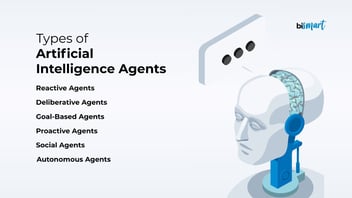
The most sophisticated AI agents —such as deliberative agents, goal-based agents, and proactive agents— act as tireless analysts capable of processing large volumes of data and identifying meaningful patterns.
For example, a deliberative agent can consolidate sales, market, and operational data within minutes to suggest strategic adjustments. Some autonomous agents even make operational decisions within predefined safety parameters —such as adjusting e-commerce prices based on real-time demand— while others generate recommendations for human teams to evaluate.
In both cases, the organization becomes more data-driven, able to respond with agility to signals from its environment and make better-informed decisions at speed.
4. Enhancing Customer Experience and Personalization with AI Agents
Social agents and conversational agents significantly elevate how organizations interact with both customers and employees, delivering fast, consistent, and highly personalized responses.
A virtual assistant can address inquiries instantly at any time of day, improving customer satisfaction while freeing human teams to focus on more complex, high-value cases.
In addition, AI-based agents can tailor product or content recommendations based on a user’s profile or behavior, increasing relevance and boosting conversion rates.
Within internal environments, these agents can guide new employees through corporate processes, acting as a digital mentor available at any moment.
Together, these capabilities support a people-centric digital transformation, where technology makes every interaction more intuitive, seamless, and effective.
5. How AI Agents Drive Digital Transformation and Competitive Advantage
In a broad sense, adopting AI agents has become a foundational pillar of modern digital transformation. It is no longer about deploying a single tool, but about rethinking processes, operating models, and decision flows with AI as a strategic partner.
Organizations redesign their workflows to integrate agents that collaborate with humans—such as analysts reviewing alerts generated by an autonomous risk agent—and to enable systems to make real-time decisions without waiting for periodic reports.
This shift introduces challenges: from adapting organizational culture to ensuring transparency, ethics, and strong AI governance in automated decisions. Yet the benefits outweigh the obstacles.
Companies that integrate AI agents effectively gain a clear competitive advantage through greater agility, smarter operations, and faster time-to-value.
Get started with AI Agents with Copilot.
👉 Download the free guide and start designing Copilot agents that generate real value from day one.
AI Agents: Future Trends and What to Expect Next
The rapid evolution of AI agents suggests that we are only at the beginning of their impact on the business landscape. The next waves of innovation point toward agents that are increasingly autonomous, collaborative, proactive, and ubiquitous across enterprise environments.
In the coming years, we will see major advancements in autonomous agents and proactive agents, capable of anticipating business needs and taking action without ongoing human supervision.
As Gartner predicts, proactive agents will become a standard feature in all productivity suites by 2030. This means that everyday tools—email, office applications, CRM, ERP—will integrate intelligent assistants that anticipate actions, generate recommendations, and manage tasks without being prompted.
We will also see the rise of multi-agent systems, composed of specialized agents that collaborate to manage complex processes in a coordinated, distributed way.
Thanks to advancements in generative AI, large language models (LLMs), and multimodal AI (text, voice, vision), these systems will be able to reason more deeply and make increasingly informed, autonomous decisions.
A near-future enterprise agent could, for example, read all emails in a department, summarize project statuses, detect risks based on communication tone, and schedule meetings to resolve emerging issues—acting autonomously, securely, and transparently as a digital collaborator embedded in daily workflows.
From a strategic standpoint, organizations must consider how to integrate and govern this new AI-powered workforce. Issues of trust, ethics, security, and regulatory compliance will be as critical as the technology itself. Who is accountable if an autonomous agent makes an incorrect decision? How do we ensure its actions align with corporate values and a consistent ethical framework?
These questions highlight the need for robust human oversight, traceability, and control mechanisms in any advanced AI initiative.
Investments in data governance, transparency, and staff training will be equally essential to maximize the value of AI agents and ensure their responsible deployment.
Conclusion: AI Agents, the New Engine of Enterprise Competitiveness
AI agents have become one of the pillars of modern digital transformation.
Their ability to interpret information, make decisions and act autonomously is redefining how organizations operate, accelerating processes that previously relied on human intervention and enabling teams to work with greater strategy, precision and agility.
These systems not only automate tasks: they multiply the company's operational capacity, improve the quality of services, elevate the customer experience and enable you to react to the environment with speed and confidence.
By integrating AI agents into their processes, companies can turn data into immediate actions, make more informed decisions and scale their efficiency without proportionally increasing resources.
This is a structural change. AI agents are not an additional tool: they are a new way of working, a digital extension of the human team and a key factor to compete in increasingly dynamic and demanding markets.
Organizations that prepare their data, infrastructure and culture to adopt these systems will be the ones that lead the next decade.
Artificial intelligence will not replace human talent, but it will empower those who are ready to integrate it.
The best time to start is now: every company that incorporates AI agents with vision and governance will be building a competitive advantage that will be difficult for its competitors to achieve.
Take the next step toward business-ready AI
Want to identify which processes in your organization can be automated with AI?
Or do you need to understand how to prepare and govern your data so that AI works with accuracy, security and compliance?
At Bismart, we offer you a free consultancy where we analyze:
- The potential for automation in your processes.
- The state of your data governance.
- What you need to build a solid foundation to enable AI to deliver real value.
Book a meeting with our experts and start designing a secure, scalable and reliable data-driven AI strategy.