

Discover how purpose-driven AI is transforming lives across Europe —from healthcare to education— proving that technology can serve humanity.
Over the past two years, artificial intelligence has become one of the most talked-about topics in the technological and business world.
Every week brings new models, record-breaking investments, and innovations that promise to reshape entire industries, along with headlines proclaiming yet another imminent revolution. From tools that generate text and video to systems capable of analyzing millions of data points in seconds, progress is nothing short of exponential.
Yet amid all the excitement, it’s easy to lose sight of what truly matters: real transformation happens when technology improves people’s lives.
Across Europe, thousands of professionals, institutions, and startups are proving that purpose-driven AI is no longer a distant vision; it’s already transforming hospitals, schools, public administrations, and businesses.
Technological innovation can — and should — have a human purpose. This article explores eight real stories that show how artificial intelligence is not only improving lives, butalso saving them.
The rise of genAI has captured the world’s imagination and opened new possibilities across almost every field. Yet beyond the hype lies a more important question: how do we ensure that this technology serves the common good?
Today, responsible AI has become one of Europe’s defining priorities. From ethical design to regulation, Europe is shaping a future where artificial intelligence doesn’t just boost productivity and competitiveness, it also drives inclusion, sustainability, and social well-being.
The results are already visible: earlier medical diagnoses, faster public services, more inclusive classrooms, greener businesses, and safer cities.
In all these stories, technology enhances what makes us human, it magnifies our intelligence and empathy instead of replacing them.
What Is Purpose-Driven Artificial Intelligence?
Talking about purpose-driven AI —also known as Positive Artificial Intelligence— means understanding how data, algorithms, and automation can become forces for positive change. It’s about recognizing that every technological breakthrough carries a responsibility: to put knowledge and innovation at the service of humanity.
Europe is leading the way with its commitment to explainable, ethical, transparent, and secure AI, aligned with frameworks such as the EU AI Act and the responsible AI policies promoted by major technology companies.
In this new era, organizations are beginning to measure the success of AI not only by its economic impact, but also by its social contribution.
Want to leverage Artificial Intelligence to improve productivity and performance in your organization but not sure where to start?
The Potential of AI in Europe: A Shift in Paradigm
This human-centered vision of technology is captured in Google’s report “The Great Potential of AI in Europe.”
The document highlights some of the most inspiring projects across the continent, showing how artificial intelligence is already having a direct and positive impact on society.
AI has evolved beyond the lab, becoming a true ally of human progress.

8 Inspiring Ways Artificial Intelligence Is Improving Lives in Europe
1. An AI That Listens to the Heart Before It’s Too Late

Every year, cardiovascular diseases claim more than 17 million lives worldwide.
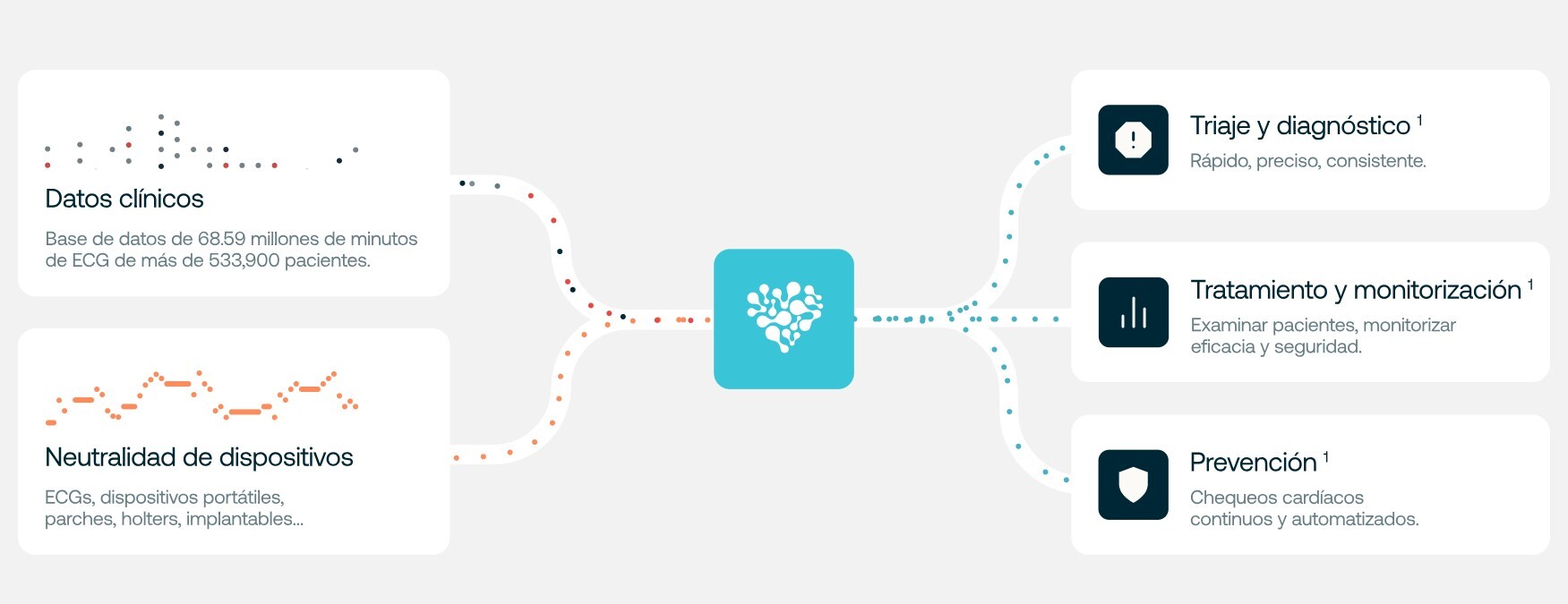
In Spain, a team of cardiologists and data scientists decided that this number had to stop rising. They developed an artificial intelligence system capable of reading electrocardiograms (ECGs) with millimetric precision, detecting arrhythmias long before symptoms appear. The result is Idoven, a pioneering project born in Spain.
2. Purpose-Driven Clinical Intelligence: Bismart’s Folksonomy at Hospital del Mar

In Barcelona, Hospital del Mar and Grupo Ferrer have transformed the way medical knowledge is managed thanks to Folksonomy Text Analytics by Bismart — an AI-powered solution that extracts information from unstructured data such as text, images, audio, and video, turning it into actionable clinical insight.
Before its implementation, healthcare professionals had to manually review thousands of medical reports to identify patterns or correlations — a time-consuming and error-prone process.
With Folksonomy Text Analytics, this task is now automated. The system analyzes medical discharge reports, identifies relevant treatments, diagnoses, and symptoms, and enables clinicians to answer complex clinical questions within hours.
By combining descriptive, predictive, and prescriptive analytics, the project has achieved outstanding results:
- Predicting clinical events, such as complications in patients with kidney disease.
- Detecting non-obvious relationships between treatments and outcomes.
- Supporting real-time decision-making based on best medical practices.
The outcome: greater medical knowledge, reduced clinical variability, and better decisions for both patients and professionals.
3. Safer, Smarter, and More Sustainable Cities

Artificial intelligence is also helping cities become more livable and human-centered.
In Amsterdam and Barcelona, city councils are using AI to analyze traffic patterns, optimize mobility, and reduce emissions. Through a network of urban sensors and predictive algorithms, congestion areas are detected, traffic lights are adjusted in real time, and accidents can be prevented before they happen.
At the same time, computer vision systems are improving waste management and public lighting, making city services more efficient and environmentally friendly.
These initiatives show how AI is becoming a cornerstone of Europe’s smart cities, improving quality of life without compromising sustainability.
4. Fighting Climate Change with Intelligent Prediction and Action

Inspired by Google’s report, the ClimateMind project combines artificial intelligence and behavioral psychology to improve how people understand and communicate about climate change — and to encourage more sustainable decisions.
At the same time, machine learning tools developed by the European Centre for Medium-Range Weather Forecasts are helping predict wildfires, heatwaves, and extreme weather events several days in advance.
Together, these innovations are helping protect ecosystems and communities, proving that AI can be a powerful ally in the global fight against climate change.
5. Accessibility and Inclusion Powered by AI

Digital accessibility is another area where artificial intelligence is making a real difference.
Applications such as Microsoft’s Seeing AI and Be My Eyes, founded in Denmark, use computer vision and natural language processing to assist people with visual impairments.
With the help of AI, users can describe their surroundings, read documents, or recognize faces simply by using their smartphone camera.
These innovations have enabled thousands of people to regain autonomy and social participation, turning technology into a true ally of equality and inclusion.
6. Artificial Intelligence Protecting What Matters Most

Every year, Europe faces a growing number of cyberattacks targeting hospitals, businesses, and public institutions.
To confront this threat, new AI-powered security solutions are helping detect intrusions, analyze patterns, and respond in real time. These tools drastically reduce response times and allow security teams to focus on the most critical threats.
At the same time, educational initiatives supported by European organizations and Google are training the next generation of cybersecurity experts — with a special emphasis on encouraging more women to join the field.
A purpose-driven AI is also one that protects what allows us to keep moving forward.
7. Sustainable and Efficient Agriculture Through Machine Learning

The environmental impact of agriculture is being reduced thanks to European startups using AI and predictive analytics to optimize the use of water, fertilizers, and energy.
Companies such as France’s Dilepix and Spain’s Agrodrone apply computer vision technology to detect crop pests or water stress before they are visible to the human eye.
These solutions help reduce waste, increase productivity, and advance toward regenerative agriculture — a clear demonstration of how technology can help feed the planet without depleting its resources.
8. Personalized and Inclusive Education for Every Student

In Spain and Finland, pioneering schools are using AI-powered tools that analyze each student’s learning pace and adapt educational content to their individual needs.
The Spanish startup Odilo, for instance, has developed AI-based learning ecosystems that promote reading, comprehension, and personalized learning experiences.
Meanwhile, projects like TeachFX and Kialo Edu are helping teachers enhance participation and equity in the classroom.
The result is a more inclusive, equitable, and engaging education, where technology acts as an ally for teachers and students — not a substitute for them.
Lessons from Real-World AI Success Stories Across Europe
Eight examples, eight different ways of understanding artificial intelligence.
From hospitals to startups, from classrooms to city halls — they all share a single idea: technology only makes sense when it creates human value.
These stories prove that AI doesn’t belong to the future — it’s already part of our present.
It’s not just about algorithms, but about people who think, create, and choose to put technology at the service of something greater: health, safety, education, and collective well-being.
Europe is showing that innovation can also have a soul, and that real progress happens when AI improves people’s lives.
How to Apply Purpose-Driven Artificial Intelligence in Your Organization
Any organization —large or small — can start implementing purpose-driven AI.
This mini guide outlines the essential steps to move from inspiration to action, following the same principles shared by the projects you’ve just read about: ethics, clarity, and purpose.
Before applying AI responsibly, it’s crucial to understand how artificial intelligence can be integrated across your business and what it can do for each department or function.
In our “The Ultimate Guide to AI Automation in Business,” you’ll find a complete roadmap with real examples of how to automate key processes in every department using intelligent technologies.
1. Identify the Challenges That Truly Matter
The first step isn’t choosing a tool, it’s defining a human or business problem worth solving.
It might be about improving customer service, automating processes, detecting inefficiencies, or making information more accessible.
AI only makes sense when it solves a specific challenge and improves the experience of the people involved, whether they are employees, customers, or citizens.
2. Build a Solid and Reliable Data Foundation
No artificial intelligence system can function without quality data. Evaluate your data sources, their structure, level of accuracy, and consistency.
Working with poorly organized or incomplete data only leads to frustration and unreliable results.
Implementing a strong data governance framework with clear standards for privacy, quality, and traceability; is the first step toward AI that creates real, measurable value.
3. Start Small: Measurable and Scalable Projects
Success doesn’t start with grand promises, but with well-defined pilot projects.
Choose one or two low-risk, high-impact initiatives that can be clearly measured — such as time savings, error reduction, or increased customer satisfaction.
When you demonstrate tangible value, internal support and investment will follow naturally.
4. Prioritize Ethics and Transparency
Trust is the new competitive advantage.
Every AI project should include ethical principles from the very beginning, how models are trained, what biases may emerge, the level of human oversight required, and how results are communicated and explained.
Responsible AI doesn’t just comply with regulations, it builds trust among employees, customers, and society at large.
5. Prepare People to Work With AI, Not Against It
Technology adoption ultimately depends on people.
Train your teams, listen to their concerns, and explain the purpose behind each change. AI doesn’t replace human intuition or empathy, it enhances them.
Investing in digital skills and AI literacy is just as important as investing in infrastructure.
6. Measure Impact and Adjust Along the Way
Every AI strategy should be measured, monitored, and continuously improved.
Define clear success metrics and regularly review outcomes such as productivity, satisfaction, efficiency, sustainability, and equity.
The best AI initiatives are those that learn and evolve over time, just like people.
Conclusion: AI That Empowers, Not Replaces
Europe is proving that artificial intelligence can have purpose, ethics, and measurable impact.
The stories we’ve explored —from hospitals and schools to businesses and governments— show that technology can truly improve people’s lives when used with intention and responsibility.
The real challenge for organizations today isn’t deciding whether to adopt AI, but how to do it right, with purpose, with reliable data, and with people at the center.
Because true innovation isn’t about predicting the future, it’s about building it responsibly.
Before you go...