Copilot and Claude represent two distinct models of enterprise AI. Discover the differences in integration, governance, scalability and AI readiness for organizations.
For years, enterprise software revolved around applications: CRM systems, ERPs, data platforms, productivity tools. Each system served a specific purpose, and employees worked within those boundaries.
The emergence of AI coworkers is fundamentally changing that model.
For the first time, artificial intelligence is no longer limited to supporting isolated tasks. It is beginning to operate across emails, documents, meetings, files, processes, and entire workflows.
That shift is forcing organizations to confront a much deeper strategic question than it may initially seem:
Copilot Cowork or Claude Cowork?
Comparing Copilot Cowork and Claude Cowork is not simply about choosing an AI tool. It is about deciding how AI will function inside the organization: through individual autonomy or within a governed enterprise framework.
What makes the comparison especially interesting is that both models are built on a relatively similar technological foundation.
Microsoft has integrated Claude-based capabilities into Microsoft 365 Copilot, while Anthropic positions Claude Cowork as a system capable of executing multi-step knowledge work across files, applications, and user context.
If both technologies rely on comparable intelligence, the discussion quickly stops being about which one is “smarter” and becomes something far more strategic: where should AI operate in order to generate real business value?
The difference between Copilot Cowork and Claude Cowork is not performance, it's operating logic
Claude Cowork and Copilot Cowork are not simply two alternative AI products. They represent two fundamentally different approaches to introducing agentic AI into the workplace.
Claude Cowork follows a more individual-first logic: giving users the autonomy to work with files, applications, and tasks directly within their own environment.
Anthropic describes it as an evolution of Claude Code’s agentic capabilities into non-technical work, enabling access to local files and the ability to complete end-to-end tasks autonomously.
Copilot Cowork, by contrast, is designed from a corporate-first perspective. Microsoft positions it within the Microsoft 365 ecosystem, where security, permissions, compliance, and auditability are embedded by default.
That distinction is critical. Claude prioritizes speed, flexibility, and user autonomy. Copilot prioritizes integration, governance, and enterprise control.
Claude Cowork is designed to amplify the capabilities of an individual employee. Copilot Cowork is designed to integrate AI into the enterprise operating model.
Copilot Cowork vs Claude Cowork: Key Differences
The following table summarizes the main differences between Copilot Cowork and Claude Cowork:
| Dimension | Claude Cowork | Copilot Cowork |
|---|---|---|
| Adoption logic | Individual and flexible | Enterprise and governed |
| Usage environment | Desktop, local files, and user applications | Microsoft 365 and corporate environment |
| Main advantage | Speed, autonomy, and experimentation | Control, traceability, and scalability |
| Governance | More dependent on the user and configuration | Built into corporate policies |
| Relationship with data | Direct access to local files and user context | Access governed by permissions, identity, and compliance |
| Main risk | Fragmented or difficult-to-audit usage | Dependencia del ecosistema MicrosoftDependence on the Microsoft ecosystem |
| Best fit | Advanced users, agile teams, experimentation | Large organizations, critical processes, enterprise-scale adoption |
The table makes one thing clear: the comparison between Claude Cowork and Copilot Cowork is not just about functionality, but about operating models.
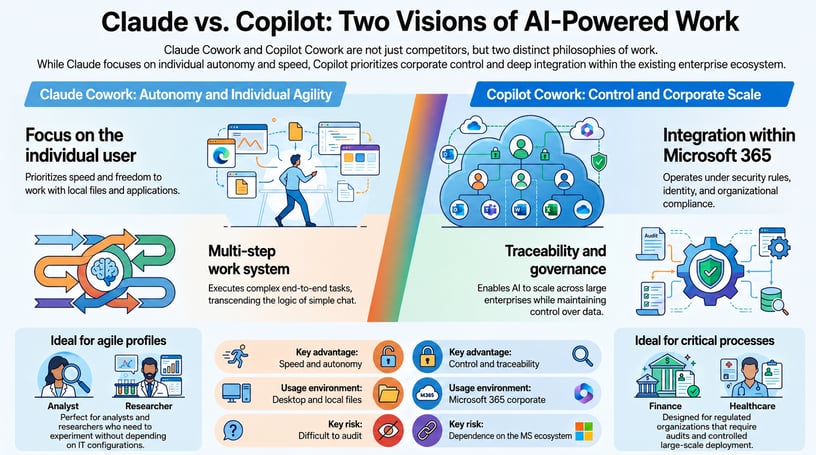
Claude Cowork is often a better fit for organizations whose priority is speed and experimentation. Copilot Cowork is generally better suited to organizations that need AI deployment to be scalable, secure, and fully governed.
Claude Cowork: Autonomy, Speed and Augmented Individual Work
Claude Cowork’s value proposition is compelling because it addresses a very real source of friction: much of today’s knowledge work still happens across disconnected documents, folders, browsers, spreadsheets, and applications.
Claude Cowork attempts to reduce that fragmentation.
It does not simply answer questions. It can work directly with files, edit documents, organize information, and complete tasks on behalf of the user.
Anthropic explicitly defines it as something beyond a traditional chatbot: “a system that executes multi-step knowledge work.”
That capability creates significant value for profiles that rely heavily on autonomy and agility: analysts, researchers, consultants, product teams, operations teams, and advanced users who want to delegate work without depending on IT to configure a broader enterprise environment.
However, that same autonomy also introduces limitations.
When AI operates primarily from an individual environment, organizations can lose visibility into which data is being used, how decisions are being made, and what outputs are being generated.
In personal contexts or smaller teams, that flexibility may be an advantage. In large enterprises, it can quickly become a governance challenge.
Copilot Cowork: Control, Integration and Enterprise Scalability
Copilot Cowork is built around a fundamentally different logic. Its goal is not simply to help individual users work faster, but to enable AI to operate within the rules, structures, and governance framework of the organization.
Microsoft states that Copilot Cowork operates within the existing security and governance boundaries of Microsoft 365 AI: identity management, permissions, compliance policies, and auditability are applied by default.
This is not just a technical detail. It is what allows AI to evolve from an isolated experiment into enterprise infrastructure.
In large organizations, artificial intelligence cannot simply access any data, generate any document, or execute any action without traceability. It must operate within a defined architecture of permissions, security, and governance.
From that perspective, Copilot has a clear advantage: it does not function as an external tool layered on top of the business environment, but as an extension of the corporate workspace.
That approach makes Copilot Cowork feel less like a standalone assistant and more like an operational layer embedded directly into the organization.
In our analysis of what Copilot Cowork is and how it works in enterprise environments, we explore in greater depth how Microsoft is integrating agentic capabilities directly into the corporate technology stack.
The trade-off, however, is that this level of integration also creates dependency. Copilot delivers the greatest value when the organization already operates within the Microsoft 365 ecosystem, or when it intends to consolidate its workflows around it.
For companies with highly distributed, hybrid, or non-Microsoft architectures, adoption may require a broader strategic and technological alignment beforehand.
The Key Difference: Control vs Autonomy
Many AI comparisons still focus on which model reasons better, writes better, or automates more tasks. But in an enterprise context, that is no longer the only question that matters.
The real question is: Can this AI operate securely, traceably, and consistently within our organization?
Every AI coworker introduces a new operational layer into the business. It does not simply generate text. It can read documents, transform information, summarize meetings, prepare deliverables, and execute actions within workflows.
An AI coworker is not an isolated productivity tool. It is an operational layer that interacts with data, processes, and business decisions. And if that layer is not properly governed, it does not scale effectively.
Claude Cowork prioritizes autonomy. Copilot Cowork prioritizes control. Neither approach is universally better. The right choice depends entirely on the organizational environment and the specific use case.
For an individual user, excessive control may feel like friction. For a regulated enterprise, autonomy without traceability may simply be unacceptable.
The Point Many Companies Underestimate: Data
Most discussions around Copilot Cowork vs Claude Cowork focus on interfaces, integrations, or agent capabilities. But there is a far more decisive factor behind the success or failure of enterprise AI: data.
Enterprise AI is only valuable when it operates on reliable, integrated, and contextualized information.
If data is fragmented, duplicated, poorly governed, or disconnected from real business processes, the AI coworker does not solve the problem, it makes it bigger.
And this affects both Claude and Copilot alike.
Claude Cowork can be extremely effective for individual tasks, but if users provide incomplete, inconsistent, or decontextualized information, the quality of the outcome will inevitably be limited.
Copilot Cowork may integrate more naturally into the corporate environment, but if enterprise data lacks structure, governance, or consistency, it will still operate on an unstable foundation.
Most AI initiatives do not fail because the model itself is insufficient. They fail because organizations have not prepared the data, governance framework, and integration architecture required to transform AI into a scalable operational capability.
This is the point where comparing tools alone stops being enough.
Is your business ready to operate AI coworkers?
Most AI initiatives fail not because of the technology itself, but because of poor integration, weak data quality, and insufficient governance.
Download our Data Maturity Model to assess your organization’s level of maturity in data management and governance.
AI Readiness: Having AI Does Not Mean Being Ready to Operate It
Copilot Cowork and Claude Cowork represent two different approaches to AI adoption. But in both cases, success ultimately depends on the same foundation: data quality, integration, and governance.
Having access to AI is not the same as being operationally prepared to scale it across the organization.
Talk to us to assess your organization’s AI readiness and evaluate how to integrate artificial intelligence into your business in a secure, scalable, and sustainable way.

So, Which Tool Should You Choose?
The most honest answer is that Claude Cowork and Copilot Cowork are not competing for exactly the same space.
- Claude Cowork makes sense when the priority is user autonomy. It is a strong fit for teams that need to explore quickly, automate non-critical tasks, move fast, or empower highly operational individual contributors.
- Copilot Cowork makes more sense when AI is expected to become part of the enterprise operating model itself. It is particularly relevant for organizations that require control, traceability, compliance, and deep integration with Microsoft 365.
The decision depends less on raw model performance and far more on operational context.
If the question is, “Which tool helps individual users become productive faster?” Claude may be the better answer. If the question is, “Which tool can scale more effectively across an enterprise environment?” Copilot is likely the stronger option.
But the most mature strategy may not be choosing one and rejecting the other altogether.
Many organizations will ultimately adopt different AI models for different contexts: flexible tools for experimentation and exploration, and governed systems for critical business processes.
The Fork in the Road for Ai-Powered Work
The comparison between Copilot Cowork and Claude Cowork reveals something deeper than a product battle. It exposes a broader divide in the future of AI-powered work.
- On one side is individual AI: fast, flexible, user-centric, and capable of dramatically amplifying personal productivity.
- On the other is enterprise AI: integrated, governed, connected to the corporate technology stack, and designed to scale across the organization.
Both models are necessary. But they are not designed to solve the same problems. The mistake would be assuming that an individual AI tool can, on its own, solve the structural and operational challenges of a large organization.
But it would also be a mistake to believe that a fully governed enterprise system can replace the creativity, speed, and experimentation that happen at the individual level.
The strategic question is not which model will win. The real question is how both models will coexist.
Conclusion: Copilot Cowork vs Claude Cowork Is Not Just a Comparison of Tools
The comparison between Copilot Cowork and Claude Cowork reveals something far more significant than the differences between two AI products. It reflects the emergence of two distinct models for integrating artificial intelligence into the workplace.
One prioritizes autonomy, speed, and individual capability. The other prioritizes control, governance, and organizational scalability. Both address real business needs. Both represent valid ways of bringing AI into day-to-day operations.
But the deeper question is not which model “wins.”
The real shift is that artificial intelligence is no longer functioning as an isolated productivity tool. It is becoming part of the operational infrastructure of the enterprise itself. And once that happens, the conversation changes entirely.
AI success no longer depends solely on the quality of the model. It depends on the quality of the data, the architecture that connects it, and the organization’s ability to govern how intelligence operates across the business.
That is why the real challenge is not simply adopting AI coworkers. The challenge is enabling them to operate reliably, securely, and at scale within real business environments.
Because without integration, AI becomes fragmented. Without governance, it loses traceability. And without a well-prepared data foundation, even the most ambitious automation initiatives eventually collide with the structural limits of the organization.
The difference between experimenting with AI and turning it into a sustainable enterprise capability does not lie in the tool itself. It lies in the system that supports it.
The difference between testing AI and operating it at scale lies in the data
At Bismart, we help organizations prepare their data platforms, data governance frameworks, and integration architectures to deploy artificial intelligence in real business environments.
Schedule a strategic session to evaluate how to integrate AI coworkers and AI agents into your organization in a secure, governed, and scalable way.