Microsoft MAI introduces 7 new AI models for reasoning, coding, image generation, transcription, voice and cybersecurity. Here’s what they do.
Microsoft AI has just unveiled one of its most significant bets in artificial intelligence to date: a family of seven new AI models developed in-house under the MAI brand.
But the announcement goes beyond the models themselves. Microsoft is setting out a much broader ambition: to build a superintelligence lab and an organization capable of improving its models continuously, cycle after cycle, as compute, data and evaluation capabilities advance.
Microsoft explains this ambition through a metaphor: “building a machine for climbing hills.” In machine learning, climbing a hill means gradually moving toward better outcomes, adjusting direction with each iteration.
“The next phase of artificial intelligence will not depend solely on releasing more powerful models, but on building a system capable of continuously pushing the boundaries of AI.”
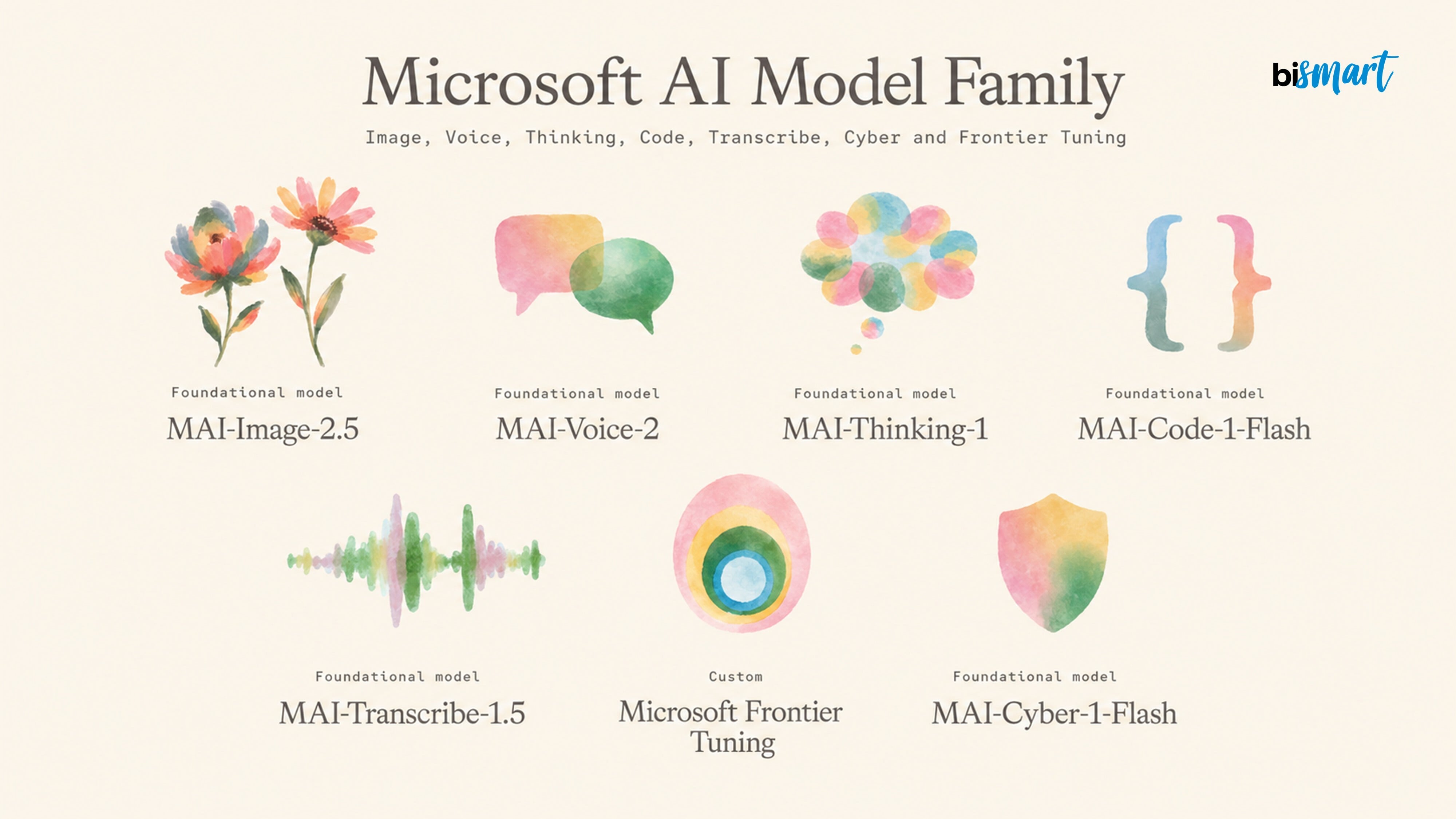
The first step in this strategy is already here: seven new MAI models covering reasoning, coding, image generation, speech and transcription. Together, they offer a clear signal of where Microsoft wants to take its own artificial intelligence technology.
In this article, we review Microsoft AI’s seven new MAI models: what each one is designed for, what makes them different and what they reveal about the future of Microsoft’s AI strategy.
What Are Microsoft AI’s MAI Models?
MAI is Microsoft AI’s new family of internally developed artificial intelligence models, designed to cover some of today’s most relevant AI capabilities: reasoning, coding, image generation and editing, speech and transcription.
The initial release brings together seven specialized AI models, although Microsoft already positions MAI as a model family that will continue to grow and evolve with new capabilities.
Beyond the number of models, the significance of MAI lies in what it represents for Microsoft’s strategy: a commitment to building proprietary AI technology optimized for different types of tasks and usage contexts.
Rather than relying exclusively on large general-purpose models, Microsoft is moving toward models that can be embedded into specific products, tools and workflows, with different levels of specialization depending on the task.
Is Your Company Ready to Move From AI Pilots to Real Operational Outcomes?
The 7 Microsoft MAI Models: What Can They Do?
Microsoft AI’s MAI family initially consists of seven specialized models for reasoning, coding, image generation and editing, transcription and speech.
Each model has been developed to address a specific type of task, from solving complex problems and generating code to creating visual content or processing spoken language.
1. MAI-Thinking-1: Microsoft AI’s Reasoning Model

MAI-Thinking-1 is Microsoft AI’s flagship reasoning model. According to the company, it is a medium-sized model capable of competing with some of the strongest systems in its category, delivering solid results in software engineering benchmarks and showing advanced mathematical reasoning capabilities.
One of its differentiating features is its training process. Microsoft emphasizes that MAI-Thinking-1 was trained from scratch on clean data, without relying on the distillation of third-party models.
This reinforces Microsoft’s commitment to developing its own AI capabilities and maintaining greater control over how its models are built and evolve.
2. MAI-Code-1-Flash: Microsoft’s Coding Model for GitHub Copilot and VS Code

MAI-Code-1-Flash is Microsoft AI’s coding model for AI agent-based software development, designed to deliver strong performance at a lower inference cost.
Microsoft presents it as a model built specifically for integration with GitHub Copilot, Visual Studio Code and the broader Microsoft technology ecosystem. This reflects a different strategy from general-purpose models: optimizing AI for the environments and tools where it is actually used.
With 5 billion active parameters, Microsoft compares its performance profile to models such as Haiku, but at a lower cost.
Beyond that comparison, one of the most relevant aspects of MAI-Code-1-Flash is its specialization. It is designed to be embedded directly into tools used every day by developers and engineering teams.
MAI-Code-1-Flash therefore represents Microsoft’s commitment to a more specialized, efficient and tightly integrated form of AI for coding — a particularly strategic area given the role of GitHub Copilot and Visual Studio Code in the adoption of AI-assisted programming tools.
3. MAI-Image-2.5: AI Image Generation and Editing

MAI-Image-2.5 is Microsoft AI’s model for image generation and image editing. According to the company, it supports both text-to-image tasks and more advanced visual editing capabilities.
Microsoft says that MAI-Image-2.5 outperforms the Arena score of Nano Banana Pro, making it clear that the company intends to compete in one of the most visible areas of generative AI: visual content creation.
In an enterprise context, the value of this type of model is not limited to generating appealing images. It also lies in the ability to edit, iterate, adapt formats, maintain visual consistency and accelerate content production workflows.
For teams in marketing, design, communications or product, that combination of speed, control and consistency can be especially valuable.
4. MAI-Transcribe-1.5: Fast, Domain-Specific Transcription in 43 Languages

MAI-Transcribe-1.5 is the transcription model in the MAI family. Microsoft presents it as a system with state-of-the-art accuracy, capable of running up to five times faster than competing models and recognizing domain-specific terminology across 43 languages.
These capabilities have direct implications for sectors where conversation, spoken documentation and specialized knowledge are part of daily work, such as healthcare, legal services, finance, customer service, education, public administration and industry.
Transcription stops being a secondary function when it can understand specialized vocabulary, process large volumes of audio quickly and adapt to specific professional contexts.
In that scenario, it can become a key layer for turning voice into structured, searchable and reusable information within business processes.
5. MAI-Voice-2: Natural Voice Generation With Safeguards

MAI-Voice-2 is Microsoft AI’s voice generation model. It is designed to produce natural-sounding speech in 15 languages and can adapt to a specific voice from a short sample.
Microsoft also highlights the use of safeguards to help prevent potential misuse.
Voice is one of the areas where enterprise adoption requires a careful balance between capability and control. Quality and naturalness matter, but so do security, impersonation prevention, consent management and usage traceability.
The fact that Microsoft explicitly emphasizes these safeguards reflects an important shift in the market: advanced voice generation capabilities are no longer assessed only by how realistic they sound, but also by the responsibility, control and trust mechanisms that support their use.
6. MAI-Cyber-1-Flash: A Cybersecurity Model Integrated Into MDASH

MAI-Cyber-1-Flash is Microsoft AI’s cybersecurity model, integrated into MDASH, Microsoft’s multi-agent system for identifying, validating and remediating vulnerabilities.
According to Microsoft, MAI-Cyber-1-Flash is designed to address complex vulnerabilities in large and highly complex codebases.
The company presents it as a compact model specialized in code and security, derived from the MAI-Thinking-1 line and developed using high-quality data.
Its value proposition does not lie in the model alone, but in the combination of model, data and orchestration system. Microsoft highlights that MDASH coordinates more than 100 agents to detect, validate and remediate vulnerabilities at a speed that would be difficult to achieve through manual review processes.
From an enterprise perspective, this approach is especially relevant. AI applied to cybersecurity cannot be assessed only by its technical capabilities, but also by the level of control, trust and responsible use it provides.
In this sense, Microsoft states that MAI-Cyber-1-Flash is specifically intended for defensive tasks and is available only to verified defenders through MDASH.
7. Microsoft Frontier Tuning: MAI Models Adapted to Your Business

Microsoft Frontier Tuning is not a standalone model within the MAI family, but a capability that allows organizations to customize one or more MAI models according to their specific needs, using reinforcement learning in real-world environments.
According to Microsoft, the goal is not simply to use a generic model, but to adapt MAI models to each company’s data, workflows and expert knowledge, within a secure environment and under the organization’s own control.
This approach moves AI from general-purpose capabilities toward models that are more specialized in the context, rules and operational needs of each organization. That can be especially relevant in enterprise scenarios where proprietary knowledge and business-specific adaptation make the difference.
How Are AI Models Trained With Microsoft Frontier Tuning, the “Training Gym” for AI?
Microsoft describes these reinforcement learning environments as organization-specific “training gyms” for AI. In practice, this makes it possible to adapt a model to a company’s own data, processes and knowledge within a private, controlled environment.
The process starts by defining the task and establishing what a good outcome looks like. From there, data, workflows and expert knowledge from Microsoft 365 and other environments are used to train and adjust the model’s behavior.
This is not simply about personalizing responses or changing the tone of an assistant. The goal is to embed institutional knowledge into the model’s behavior: how an incident is resolved, how a proposal is reviewed, how a task is prioritized, how a decision is validated or how an internal process is executed.
For regulated industries, large corporations or companies with highly specific operations, this distinction can be especially important.
General-purpose AI can be a useful starting point, but it does not always reflect the rules, constraints, priorities and exceptions that shape how an organization actually works.
This logic connects with one of Microsoft AI’s major bets: that the next generation of AI will not only be more powerful, but also better able to adapt to each company’s operational context — an ambition Microsoft had already hinted at with the launch of Fabric IQ.
Frontier Tuning acts as a bridge between MAI models and their enterprise application. It enables organizations to move from a general model to a capability tailored to specific rules, priorities, processes and standards.
Early Results From Frontier Tuning
Microsoft says that adapting models through Frontier Tuning can improve both performance and efficiency. Among the first results shared by the company, two stand out:- An MAI model tuned for Excel matches the performance of GPT-5.4 and can be up to ten times more efficient.
- In early enterprise use cases, tuned MAI models reportedly achieved a higher success rate at approximately one-tenth of the cost.
Mayo Clinic: An Advanced AI Model for Healthcare
Alongside the launch of the seven new MAI models, Microsoft has also announced a particularly significant collaboration with Mayo Clinic to co-create an advanced AI model for healthcare.
According to Microsoft, the model will combine the company’s foundational AI capabilities with Mayo Clinic’s clinical expertise, de-identified clinical data and knowledge derived from longitudinal information.
The goal is to develop a system capable of excelling in clinical reasoning and specialized healthcare use cases, reaching a level of adaptation and domain knowledge that today’s general-purpose models can rarely provide.
Microsoft plans to deploy it first within Mayo Clinic’s own environment and, once validated, make it available to other healthcare organizations through Microsoft Foundry.
The company also notes that the model will be owned by Mayo Clinic, a particularly relevant point in a field where patient trust, clinical rigor, security and the responsible management of data and AI are fundamental requirements.
This collaboration points to a possible shift in the market toward AI models co-created with leading organizations in specific industries, where institutional knowledge and domain expertise become part of the system’s development itself.
This is not simply about applying artificial intelligence to a sector. It is about creating models that incorporate, from the design stage, the knowledge, specific requirements and operational realities of the field in which they will be used.
The MAI Lab: The Infrastructure Behind the Models
Microsoft wants to build more than a family of models. Its ambition is to create an AI lab capable of continuously developing, training, evaluating and improving advanced systems.
The company is clear that there are no shortcuts to staying at the forefront of artificial intelligence.
Its reasoning models are trained from scratch, without relying on distillation from other labs’ models or on data of unclear origin or licensing status. Microsoft also says it works with clean, traceable and properly licensed data.
This positioning is especially relevant at a time of growing regulatory scrutiny around data provenance, training rights and transparency in AI model development, particularly following the implementation of the EU AI Act.
Microsoft wants MAI to stand out not only for its performance, but also for the trust it can build around its development process.
The company also emphasizes that it has developed the main components of the system internally, from model architecture to training and post-training infrastructure.
This is reinforced by the co-design with its own Maia 200 silicon, which, according to Microsoft, has helped deliver a 1.4x efficiency improvement.
The “hill-climbing machine” Microsoft refers to is therefore not a single model, but a complete system designed to improve continuously.
What Does MAI Mean for Companies?
The launch of MAI is proof of an increasingly clear shift in the market: enterprise AI is moving from general-purpose models toward more specialized, adaptable models that are embedded into specific tools and business processes.
Esto cambia la forma de pensar la IA empresarial. Ya no se trata únicamente de incorporar un asistente conversacional o automatizar tareas aisladas, sino de identificar qué tipo de modelo aporta más valor en cada flujo de trabajo: desarrollo de software, análisis documental, generación visual, voz, transcripción, razonamiento complejo o automatización de procesos.
La especialización de los modelos de IA solo genera valor cuando la empresa tiene datos preparados, procesos claros, integración, seguridad y gobierno. El Roadmap de IA Operativa en la Empresa de Bismart ayuda a ordenar ese camino: desde la identificación de casos de uso hasta la industrialización y escalado de soluciones de IA.
This changes how organizations should think about business AI. It is no longer just about adding a conversational assistant or automating isolated tasks. The real question is which type of model creates the most value in each workflow: software development, document analysis, visual generation, voice, transcription, complex reasoning or process automation.
Specialized AI models only create value when the organization has prepared data, clear processes, integration, security and governance. Bismart’s Operational AI Roadmap for Businesses helps structure that journey: from identifying use cases to industrializing and scaling AI solutions.
Beyond Power: Specialization and Applicability
A model can be highly advanced and still not be the right fit for a specific task if it is too expensive, too slow, difficult to integrate or not adaptable enough. Microsoft’s strategy with MAI appears to be aimed precisely at that balance between performance, efficiency, specialization, integration and control.
For organizations already working within the Microsoft ecosystem, this direction is especially relevant. Integration with GitHub Copilot, Visual Studio Code and Microsoft Foundry can make it easier to bring these models into tools and environments that companies and developers already use.
At the same time, availability through platforms such as OpenRouter, Fireworks and Baseten expands access and integration options beyond Microsoft’s own products.
Overall, MAI offers a clear indication of where competition in artificial intelligence is heading: toward more specialized, efficient, multimodal models that can adapt to the real context in which they will be used.
Conclusion: MAI Signals Microsoft AI’s Next Strategic Move
MAI is not just another model release from Microsoft AI. It reflects a broader shift in how the company wants to develop, improve, distribute and adapt artificial intelligence to specific contexts.
Microsoft wants to show that it can build advanced AI internally, embed it into widely used products, make it available to developers and specialize it for the needs of specific organizations and industries.
The “hill-climbing machine” metaphor captures this ambition well. In artificial intelligence, there is no final summit: the frontier keeps moving. Competitive advantage will therefore depend on the ability to improve continuously, iteration after iteration.
For enterprises, this evolution points toward AI that is more specialized, integrated and task-oriented. Models will increasingly move beyond conversational interfaces and become capabilities embedded directly into applications, processes and workflows.
MAI is one of Microsoft’s first visible steps in that direction. Its real impact will depend on adoption, performance and its ability to create value in specific scenarios. But the strategic direction is clear: the next generation of AI will be more specialized, more adaptable, more multimodal and more deeply integrated into how organizations actually operate.
Activate AI in Your Company, Beyond Pilots
At Bismart, we help companies identify real business opportunities, prepare their data architecture and develop AI solutions integrated into operational processes.
Download the Operational AI Roadmap for Enterprises and discover how to turn artificial intelligence into a scalable, governed capability focused on real business impact.
If your organization is already assessing specific use cases or needs to define a roadmap aligned with its priorities, you can also schedule a no-obligation advisory session.
We will help you evaluate your starting point and move toward secure, sustainable AI adoption that is ready to scale.